
PPS stringing: Why does stringing persist even after raising mold temperature to 150°C?
问题排查15 min read
On this page
For PPS connectors, with a mold temperature of 150°C and nozzle temperature of 315°C, stringing occurs on the parts. The customer switched from LCP and has been adjusting based on their previous experience with mold temperatures of 80–120°C.
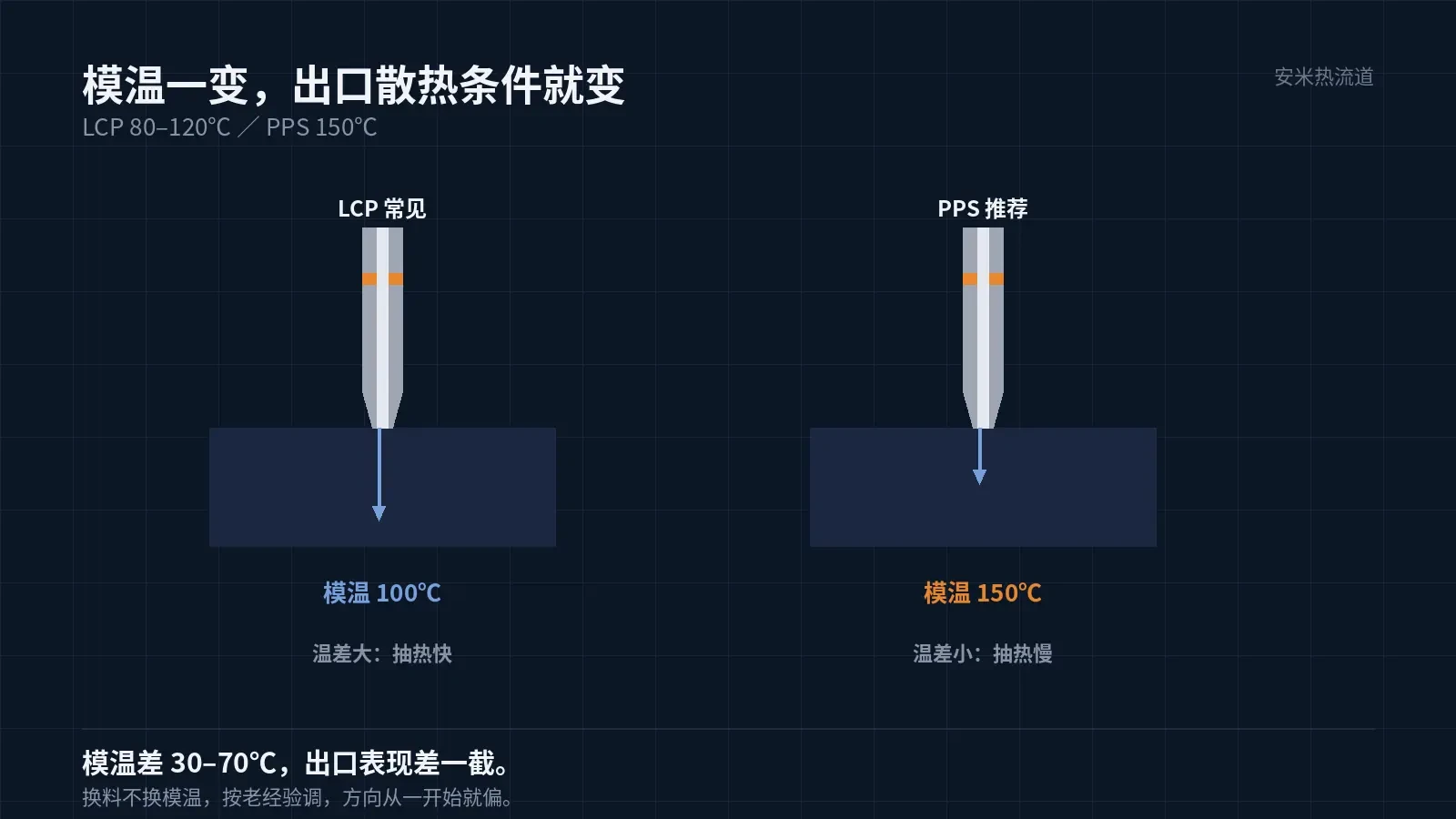
Changing the mold temperature alters the heat dissipation conditions at the gate exit. The causes of stringing in PPS differ from those in LCP.
What changed with a 150°C mold temperature
The recommended mold temperature for PPS is 150°C, generally requiring above 130°C and not below 120°C (DURAFIDE technical data). For the same hot runner system, LCP was processed at 80–120°C, while PPS requires 150°C.
A higher mold temperature reduces the temperature difference between the nozzle tip and the mold, causing the material at the gate exit to cool more slowly. During mold opening, it has not solidified enough to break cleanly.
To understand this: clean breaking at the gate relies on the temperature difference between the melt and the mold to extract heat. A smaller temperature difference results in slower heat extraction, keeping the material semi-soft. With LCP's lower mold temperature, heat extraction is fast; with PPS's higher mold temperature, it is slow.
Therefore, stringing in PPS is not due to premature solidification, but rather failure to break when required. Reversing this diagnosis reverses all subsequent corrective actions.
Additionally, PPS melt temperature is 310–320°C, one tier lower than LCP's 335–345°C. Its lower viscosity and better flowability make it easier for material to adhere at the gate exit.
If stringing consistently occurs in specific cavities of a multi-cavity mold, first check the gate dimensions of those cavities. Within the same mold set, machining tolerances on gates can cause inconsistent shear heating, manifesting as stringing appearing first in individual cavities.
Viscosity also plays a role
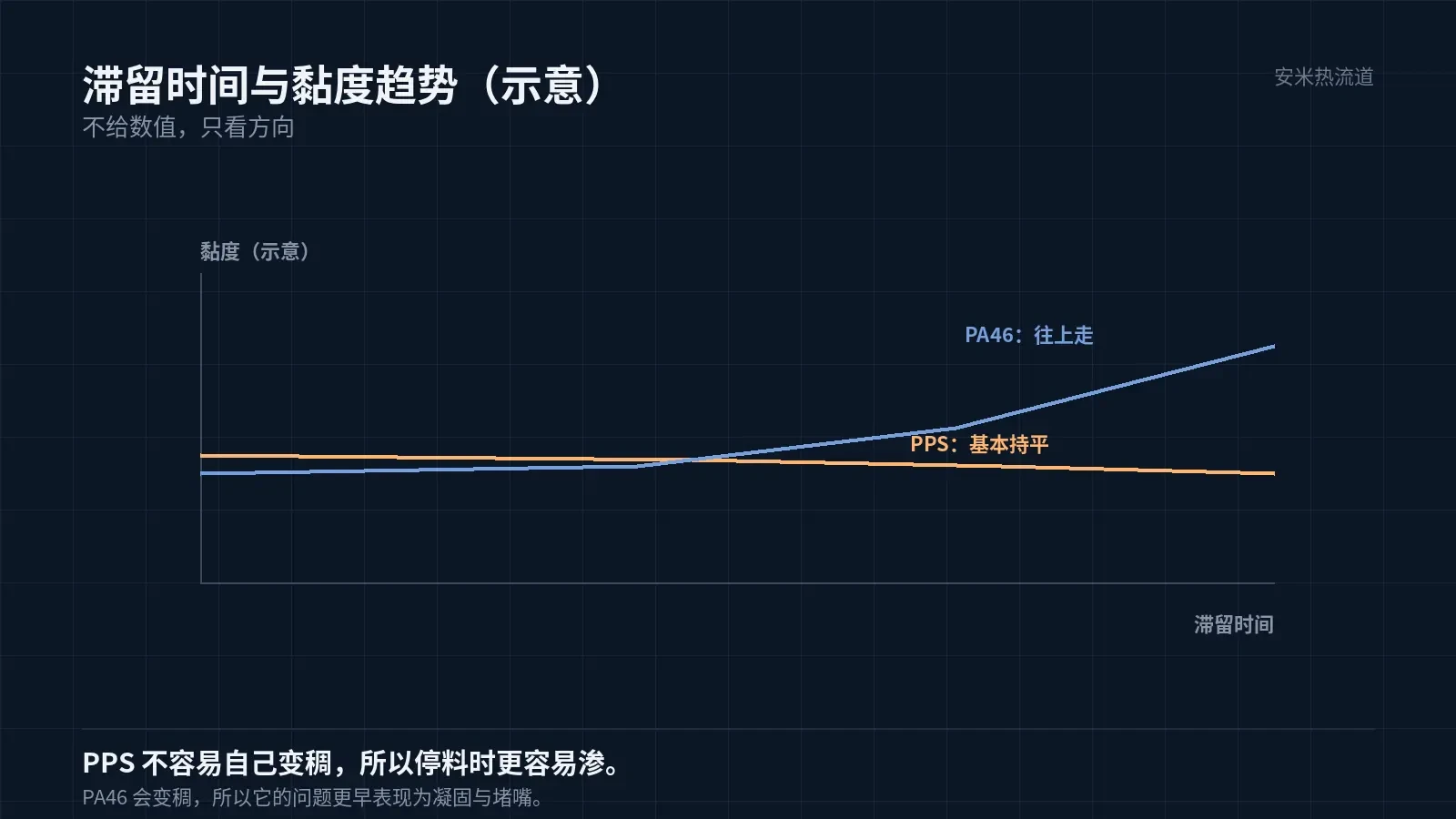
A key point from the manufacturer: DURAFIDE does not experience significant viscosity increase during prolonged residence in the barrel. This indicates good thermal stability, preventing self-thickening and clogging.
Conversely, it tends to ooze out more easily during material stoppage. Therefore, stringing and drooling in PPS often occur together.
This explains why PPS is suitable for hot runners: the material resists degradation within the runner. However, suitability does not guarantee problem-free operation; gate sealing must be resolved through timing control.
Customers often investigate these issues separately, only to find the same root cause: failure to seal the gate promptly.
Cannot be solved by increasing temperature
Material temperature has an upper limit: it must not exceed 360℃ to prevent thermal decomposition. This is a boundary condition, not a recommendation.
Therefore, upon seeing stringing, the first reaction should not be to assume insufficient temperature and increase it. The PPS processing window is already at a high level; further increases lead to decomposition and discoloration.
Signs of decomposition are discoloration, odor, and reduced mechanical properties, not stringing. By the time these appear, overheating has persisted for a long period. Using increased temperature to treat stringing in PPS replaces one problem with two.
Adjustable factors include gate design and shear: pin-point gates have a minimum diameter of φ0.6mm, commonly φ0.8–1.2mm, preferably no less than φ1mm (manufacturer recommendation). Gates that are too small generate high shear heat, making the melt more fluid at the exit.
Another factor is injection speed. Higher injection speed increases shear rate, which raises shear heat. Adjust injection speed independently; do not change it simultaneously with temperature.
Troubleshooting Sequence
First, measure the actual nozzle tip temperature to confirm if it exceeds the setpoint; then check gate diameter and length; finally, verify if the valve pin closing point falls within the late packing stage.
The valve pin setting is particularly critical for PPS because the gate area cools slowly, requiring longer natural solidification for sealing. Advancing the closing point effectively moves the sealing moment earlier.
Discuss mold temperature last. Do not lower mold temperature to address stringing—values below 120℃ compromise dimensional stability, heat resistance, and creep resistance, causing greater issues than stringing.
Mold opening speed can be fine-tuned, but it affects the form of the stringing, not its presence. First resolve whether stringing occurs at all.
In PPS, drooling and stringing often coexist: leakage during hold-off and pulling during mold opening. The troubleshooting sequence is to ensure timely gate sealing first, then address stringing. Proper sealing mitigates both symptoms.
An easily overlooked factor
For PPS with 40% glass fiber, shrinkage is 0.3% in the flow direction and 0.8% perpendicular to it (80×80×2mm plate, mold temperature 150°C). The anisotropy ratio is 2.7. Changing gate position affects warpage, so dimensional checks are required when adjusting gates.
In other words, PPS gate positions cannot be changed arbitrarily. Verify dimensional acceptability before modification; do not introduce warpage while attempting to resolve stringing.
Before changing the gate, confirm critical dimensions and flatness requirements. For connectors, altering the gate position changes flow direction and anisotropy, resulting in redistributed dimensions.
Regarding PPS stringing: recognize that this is due to incomplete break-off, not premature solidification. Understanding this prevents incorrect adjustments.
Provide material grade, mold temperature, and gate dimensions. We will verify outlet temperature differential and shear conditions, then quote after confirming the solution.
Shear assessment must consider injection speed. Increasing injection speed raises the actual temperature at the gate above the set value.
MATCHED BY MATERIAL AND DEFECT
This article covers stringing, drooling, clogging, and high-heat resins; refer to SD for gate freeze and break-off.
Register for a selection review and quote
Submit part, mold, and material details. Our engineers will evaluate the gate solution per part and provide a quote.
Upload a 2D layout drawing using the form.
Online selection and quote
Scan to register