
LCP connector stringing: Is it caused by high melt or mold temperature?
问题排查21 min read
On this page
A technician working on LCP automotive connectors sent a photo showing an almost invisible string between the pins. He reported that lowering the temperature by 8°C resolved the issue for three days, but it reappeared on the fourth day.
This is a common issue. Stringing is easy to identify, but determining whether temperature, timing, or mold opening is the root cause can be difficult. Incorrect troubleshooting steps lead to repeated failures.
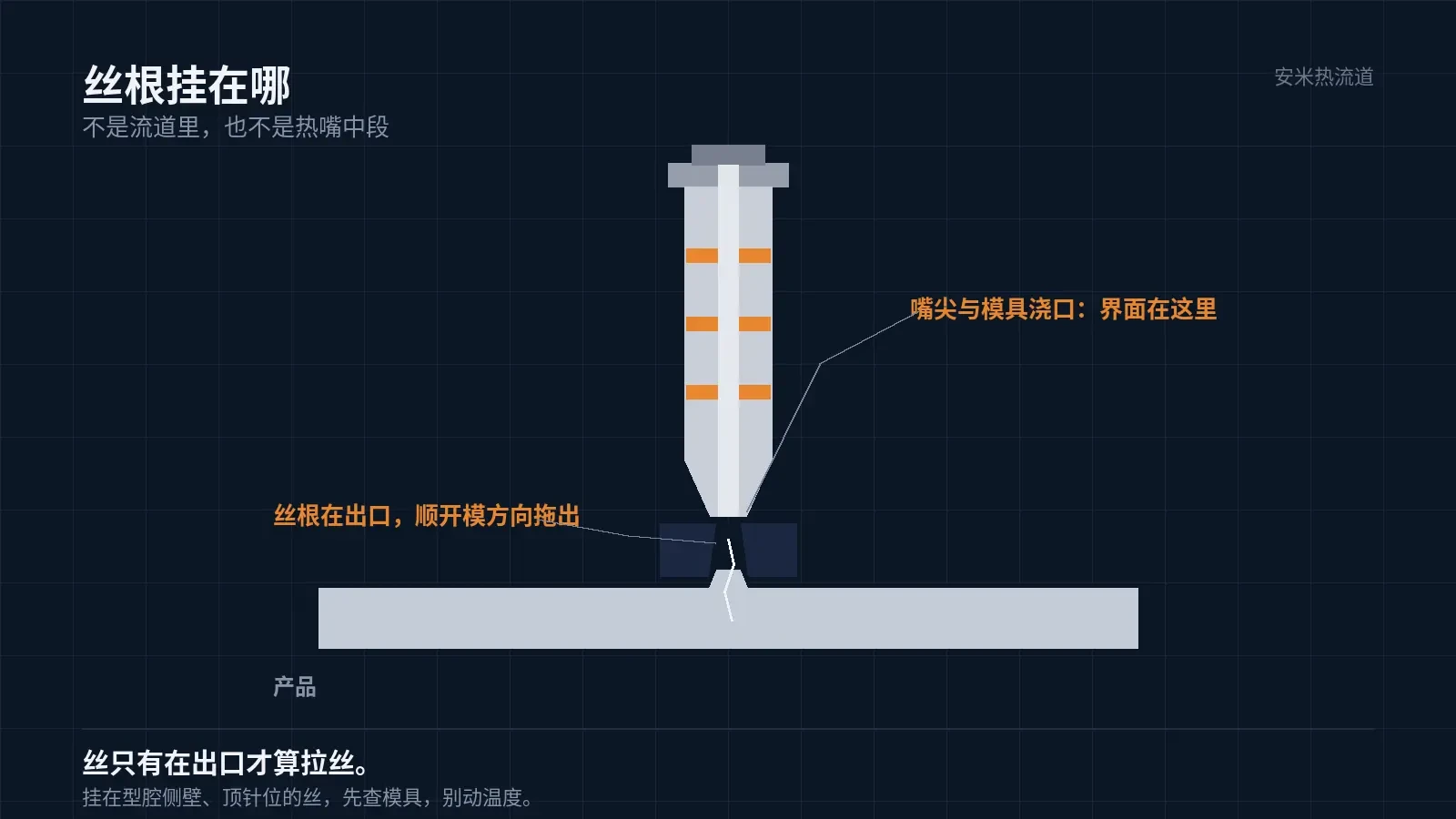
First, check where the string is attached.
The string root attaches at a single location: the interface between the nozzle tip and the mold gate. It is withdrawn along the mold opening direction, with the root exiting and the tip remaining on the part.
In multi-cavity molds, stringing may not affect all cavities. First, identify which cavities are affected and whether the issue occurs at a consistent location. If it is fixed to specific cavities, inspect the heating circuits and nozzle tip fit for those cavities first. Only review overall settings and cycle time if all cavities are affected. Maintaining this log for two weeks provides more accurate insights than any parameter table.
To diagnose stringing, first verify three points without instruments: Does it occur on every shot? Is the break clean or accompanied by material skin? Did it change after switching material batches? If it occurs on three consecutive shots, the break is clean, and the issue appeared after a material change, the problem likely relates to temperature and solidification rate. If it occurs on only one shot and the break is rough, the issue likely involves mold opening action and residue at the gate exit.
If strings appear on cavity sidewalls, ejector pin locations, or slide gaps, the issue is not hot runner stringing. Do not adjust the temperature; inspect the mold first. This quick two-minute check can save two days of troubleshooting.
Why is LCP so sensitive to this location?
LCP is a liquid crystal polymer whose viscosity is more temperature-sensitive than PA or PBT. A small rise in temperature significantly reduces melt viscosity, preventing the material at the gate from cleanly shearing off during mold opening.
Mechanistically, LCP experiences high shear rates at the gate's narrow cross-section. Shear heating raises the material temperature above the barrel setpoint, while shear-thinning further reduces viscosity as temperature increases. This combination leaves the material at the exit highly prone to stringing.
The nozzle tip is the outermost section of the hot runner, featuring a small volume and low thermal mass. Mold temperatures ranging from 80 to 120°C continuously draw heat away. This creates a temperature gradient—cooler on the outside, hotter inside—causing semi-solidified material to accumulate at the interface.
Although the material solidifies quickly and the part has hardened, the material at the gate remains partially molten. Pulling it causes stringing.
The impact on the product varies. Fine strings between pins cause minor cosmetic issues and sorting labor; severe cases reduce electrical clearance and lead to bending or shorting to adjacent pins during assembly. In automotive connectors, such residues often go undetected until dielectric withstand and insulation tests, after hundreds of shots have been produced.
Lower Temperature by 8°C: Temporary Fix for Three Days
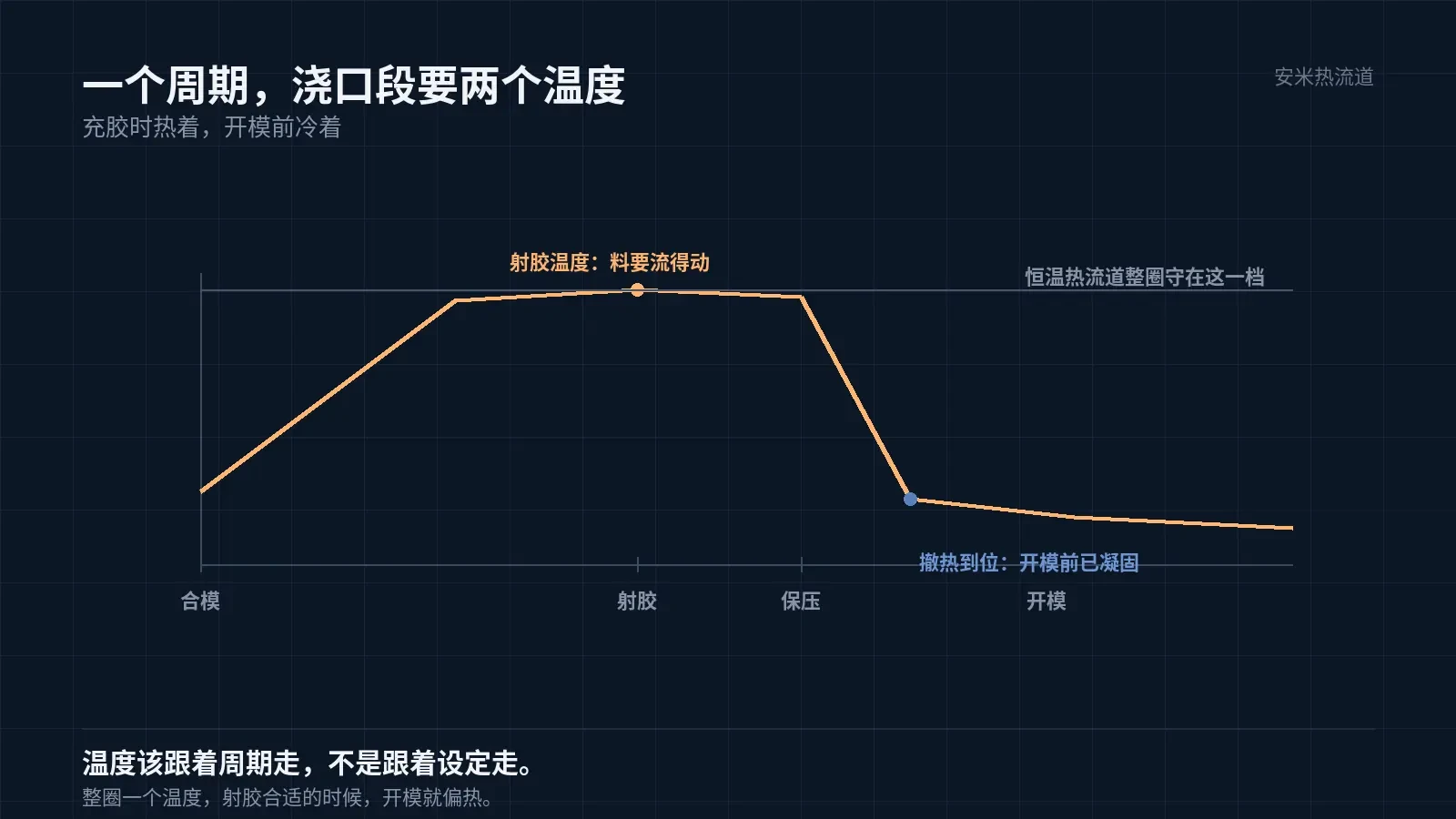
A standard controller maintains the entire hot runner at a single setpoint. This temperature remains constant during the 1–2 seconds between end of holding pressure and mold opening, regardless of whether it is optimal during injection.
Lowering the setpoint cools the entire nozzle. Although this temporarily reduces stringing, it impairs flow at the tip; further reduction can cause clogging or short shots. If the issue recurs after three days, it is typically due to changes in material, mold, or cycle time that disrupt the thermal balance established by lowering the temperature.
Recurrences are typically caused by specific triggers: material lot changes, mold changes, shortened cycle times, or increased mold temperature due to cooling line blockage. These factors disrupt the established process balance. We recommend recording setpoint temperature, cycle time, material lot number, and mold ID together. Reviewing these logs when a recurrence occurs is more effective than further reducing the temperature.
Don't Confuse Drooling with Cold Slugs
All three phenomena occur at the gate exit but at different times. Stringing happens when the melt is drawn into a thread during mold opening. Drooling occurs when material flows out and spreads after holding pressure ends or during a color change. Cold slug appears in the first few shots after startup and disappears after several cycles.
Equipment issue: localized heating band burnout or poor thermocouple contact causes uneven temperature around the nozzle tip, leading to consistent stringing on one side. This cannot be fixed by adjusting parameters alone; you must compare temperature readings at four points around the circumference.
Treating drool as stringing increases clogging with each reduction. Treating cold slug as stringing wastes effort. Identify the morphology first, then adjust parameters.
No need to memorize diagnostic terms. Ask three questions: When does it appear? What shape is it? Is it repeatable? - If it occurs only in the first few shots after stopping, it's drooling. - If it appears in the first few shots after startup and clears on its own, it's a cold slug. - If it persists at a fixed position between pin contacts on every shot, it's stringing. Answer these before taking action to avoid blind adjustments.
Gate Policies: What You Can and Cannot Do
Cycle-based temperature control is feasible: heat the gate exit section to the target material temperature before injection, remove heat immediately after packing ends, and allow solidification before mold opening—leaving only a small mark on the part. Each cycle uses hot filling followed by cold ejection.
Cycle-based temperature control requires three prerequisites: independent heating and temperature sensing for the gate section, synchronization with the injection molding machine's clamp open/close signals, and a heating structure that withstands repeated thermal cycling. Without all three, the curve remains theoretical.
A single fixed temperature cannot satisfy both requirements. A uniform nozzle temperature cannot simultaneously meet injection and mold-opening conditions.
For valve-gated systems, verify the valve pin closing timing. The pin should seal immediately after packing ends; delaying closure until just before mold opening creates a window for stringing.
Valve pin closure depends on timing signals. If set after packing but before mold opening, the melt at the exit stays connected to the part during this interval, creating a window for stringing. Conversely, advancing closure to the end of packing cuts the melt at the gate, so mold opening pulls off an already severed slug.
Boundary condition: Lower temperatures are not always better, as continuous reduction can cause nozzle clogging. With cycle-based temperature control, stringing and clogging do not conflict since they require different temperatures at different times.
Nozzle-to-gate alignment is often overlooked. Misalignment creates uneven clearance—tight contact on one side and larger gaps on the other. Heat dissipates faster where contact is tight, causing non-uniform circumferential exit temperature and consistent stringing direction. This issue cannot be resolved by temperature adjustments alone; verify the gate bushing position on the mold side.
Stringing may appear as minor burrs, but on multi-cavity mass production lines, it affects sorting labor, yield, and downtime. First, identify the location; then analyze temperature, timing, and mold opening speed—adjust only one variable at a time.
For cases requiring verification, please provide the mold layout drawing and material grade. We will verify gate positions and cavity temperatures against the layout and submit a quote once the solution is confirmed.
MATCHED BY MATERIAL AND DEFECT
This article covers stringing, drooling, clogging, and high-heat resins; refer to SD for gate freeze and break-off.
Register for a selection review and quote
Submit part, mold, and material details. Our engineers will evaluate the gate solution per part and provide a quote.
Upload a 2D layout drawing using the form.
Online selection and quote
Scan to register