
Is PEI Nozzle Clogging Due to High Viscosity or Material Degradation?
问题排查16 min read
On this page
When PEI causes nozzle clogging, two causes appear similar: material fails to flow, pressure rises, and parts show short shots. However, one is a viscosity issue, while the other indicates degraded material.
Failing to distinguish these leads to conflicting remedies: viscosity issues require increased heating, whereas degradation requires cooling; applying the wrong action worsens the problem.
First, understand PEI's viscosity profile
In AM Industry product profiles, PEI is classified as high viscosity, grouped with PC, PPO, PPS, PES, PSU, and PETG. High viscosity results in greater pressure drop and more difficult filling within the same runner geometry.
High-viscosity materials at the gate exhibit significant shear heating, concentrated pressure drops, and extended residence times. These factors promote material degradation.
Therefore, PEI nozzle clogging often involves both viscosity and degradation occurring sequentially, not exclusively. Diagnosis should be based on timing and location, not intuition.
Also assess whether the clog occurred suddenly or gradually. Sudden clogs are typically caused by cold slug or foreign matter; gradual clogs with slowly rising pressure usually indicate accumulating viscosity issues or carbonization.
Characteristics of the two clog types
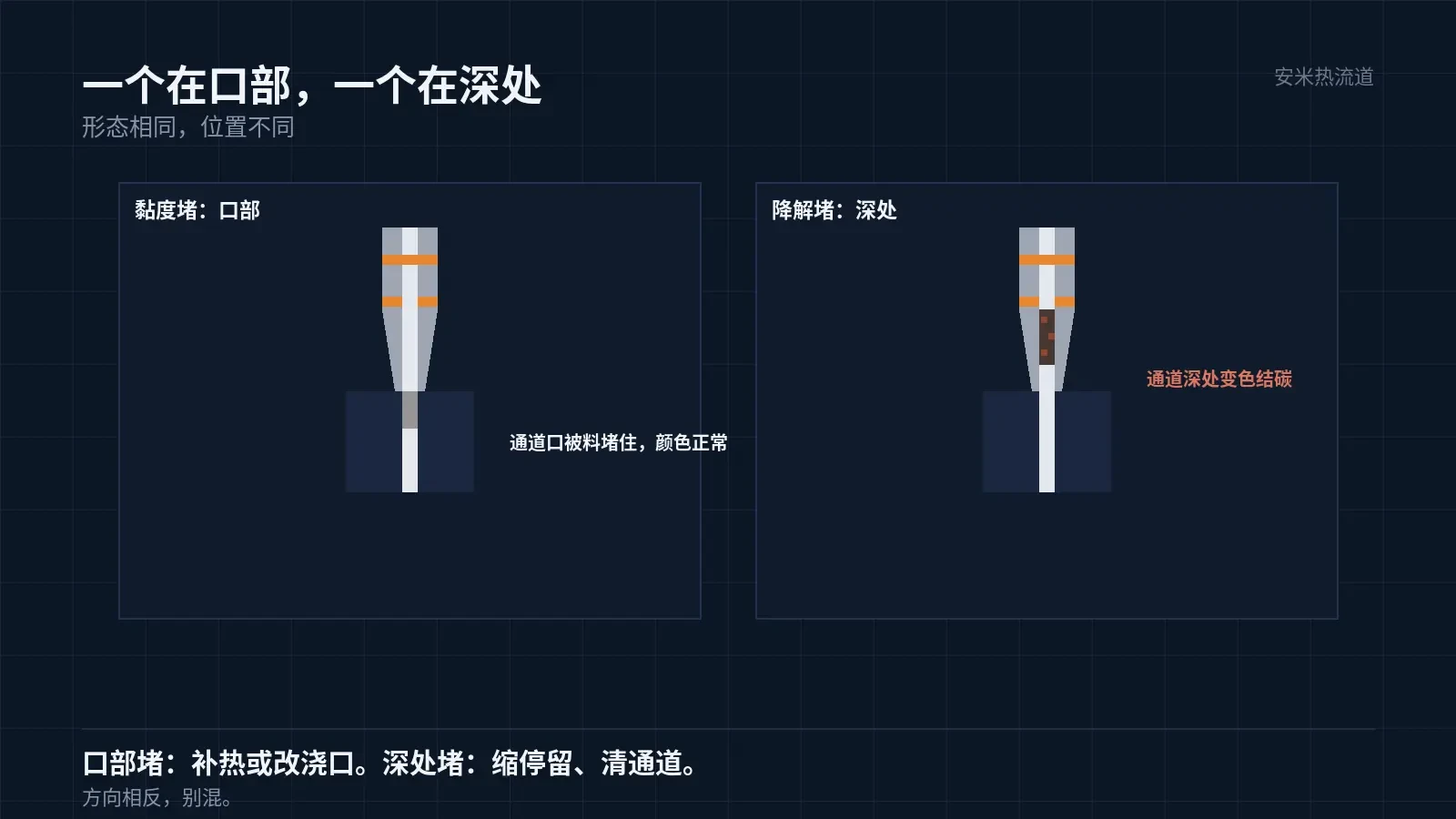
Viscosity clog: Upon disassembly, the channel contains normal-colored material that is hard and solid, odorless, located near the tip opening. Causes include material cooling at the exit or insufficient pressure to overcome flow resistance.
Degradation clog: Upon disassembly, material shows black specks, brown streaks, and a pungent odor, potentially lodged deeper. Causes include excessive residence time at high temperature, leading to discoloration followed by carbonization.
There is also an intermediate state: material repeatedly heated and held in the channel, yellowing but not yet carbonized, with changed viscosity. This is harder to judge than pure degradation; color and odor only provide rough estimates.
Judgment mnemonic: check location, color, odor, and time. If three of these four match, the issue can generally be identified.
If indistinguishable, perform a comparison test: replace with a new nozzle tip. If clogging recurs within hours, the issue lies with the material or temperature; if no clogging occurs for days, the issue lies with the channel condition of the old nozzle tip.
Residence Time Is the Primary Variable
PEI melt temperature ranges from 350–410°C, which is inherently high. High temperature itself is not the problem; remaining at high temperatures without movement is.
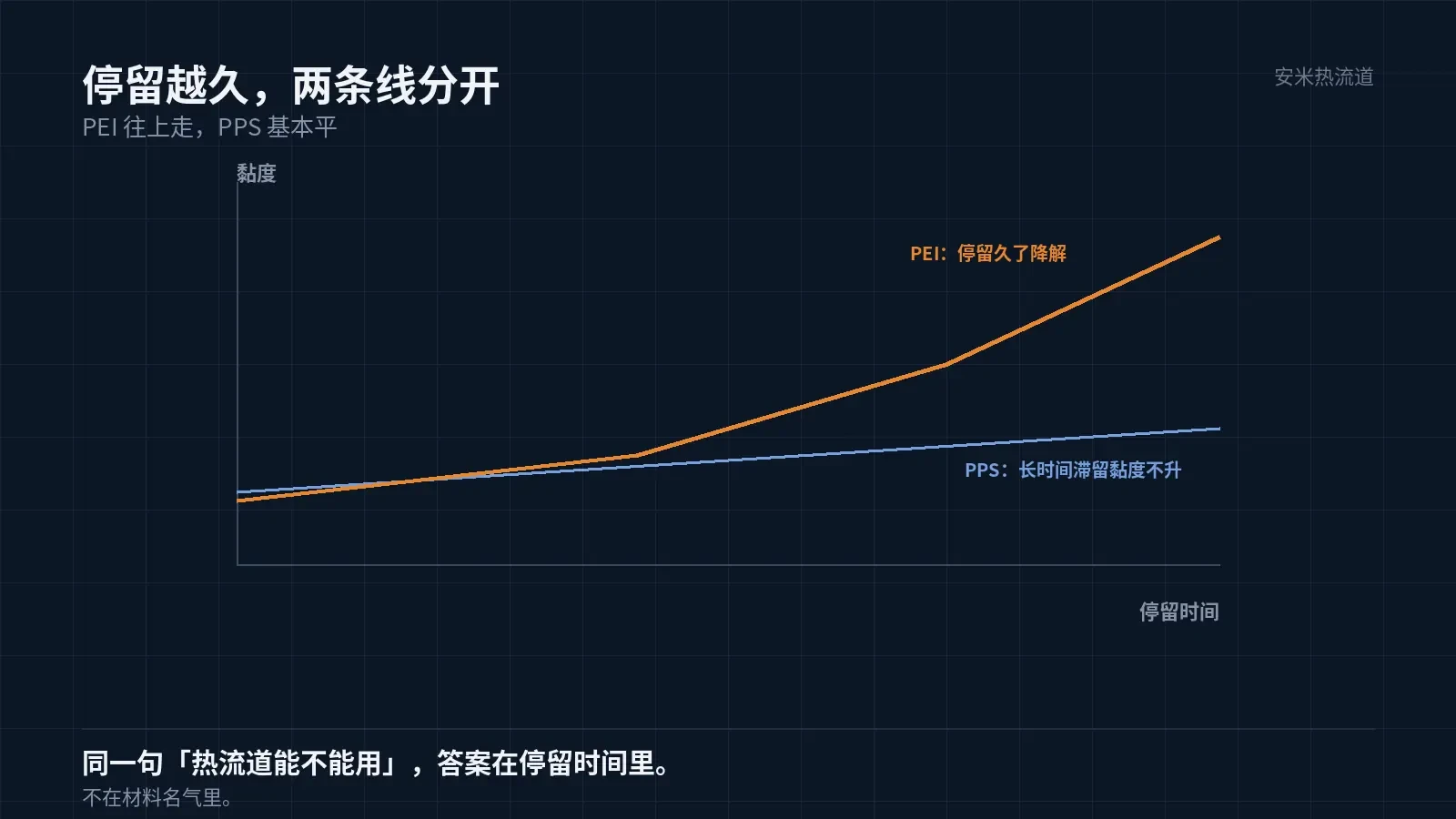
In hot runners, only the section near the gate undergoes frequent renewal; deeper channels renew slowly. Longer downtime, waiting for material, or mold changes increase heat exposure duration for the deeper sections.
This contrasts with PPS. PPS manufacturer data states that viscosity does not significantly increase even after prolonged residence in the barrel, making it suitable for hot runners. PEI lacks this specification; its issue is degradation due to extended residence time.
The answer to 'Can hot runners be used?' for these two materials depends on residence time, not material reputation.
Using hot runners with PEI is feasible; AM Industry's SD, VG, and PVG series are compatible. The prerequisite is calculating residence time accurately, matching channel volume with turnover time, and avoiding large channels for small parts.
Troubleshooting Sequence
1. Disassemble and inspect to identify the cause. Check location, color, and odor to determine whether it is a viscosity issue or degradation.
2. Verify heater bands and thermocouples. Normal temperature readings do not guarantee actual conditions; localized heater band failure or thermocouple displacement can cause specific zones to be too low or too high.
3. Calculate residence time. Sum the minutes for mold changes, material waiting, and downtime, then compare against this machine's channel volume to check if turnover time is sufficient.
4. Adjust process flow. Schedule PEI runs consecutively in production planning, avoiding interleaving with low-temperature materials that require repeated heating and cooling; each material change results in high-temperature residence.
5. Adjust temperatures last. For viscosity-related clogging, slightly increase heat; for degradation-related clogging, reduce temperature and clean the channels. These actions are opposite.
Channel cleaning also follows a sequence: first run purge material through, then check gate output. Direct disassembly risks pushing carbonized material deeper into the channels, worsening the clog.
Two Boundaries
Do not operate continuously at 410°C. The upper limit is a maximum allowable value, not a recommended one; operating near this limit inevitably causes degradation.
If clogging persists across multiple machines and nozzle tip replacement does not resolve it, suspect the flow channel design: excessive channel volume or sharp turns naturally increase residence time. In such cases, parameter adjustments are ineffective; structural changes are required.
Do not increase back pressure to compensate. Higher back pressure raises melt temperature, accelerating degradation-induced clogging rather than solving it.
Another factor is hopper material and regrind. High regrind ratios mean the material has already undergone thermal history, lowering the onset of degradation. For materials like PEI, keep regrind ratios low and track them separately from virgin material.
A scheduling detail: Do not immediately switch to low-temperature materials after processing PEI. Purge first, then lower the temperature. Reversing this order causes carbonization of the low-temperature material in hot channels, resulting in black specks upon the next startup.
Provide details on the clogging location, color/odor, time from startup to clogging, and production sequence. We will verify against residence time criteria and provide a quote once the solution is confirmed.
Production sequencing should avoid direct transitions from high-temperature to low-temperature materials. Insert an intermediate batch to allow for temperature buffering in the channels.
The transition batch need not be finished goods; purge compounds or lower-grade materials within the same family are acceptable. The key is allowing the temperature to complete a full cycle.
MATCHED BY MATERIAL AND DEFECT
This article covers stringing, drooling, clogging, and high-heat resins; refer to SD for gate freeze and break-off.
Register for a selection review and quote
Submit part, mold, and material details. Our engineers will evaluate the gate solution per part and provide a quote.
Upload a 2D layout drawing using the form.
Online selection and quote
Scan to register