
PEEK Stringing: Tough Strings – Melt Temp or Mold Temp Issue?
问题排查15 min read
On this page
For a PEEK connector set (nozzle 395°C, mold temperature 180°C), stringing occurs upon mold opening. The strands are thicker than LCP, stretch longer, and break with fine tips.
The customer reduced the mold temperature based on LCP experience. While the strand did not break, the parts exhibited dimensional and crystallization issues.
First, examine the string morphology
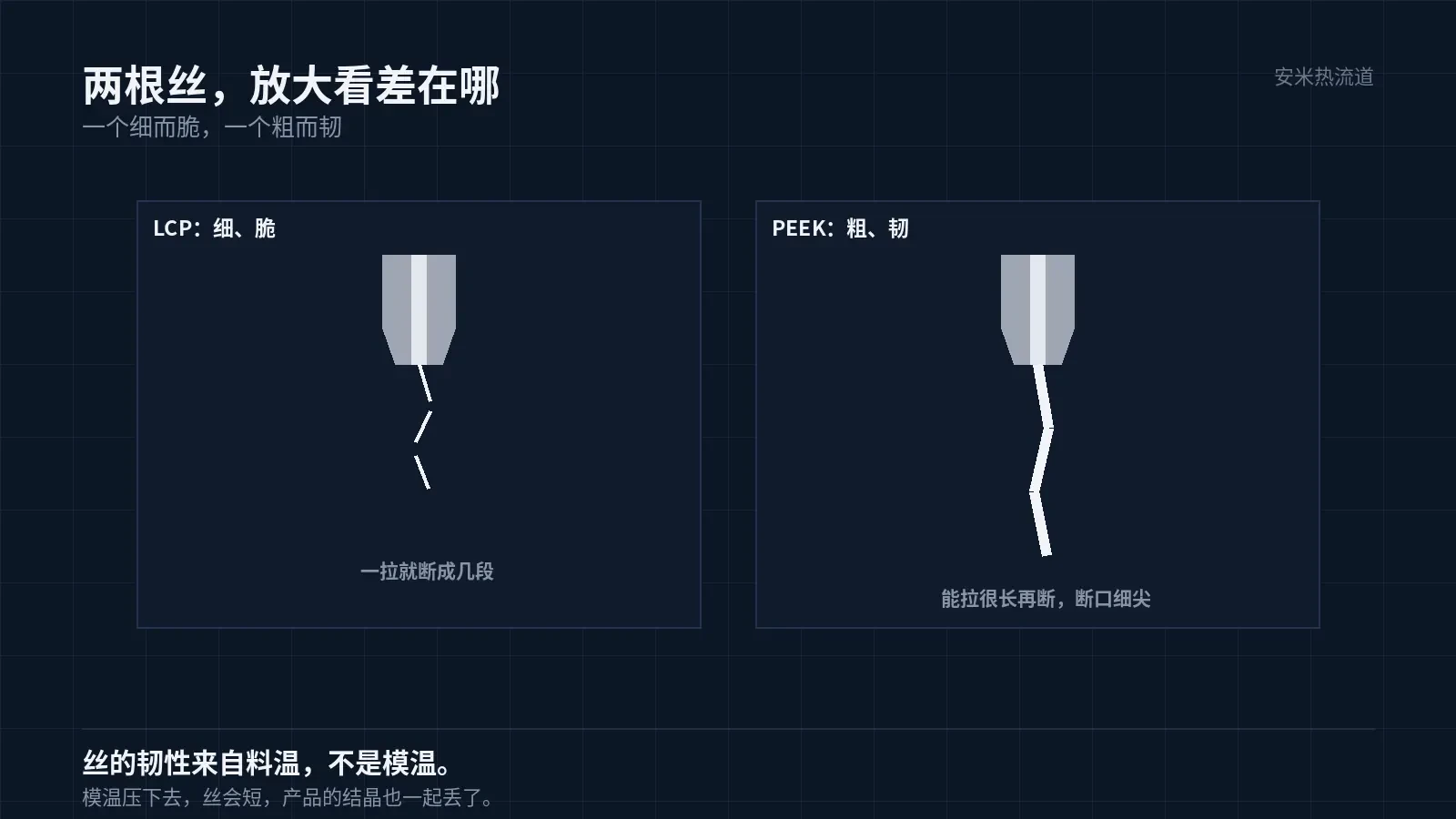
PEEK strings differ from LCP: they are thick, tough, and stretchable, breaking with a drawn-out tip rather than a clean brittle fracture.
LCP filaments are thin and brittle, fracturing into segments upon contact; PA46 filaments are short with skin layers. PEEK is one of the few materials that can be stretched.
The tough morphology indicates high melt temperature and retained melt strength at the gate exit. Focus on material temperature, not mold temperature. Establishing this early prevents unnecessary troubleshooting steps.
Pull a cut section of the string: PEEK stretches before breaking, LCP snaps into segments immediately, and PA46 breaks at the skin layer. This manual test is more accurate than visual inspection.
Check the string for bubbles or black spots. Their presence indicates degradation from excessive heat; their absence suggests the material is only too hot, not yet degraded.
395°C
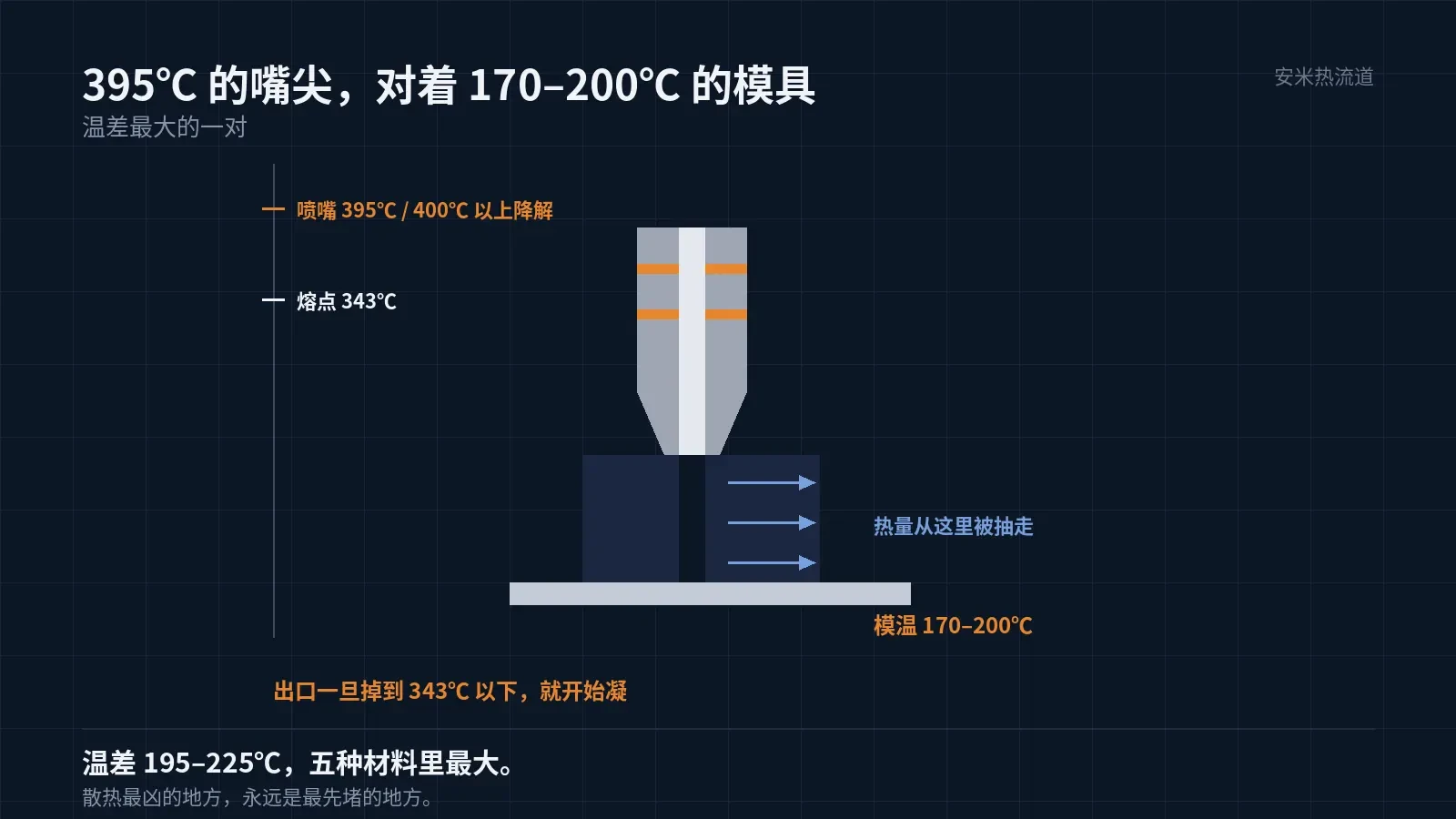
Official temperatures for 650G: rear zone 375°C, middle zone 380–385°C, front zone 390°C, nozzle 395°C; mold temperature 170–200°C; drying at 120–150°C for 3–5 hours.
395°C is the highest nozzle temperature among the five materials. At this temperature, melt flowability is good and the gate does not easily break off during mold opening.
Equipment capabilities must also be sufficient: barrel heating capacity must reach 400°C for PEEK and 430°C for HT/ST grades. Insufficient capacity leads to actual temperature drops, forcing operators to raise setpoints and pushing the process into the degradation range.
First, verify the equipment before adjusting settings. Machines with insufficient heating capacity cannot process PEEK stably; this issue cannot be resolved by parameter adjustment alone.
Shear heating is more severe with PEEK.
Small gate cross-sections combined with high PEEK viscosity generate significant shear heat at high shear rates. The actual exit temperature may exceed 395°C.
Above 400°C, PEEK risks degradation. Signs include black spots, brown streaks, odors, and bubbles on the filament.
Consequently, stringing in PEEK often occurs alongside black spots. Addressing only stringing without correcting the temperature will leave black spots unresolved; conversely, cleaning only black spots will not eliminate stringing.
Gate dimensions, injection speed, and mold opening speed all increase shear. Gate size is a tooling parameter fixed after modification; injection and mold opening speeds are process parameters that can be tested incrementally.
Another often overlooked factor is the fit between the hot nozzle and the mold. A tight fit with a large contact area accelerates heat dissipation, causing a greater drop in outlet temperature. This leads operators to increase setpoints, which in turn raises shear heating.
Do not use mold temperature to prevent stringing.
Official mold temperature range: 170–200°C. Target temperatures: 170°C for PEEK, 190°C for HT, and 200°C for ST to achieve crystalline parts.
Lowering the mold temperature cools the outlet faster and shortens strings, but insufficient crystallization compromises dimensional accuracy, wear resistance, and chemical resistance.
This trade-off is most costly for PEEK: its mold temperature must be set specifically for crystallization, not arbitrarily. Lowering the mold temperature to stop stringing sacrifices product performance for appearance.
Changing grades requires re-evaluation. The 395°C for 650G applies only to that grade; HT and ST use different mold and nozzle temperatures. Reusing settings across grades will recreate the issue.
Processing sequence
First, measure the actual nozzle tip temperature: a setpoint of 395°C does not equal an outlet temperature of 395°C; use the difference to determine subsequent adjustments.
2. Inspect the gate for diameter, length, and wear. Shear heat is self-generated; if the gate design remains unchanged, temperature compensation will always be required.
3. Reduce residence time: PEEK degradation worsens with prolonged exposure near 400°C. Factor in downtime, mold changes, and material waiting times when calculating total residence duration.
4. Inspect the valve pin: Set the closing point at the end of holding pressure to seal off material at the gate first, preventing it from being pulled out.
5. Adjust injection speed and mold opening speed last. These parameters alter the stringing morphology, not its presence or absence.
Verification is required after treatment. Run a continuous batch, inspecting the gate every 30 minutes, and recheck melt flow upon startup the next day. The issue is resolved only if both checks are normal. Stopping after a single shot leads to a high recurrence rate.
A Critical Boundary
Do not apply LCP parameters to PEEK. LCP uses nozzle temperatures of 335–345°C and mold temperatures of 80–120°C, while PEEK requires a nozzle temperature of 395°C with mold temperatures of 170–200°C—a difference exceeding 50°C.
When changing materials, increase the entire temperature profile and mold temperature accordingly. Partial adjustments can lead to different issues: stringing may disappear, but short shots and cold slugs may appear.
For PEEK stringing, first identify the string morphology: thick, tough, long strands indicate excessive melt temperature. The solution lies in controlling melt temperature and residence time, not mold temperature.
Specify the material grade, measured nozzle tip temperature, and gate dimensions. We will verify outlet shear and temperature conditions before confirming the solution and providing a quote.
MATCHED BY MATERIAL AND DEFECT
This article covers stringing, drooling, clogging, and high-heat resins; refer to SD for gate freeze and break-off.
Register for a selection review and quote
Submit part, mold, and material details. Our engineers will evaluate the gate solution per part and provide a quote.
Upload a 2D layout drawing using the form.
Online selection and quote
Scan to register