
PA9T drooling: Why does material ooze shortly after stopping feed?
问题排查15 min read
On this page
PA9T film residue usually appears after color changes or the first shift following weekend shutdowns. It is minimal during continuous production.
Customers often attribute this to drying issues. However, with a moisture absorption rate of only 0.19%, drying is not the primary cause; slow cooling of the outlet during material stoppage is.
First, determine when it occurs
Film residue on every shot indicates temperature or gate issues; residue appearing only in the first few shots after a stoppage or color change points to shutdown procedures. This distinction cuts troubleshooting time in half.
Record simply: note the time of occurrence, stoppage duration, whether a color change occurred, and mold temperature on a sheet. Patterns emerge within a week. Without records, everyone defines "frequent" differently.
PA9T film residue typically accumulates around the gate, covering a small area with irregular edges. Thickness decreases radially outward from the gate, and a water-line-like boundary is visible under side lighting.
If the film extends to the cavity's far end with clean edges, it resembles flow marks from the filling stage rather than stringing. Different locations require entirely different solutions.
The film location determines whether line stoppage is required. On pin contact surfaces, it affects contact resistance and plating appearance; on sealing surfaces, it impacts air-tightness; on non-functional areas, it is primarily cosmetic. Check the location first, then the size.
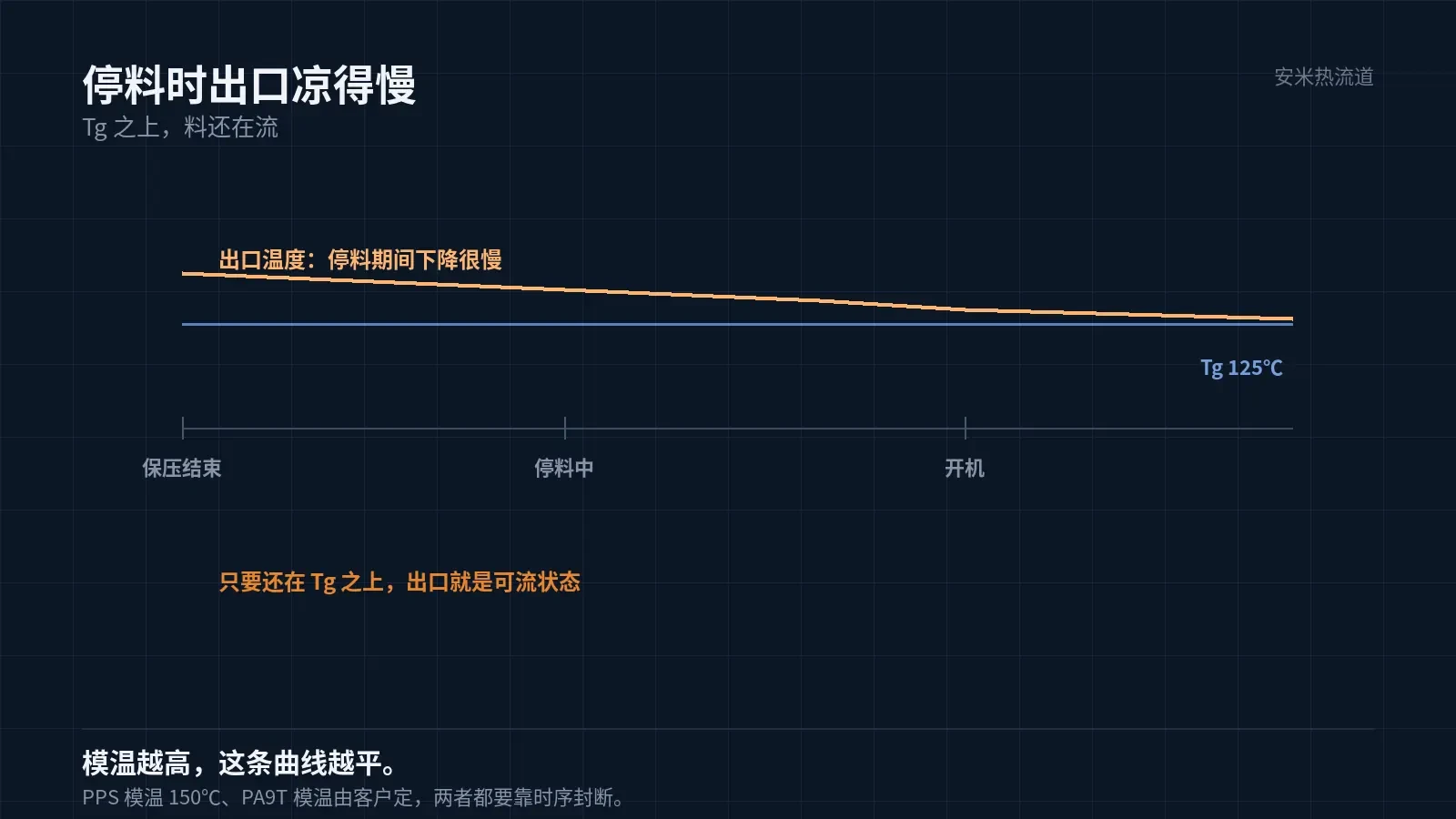
What Tg 125°C Means
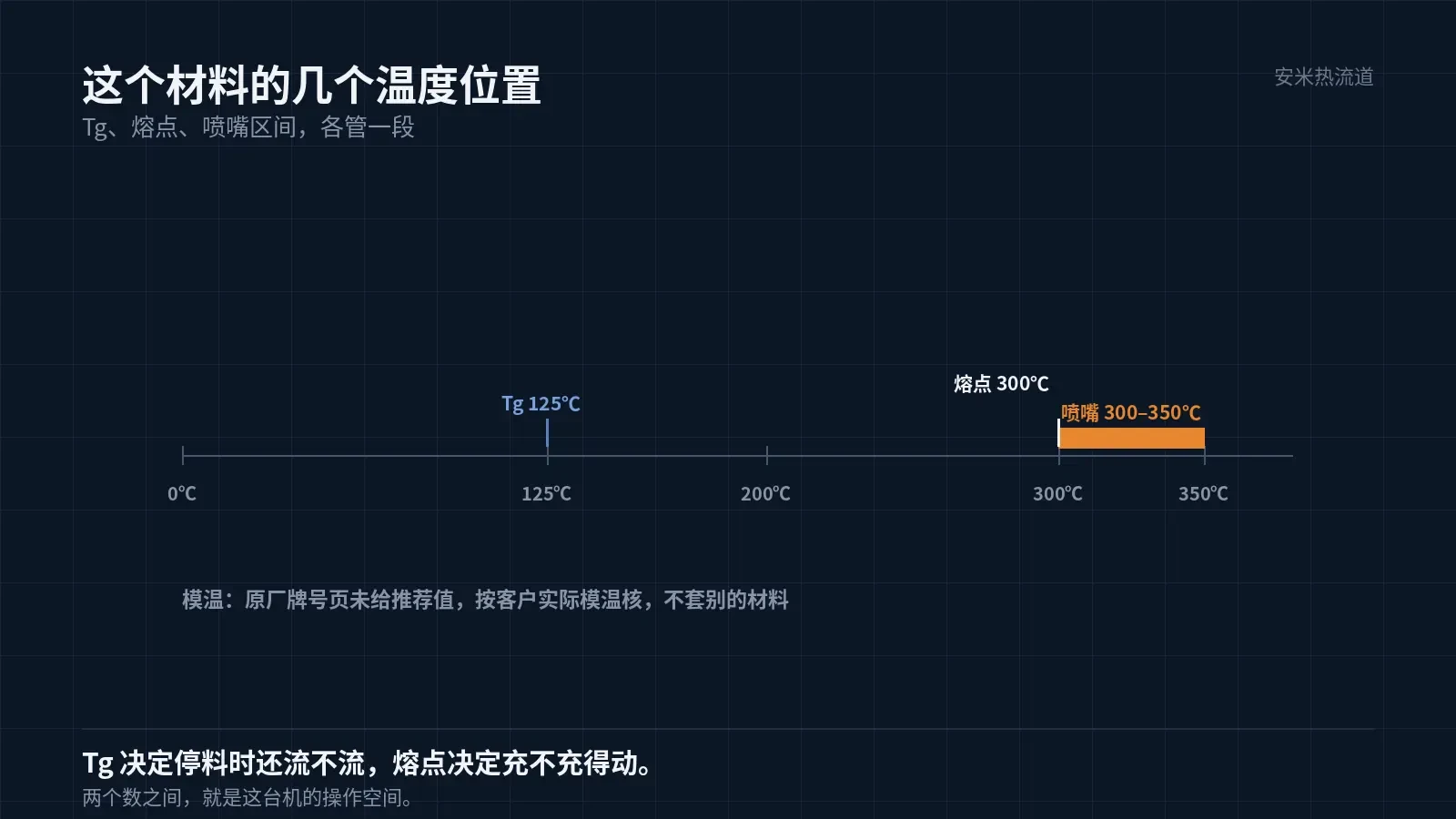
The glass transition temperature (Tg) of PA9T is 125°C (per the manufacturer's Chinese datasheet). This value is critical for material hold-up: as long as the melt temperature at the exit remains above Tg, the material stays molten and continues to flow.
Key constraint: The manufacturer does not specify a recommended mold temperature for PA9T. Do not lower the mold temperature solely to reduce stringing, as this impacts crystallization and dimensions; excessive reduction compromises dimensional stability and increases warpage. Verify the mold temperature against the customer's existing process before making any changes.
Mold temperature is specified by the customer; no recommended value is provided in the manufacturer's grade data sheet. At higher mold temperatures, cooling around the nozzle tip slows down, keeping the exit soft during material hold-up.
After a 10-minute hold, the LCP exit has already hardened, while PA9T continues to slowly ooze out. This is not caused by incorrect settings but by the material's intrinsic properties and mold temperature.
Comparing PA9T and PPS clarifies this: PPS (mold temp 150°C, melt temp 310–320°C) cools slowly at the exit and flows actively during hold-up; PA9T (lower mold temp, Tg 125°C) forms a thinner film near the gate. Both require timing-based shut-off rather than temperature reduction.
This also explains why film formation varies between summer/winter or day/night shifts under identical parameters. Ambient temperature affects the heat dissipation rate from the mold and nozzle exit.
Drying: Necessary but Not the Root Cause
Manufacturer-specified drying conditions: 70–90°C for 4–8 hours, with moisture content below 0.20%. This is mandatory. Failure modes include silver streaks, bubbles, and reduced strength—not material film failure.
Check dryer status: filters, dew point, and regeneration cycles. When switching between PPS and PA9T on the same dryer, settings must be adjusted accordingly; using incorrect settings will render drying ineffective.
Address both issues only if they occur together. Diagnosis is simple: if the film edges are clean with no silver streaks, initiate shutdown procedures first; if the film shows silver streaks or gate areas appear white, check drying first.
Review three drying records: set temperature, actual temperature, and drying duration. Relying only on set values is ineffective; low actual dryer temperatures or uncleaned hoppers can cause moist material to enter the barrel.
Material Shutdown Procedures
Before shutdown, retract the material to the designated position. Standardize the retraction location to eliminate individual variations.
Second, specify in the handover log when to reduce gate section temperatures during shutdown and to what level. Vague terms like "appropriate cooling" cannot be executed by shift changes.
Third, preheat to the target temperature before starting production. Clearly document whether initial shots are scrapped or kept as samples.
Fourth, after color-change cleaning, run several dry cycles to the gate to confirm no residue at the outlet before introducing product. Reversing this order risks contaminating initial shots with cleaned residues.
For multi-cavity molds, inspect each cavity individually. During cleaning, material flows through the runners; peripheral cavities fill last and exhibit more pronounced residue. Dry cycling only the central cavity will fail to detect these issues.
Differences from PA46 Stringing
For PA46 stringing, drying is critical: high moisture absorption leads to degradation and viscosity drop. PA9T has a moisture absorption rate of 0.19%, making this factor much less significant.
Therefore, applying the PA46 "check drying first" procedure to PA9T wastes time. For PA9T, check material hold-up and mold temperature first.
Conversely, if PA9T forms thick films with wide coverage on every shot and stops dripping during the hold phase, inspect the gate and temperature settings.
For PA9T stringing, analyze timing first, then check mold temperature, and address drying last. Reversing this order adjusts the parameters but fails to resolve the issue.
Provide the material grade, mold temperature, and shutdown practices so we can verify gate section temperatures and provide a quote after confirming the solution.
Records must specify "which machine, which shot" to ensure conditions can be reproduced next time.
MATCHED BY MATERIAL AND DEFECT
The article covers gate marks or residue on cosmetic surfaces; check VG for a flush break and pin maintenance.
Register for a selection review and quote
Submit part, mold, and material details. Our engineers will evaluate the gate solution per part and provide a quote.
Upload a 2D layout drawing using the form.
Online selection and quote
Scan to register