
PA6T Stringing: Should Melt Temp Exceed 330°C?
问题排查15 min read
On this page
A set of PA6T connectors shows gate stringing: hard, straight strands with shiny cross-sections. They can be snapped by hand but do not break cleanly; tweezers are required to remove them after mold opening.
The immediate on-site response is to lower the melt temperature. Reducing it by 10°C slightly shortens the strings; a further reduction of 10°C causes short shots in thin-wall areas. This is the challenge with PA6T: both ends of the processing window are narrow.
First, examine the string morphology
PA6T filaments differ from others. LCP filaments are fine and brittle, shattering into multiple pieces upon contact; PA46 filaments are short with a skin layer; PA6T filaments are rigid, straight, and feature flat, shiny cross-sections, failing via brittle fracture rather than ductile stretching when snapped.
Under light, white fiber tips are visible within the strands. This is characteristic of glass-fiber reinforced material, indicating that semi-solidified material was pulled apart rather than pure melt being drawn out.
This morphology defines the direction: prioritize clean breakage at the gate before adjusting temperature.
The most common on-site error is mistaking this brittle failure for "material too hot." Overheated material creates sticky, long strands; semi-solidified tearing produces hard strands that don't stretch far and fail to break cleanly. These two tactile sensations are distinct and can be differentiated by pinching with the thumb and index finger.
The 330–340°C range
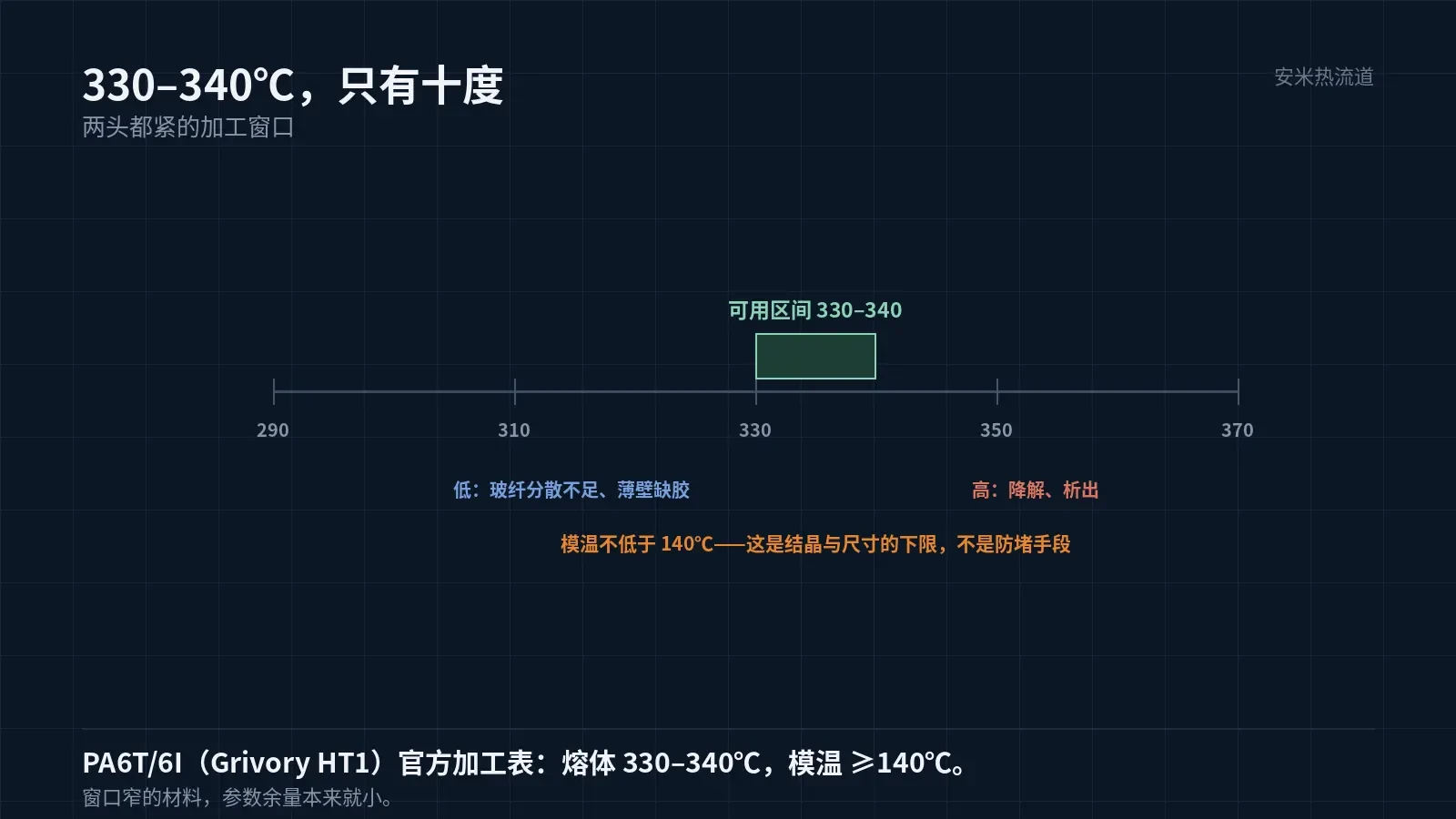
Grivory HT1 is a PA6T/6I system. Official processing data specifies: melt temperature 330–340°C, mold temperature at least 140°C. These values indicate ranges and limits, not reference points.
Below 330°C melt temperature, glass fiber dispersion is inadequate and flow becomes restricted, leading to short shots in thin-wall and long-flow regions first; above 340°C, degradation and exudation occur, making the strings stickier and harder to break.
A mold temperature above 140°C is required for crystallinity and dimensional stability. Reducing the mold temperature to stop stringing may shorten the strings but will immediately cause warpage and dimensional drift.
Compared to PA46, PA6T has a narrower processing window. PA46 requires melt temperatures above 305°C, with an optimum of 305–320°C; PA6T operates within a narrow range of 330–340°C. Materials with narrow windows inherently have smaller parameter margins.
If stringing persists despite outlet temperatures below 330°C, the issue is likely gate shear or incorrect shut-off timing. This diagnosis prevents unnecessary trial-and-error adjustments.
Shear Heat as a Secondary Factor
Small gate cross-sections and high glass fiber content generate shear heat as shear rates increase. Actual outlet temperatures may exceed barrel setpoints by over 10°C.
This temperature rise is critical near the 340°C upper limit: even if setpoints are within range, outlet temperatures may exceed limits and cause stringing. Monitoring outlet temperature is more effective than monitoring setpoints.
Gate diameter, gate length, and injection speed all affect shear. Gate geometry can be set initially; adjust the injection speed incrementally.
Why the SD Series Is Recommended for These Materials
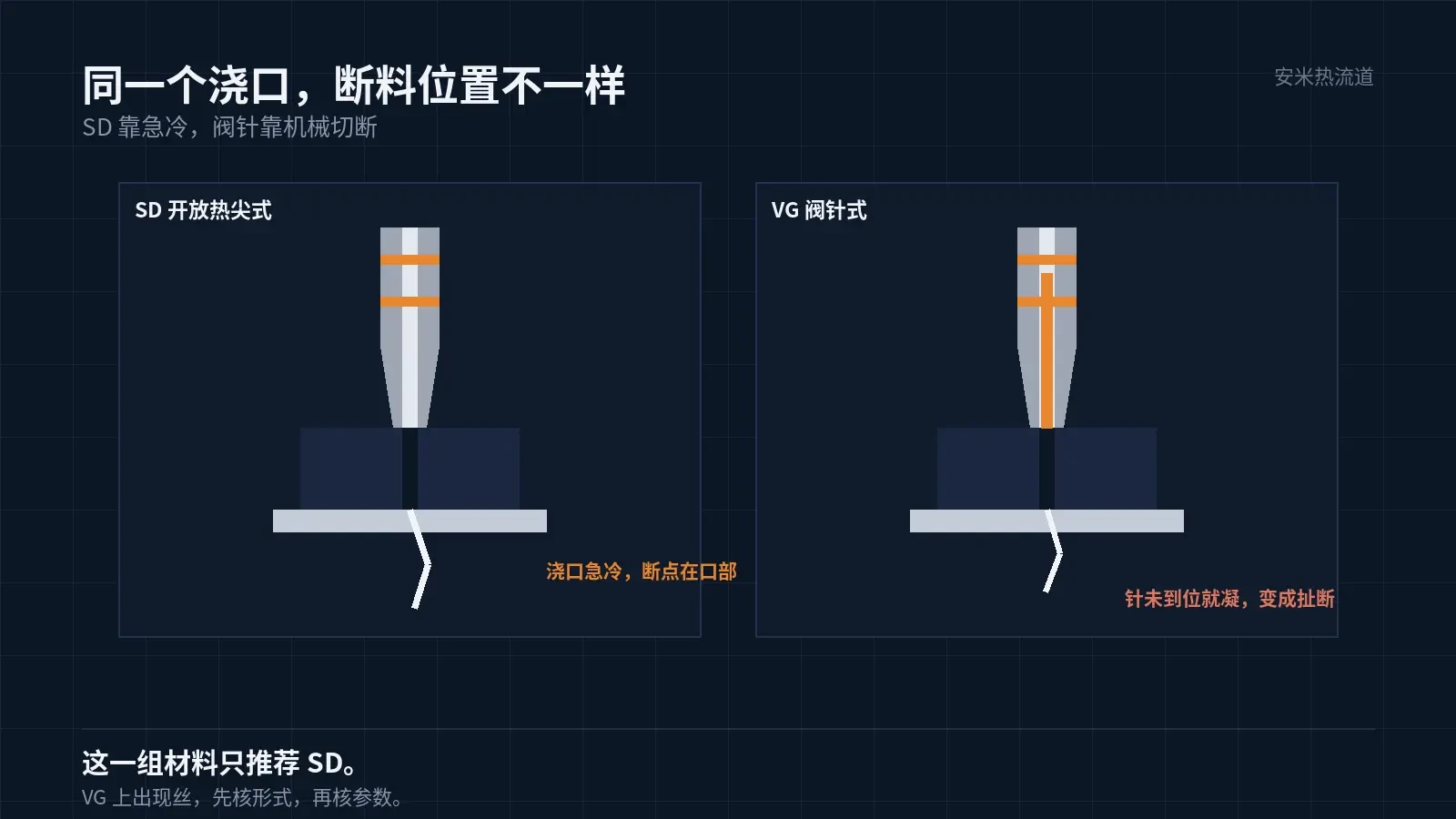
AM Industry product profiles recommend only the SD Series open hot tips for PA4T, PA6T, PA9T, PA10T, PA46, and PPS. The TP Series, VG Series, and PVG Series are not recommended.
These semi-aromatic polyamides exhibit low melt strength and rapid crystallization. If the material at the gate begins to solidify before the valve pin completes mechanical shut-off, the cut turns into a tear, causing stringing.
The SD Series uses Fast Cooling at the gate for material cutoff, with the hot tip solely maintaining temperature and providing heat compensation. This approach differs fundamentally from valve pin cutoff used for LCP and PEEK.
If VG Series units are installed on-site, do not rush to adjust parameters. First verify that the gate design matches the material. If they mismatch, parameter adjustments merely compensate for structural deficiencies.
Troubleshooting Steps
1. Measure the outlet temperature. With a setpoint of 335, determine the actual outlet deviation to decide which parameter to adjust next.
2. Inspect the gate. Check diameter, length, wear, and glass fiber bridging at the gate.
3. Adjust injection speed and switchover point to stop packing at the gate, preventing material from being pulled out.
4. Adjust mold temperature last, in increments no greater than 5°C. After adjustment, verify changes in dimensions and warpage.
5. Record data: outlet temperature, gate dimensions, injection speed, and string length. Patterns emerge only after collecting data from four or more trials.
Record data on the same sheet consecutively for the same mold number, material grade, and gate. Re-verify when changing grades: HT1 is PA6T/6I and HT2 is PA6T/66; their process windows differ. Applying one set of parameters to the other creates new issues.
Two Boundaries
Do not rely on extending cooling time to resolve stringing. Strings form at mold opening; cooling time affects only the part, not the strings.
Don't just enlarge the gate. Increasing gate size reduces shear but also alters gate marks, cut-off position, and effective holding pressure length; verify all factors together.
Standardize this routine: inspect the gate on the first shot of each shift. String length, color, and cross-section are more reliable indicators than instruments. Waiting for defects to appear often means hundreds of shots have already been produced.
Please provide the melt temperature, mold temperature, gate dimensions, injection speed, and photos of the stringing. We will verify against this process window and send you a quotation once the solution is confirmed.
MATCHED BY MATERIAL AND DEFECT
This article covers stringing, drooling, clogging, and high-heat resins; refer to SD for gate freeze and break-off.
Register for a selection review and quote
Submit part, mold, and material details. Our engineers will evaluate the gate solution per part and provide a quote.
Upload a 2D layout drawing using the form.
Online selection and quote
Scan to register