
PA6T Drooling: Material Carryover After Color Change
问题排查16 min read
On this page
PA6T stringing occurs at a fixed point: not during startup or full production, but within the first few shots after a color change, material switch, or machine cleaning. Excess material hangs below the gate, leaving marks on the part.
Some attribute this to incomplete cleaning. Regardless of cleanliness, the issue recurs with each color change. The root cause is not cleaning; rather, material at the exit continues flowing during downtime.
Align the timeline first
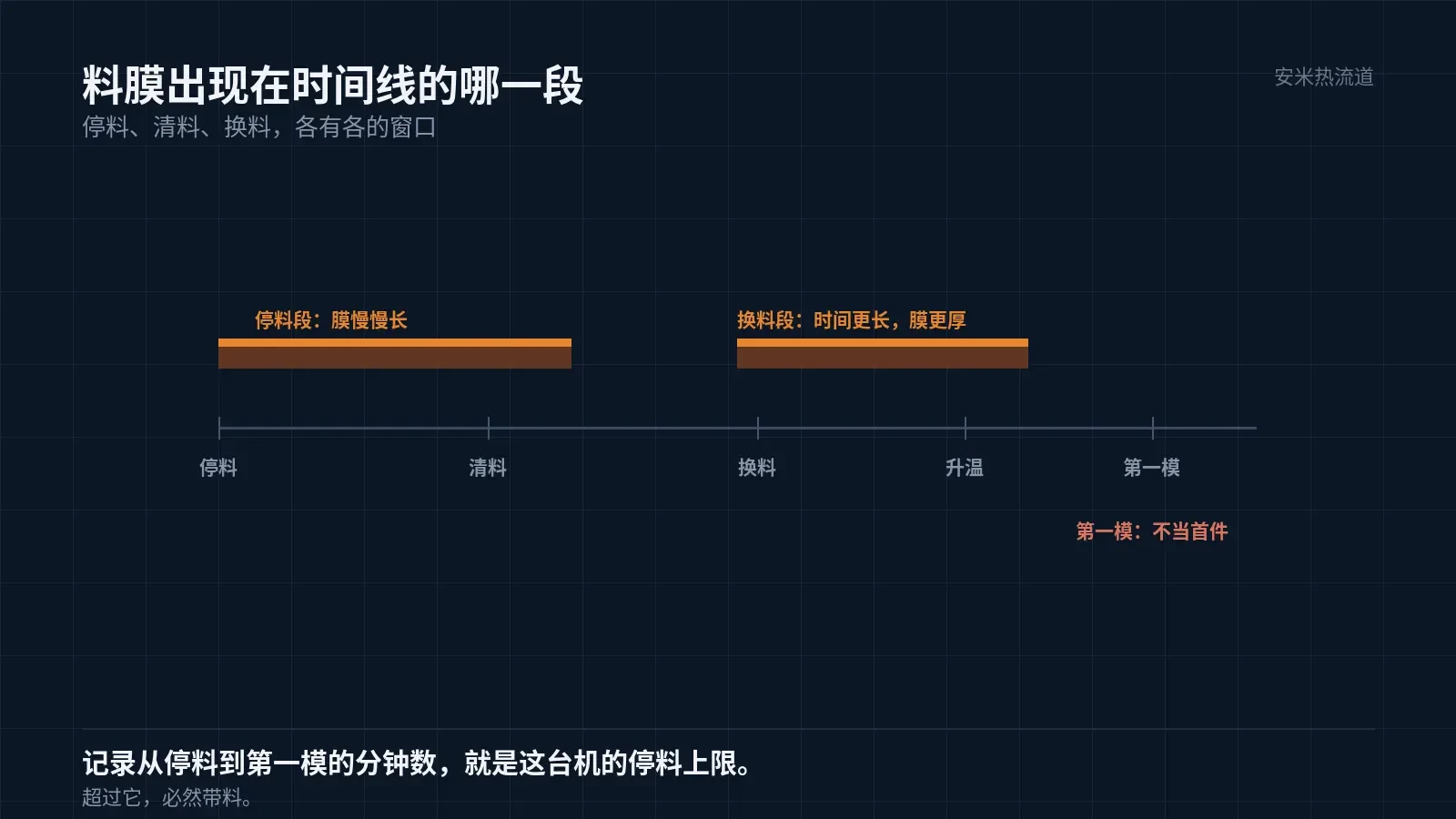
To change colors, follow these steps: stop feeding, purge, switch material, heat up, and run trial molding. Stringing in the initial shots typically occurs midway through this process, not at the end.
When feeding stops, the screw halts but the nozzle tip stays heated, keeping a small amount of material at the exit in a flowable state. The longer it remains heated, the further the material extrudes.
Thus, diagnosis is simple: record the minutes between stopping feed and the first shot. If stringing appears after more than ten minutes, it indicates seepage during downtime; if it appears in the first shot and resolves on its own, it is purge residue. These two require completely different treatments.
Another common point of confusion is material change. During this process, the screw retracts, purges, and rebuilds pressure. Because this cycle takes longer than simple downtime, more material flows out at the exit. As a result, the first shot after a material change is often lower quality than one following simple downtime.
Low moisture absorption does not eliminate the need for drying.
The PA6T family features low-moisture-absorption PPAs, a key selling point. However, drying is still required; surface moisture on pellets will vaporize in the melt at 330°C.
Moisture appears at the exit as bubbles in strands or pinholes in the film, distinct from a continuous seepage pattern. If bubbles are observed, check drying first; do not adjust temperature immediately.
Verify dryer performance: check temperature stability, dew point sufficiency, and hopper seal integrity. High setpoints are ineffective if the unit cannot reach them.
Why does the gate cool slowly?
PA6T melt temperature is 330–340°C, higher than PA46 (305–320°C) and PA9T. Higher melt temperatures require more time for the gate to transition from flowable to solid after material stoppage.
Mold temperature ≥140°C also keeps the gate warm. When both sides are hot, the temperature gradient across the short melt section becomes flat, leading to slow cooling and extended seepage.
This logic is similar to PEEK: not due to low viscosity, but because ambient heat prevents effective heat extraction.
Drying has a counterintuitive aspect: PA6T's low moisture absorption may suggest it needs no attention. However, low absorption only means slower uptake; surface moisture is still absorbed during overnight exposure in humid workshops. Keeping the hopper covered and the dryer running is more effective than temporarily extending drying time.
Differences from PA46 and PA9T
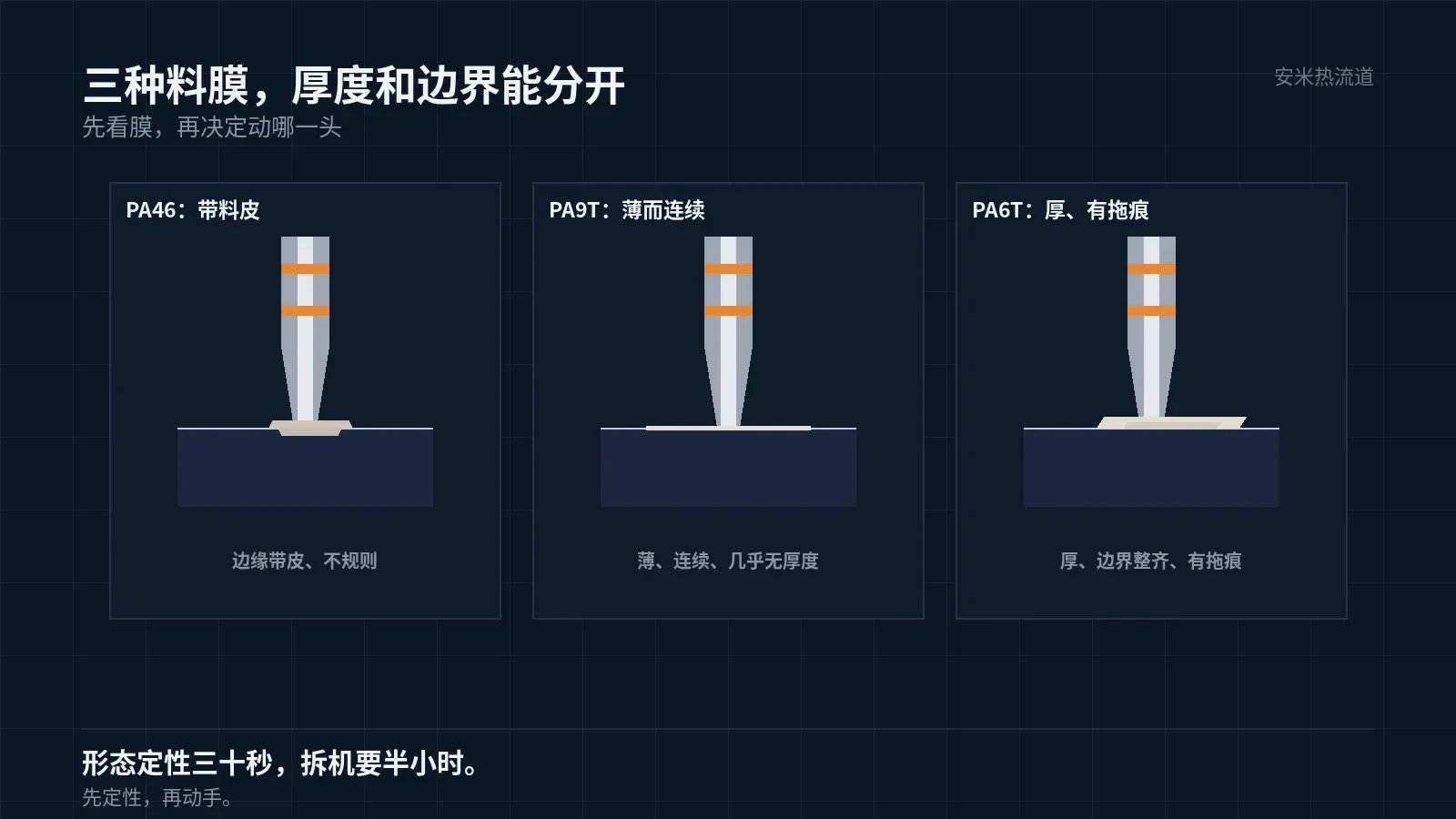
Stringing with PA46 typically occurs after material stoppage or color change. Due to its 295°C melting point and narrow processing window, the material crystallizes rapidly upon cooling, resulting in a shorter seepage window but an increased tendency for skin formation.
PA9T has a Tg of 125°C. During feed stoppage, the gate cools slowly, leading to prolonged seepage that manifests as a thin, continuous film.
PA6T falls between the two: it has the highest melt and mold temperatures, resulting in a thicker film with relatively clean boundaries, often accompanied by distinct stringing. These three film types can be distinguished by their thickness and boundary characteristics.
Thickness-based classification offers another advantage: no need to wait for finished parts. After opening the mold, inspect the film directly under the gate. Thickness, boundaries, and stringing enable a qualitative assessment in 30 seconds—much faster than disassembly.
Remediation Sequence
First, limit feed stoppage time to under 10 minutes. If this is not achievable, reduce the nozzle tip temperature by one step during stoppage and restore it upon resumption; do not idle at full temperature.
Second, schedule color changes from light to dark. Changing from dark to light is the hardest to clean, so place it last to minimize repeated purge cycles.
Third, use compatible cleaning compounds. Do not force purging with low-temperature materials. These materials carbonize in the 330°C barrel, leaving residue in the flow channels that appears during the next startup.
Fourth, after cleaning, fire several dry shots until the gate output is clean before mounting the mold for trial. Skipping this step will cause initial shots to contain residual material.
Fifth, do not accept the initial sample after a color change as qualified. Wait until the material film clears and production stabilizes before sampling.
Additionally, consider the cleaning temperature. The thermal resistance of the cleaning compound must exceed PA6T processing temperatures; otherwise, it carbonizes in the barrel and negates the cleaning effect. After cleaning, verify that gate output is clean and continuous. If discontinuous, perform another cleaning cycle.
Two Boundaries
Do not lower the mold temperature to stop seepage. If the mold temperature is below 140°C, insufficient crystallization can cause dimensional instability and warpage before seepage improves.
Do not rely on extended holding pressure. Stringing occurs after material feed stops, once holding pressure has ended, so it cannot be suppressed by pressure.
Do not immediately accept the first shot after a color change; inspect the gate first. Only discuss dimensions if the gate is clean and flow is continuous. Judging is futile if material remains at the gate.
Send us the shut-off duration, color change sequence, and melt film appearance. We will verify against this timeline and provide a quote once the solution is confirmed.
The timeline must specify minutes. Vague terms like "stop for a while" are unactionable for shift operators.
Post a numbered timeline on the machine showing actions per minute; this is more effective than verbal instructions.
MATCHED BY MATERIAL AND DEFECT
This article covers stringing, drooling, clogging, and high-heat resins; refer to SD for gate freeze and break-off.
Register for a selection review and quote
Submit part, mold, and material details. Our engineers will evaluate the gate solution per part and provide a quote.
Upload a 2D layout drawing using the form.
Online selection and quote
Scan to register