
PA46 drooling: Why does it occur mainly after stoppage and color changes?
问题排查18 min read
On this page
PA46 film defects typically occur after night-shift idle periods or during the first few shots following a color change and purging. They are less common during continuous daytime production.
This pattern indicates the issue lies not in the material formulation, but in what occurs at the gate exit during downtime.
Not in Every Shot
If film appears in every shot, check temperature settings or drying. If it only occurs in the first few shots after a stoppage or color change, review shutdown procedures. These require different solutions; identifying the cause early saves significant time.
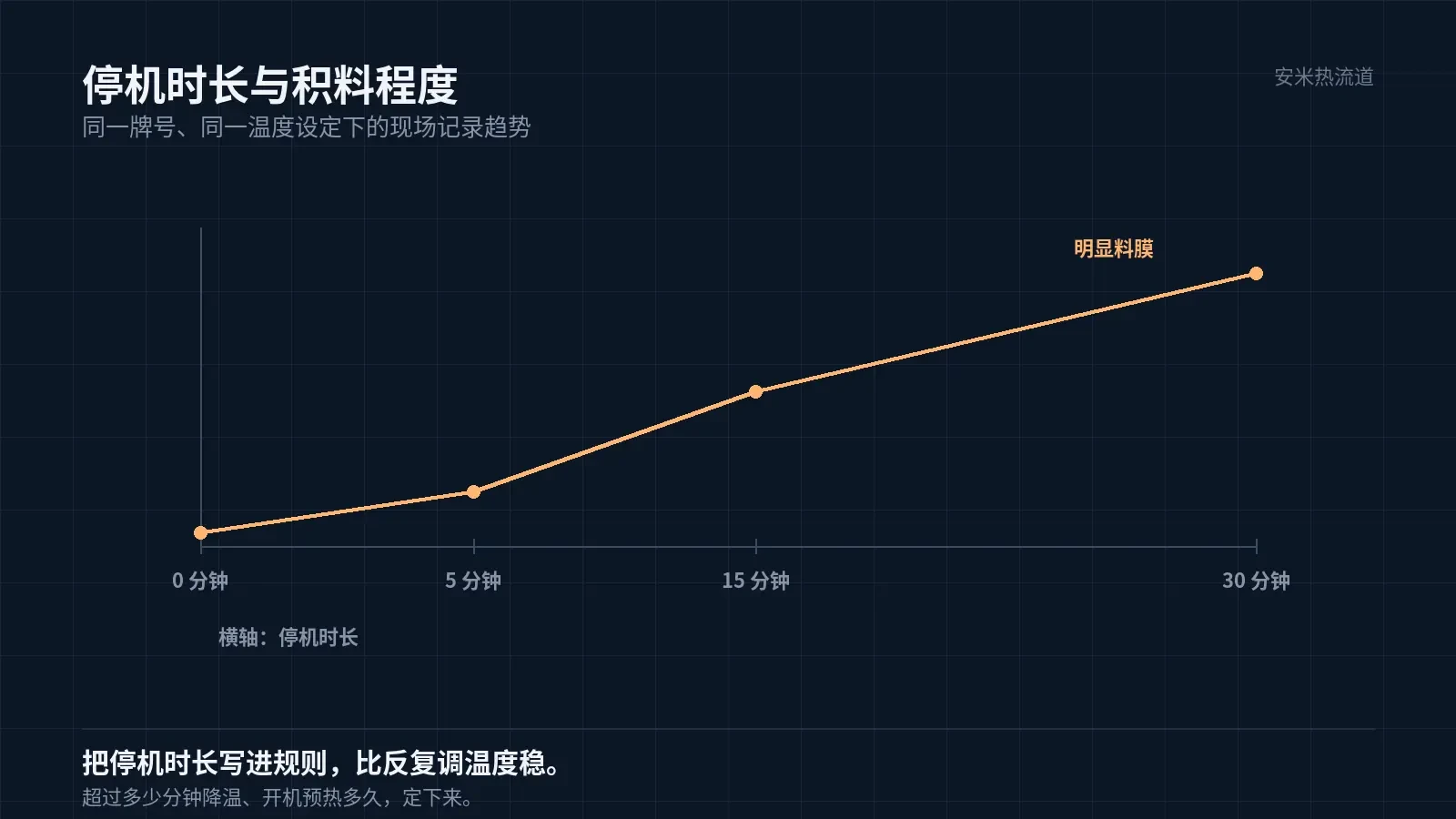
Differentiate by timing: Film appearing after a 5-minute stop indicates residual melt flowing from the gate exit. Film appearing 30 minutes or more after a shift break suggests re-exudation following reheating of the entire gate section. Film appearing only after color changes is likely due to purging actions or cleaning compound residue. Each scenario requires a distinct response; identify the timing before adjusting parameters.
PA46 film is typically thinner than LCP film, positioned closer to the gate. Its irregular edges may only be visible under side lighting.
Document the color-change sequence in work instructions: purge first, confirm no hang-up at the gate exit, run several dry cycles, then start product molding. Reversing this order causes residues displaced during purging to enter the product in the initial shots, which typically show the most severe film defects.
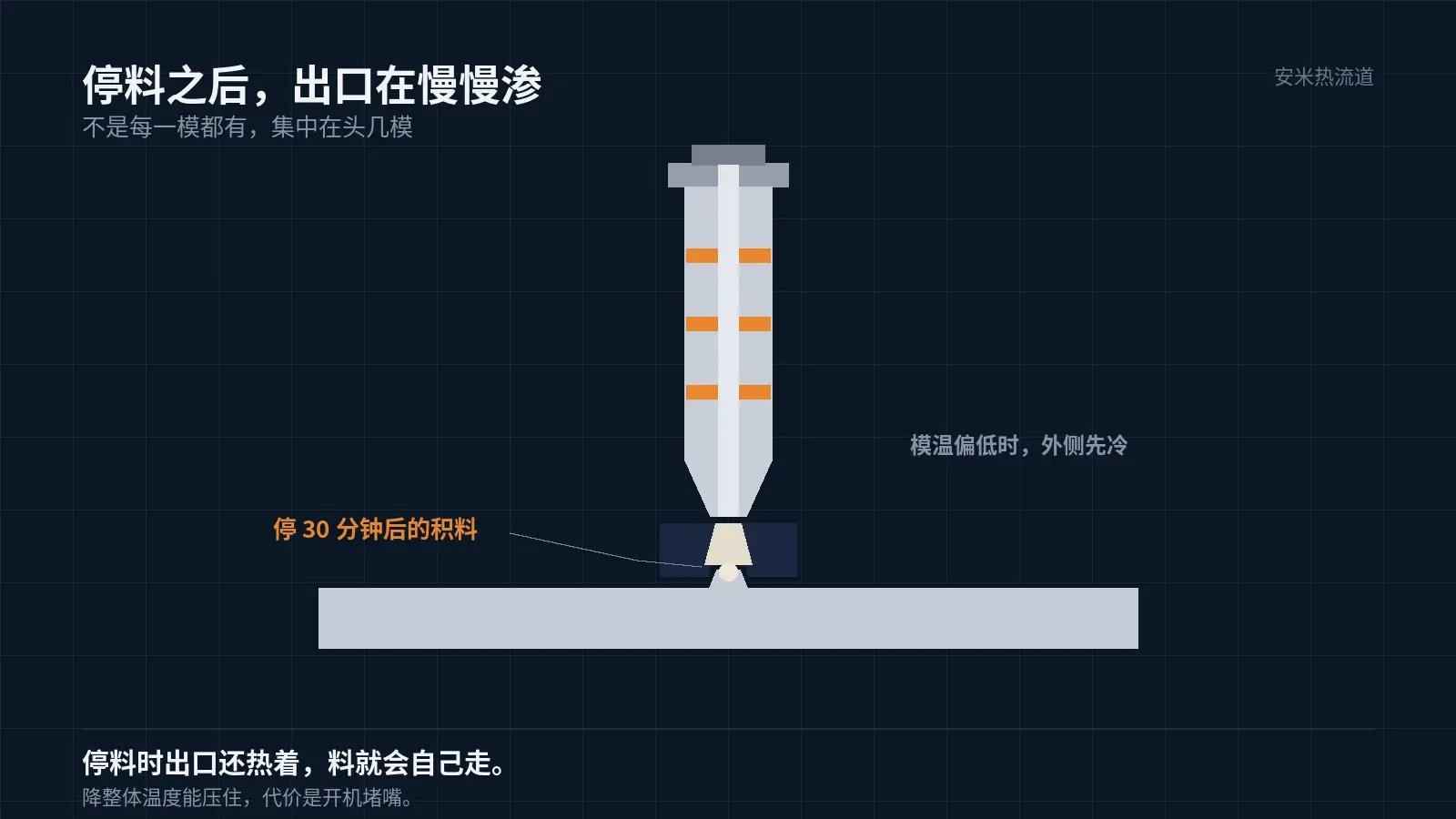
Events During Outages
Once holding pressure ends and the screw stops rotating, the machine ceases to apply thrust. However, the hot nozzle remains energized, maintaining the outlet section at injection temperature.
Another often-overlooked step is checking whether the screw retracts during shutdown. Excessive retraction creates space in the runner, allowing melt at the outlet to drain by gravity; insufficient retraction delays residual pressure release, which can introduce over-pressurized material into the first few shots. Shutdown procedures must be standardized and consistent across all operators.
PA46 melt temperature is inherently high (305–320°C), leading to low viscosity. Gravity combined with residual pressure is sufficient to cause gradual seepage at the outlet. A five-minute stop results in a thin film, while a thirty-minute stop can accumulate into a distinct droplet.
Mold temperature also plays a role. At low mold temperatures, the outlet's outer surface cools quickly while the inner side stays hot, leading to material buildup at the interface that gets pulled out when opening for the next cycle.
Temperature distribution around the outlet circumference is often uneven. The side closer to the water cooling channel cools faster, causing material buildup and skewing the gate vestige shape. If the vestige consistently appears on one side, check the mold cooling channels and gate bushing position before adjusting temperatures.
Do not skip the drying step
Inadequately dried PA46 shows reduced melt viscosity, increasing the risk of outlet seepage. This finding is based on field experience; severity varies by grade and drying history, so it should not be treated as a quantitative conclusion.
Gate vestiges and silver streaks are often confused. Silver streaks appear as fine lines along the flow direction, typically radiating from the sprue. Gate vestiges are thin layers of material around the gate with irregular edges and thickness. When both occur simultaneously, it indicates issues with both drying and outlet temperature: address drying first, then adjust the temperature.
At minimum, retrieve dryer records: temperature, duration, and hopper change status. These three often explain batches that suddenly become less viscous without an obvious cause.
Verify three items in drying records: setpoint, actual temperature, and drying time. Relying solely on setpoints is ineffective; low actual dryer temperatures, unchanged hoppers, or incomplete regeneration can introduce moisture into the barrel. Moisture promotes melt degradation at high temperatures, reducing viscosity and increasing outlet seepage.
Emergency Thermal Insulation Measures and Associated Costs
Lowering the gate temperature, increasing suck-back, and cleaning nozzle tips are common shop-floor practices. Reducing the temperature suppresses stringing but often causes clogging in the first few shots after restart. Excessive suck-back introduces air into the runner, resulting in voids or black spots in subsequent shots.
These methods work during peak production but only address symptoms, not the root issue: the outlet stays hot when material flow stops.
Temperature reduction has another drawback: PA46 has a narrow processing window, making it easy to fall below 305°C. Below this threshold, stringing decreases, but clogging and short shots occur, leading to seal failure within one or two cycles. Using temperature reduction to control stringing is riskier for PA46 than for LCP.
Define Stoppage as Executable Rules
Executable rules must specify: stoppage duration triggering gate section temperature reduction, target temperature, pre-heating duration before restart, and whether initial shots are scrapped or retained. Include these four items in shift handover logs.
Handover logs must include a field for actual results: the procedure used to address the stoppage and the condition of the first few shots after restart. After one month of data, correlations between procedures and stoppage durations become clear. Update rules based on records, not just initial definitions.
Combine with cyclic temperature control in the gate section: remove heat after holding pressure ends so the outlet seals first, preventing continued outflow during material stoppage. With both rules and hardware in place, color changes and night shifts will run consistently.
Procedures must be actionable: specify shutdown duration, target temperature, pre-start heating to the actual setpoint, handling of initial shots, and logging responsibility. Vague procedures remain just paper on the wall.
Before shutdown, ensure proper purging. Insufficient purge causes material in the runners to solidify deep within the nozzle tips during cooling, requiring prolonged reheating at startup; excessive purge introduces air during subsequent feeding. Standardizing the purge position significantly improves initial shot stability.
For PA46 stringing: first determine onset timing, then review drying records, and finally adjust temperatures. Reversing this order often causes further instability.
Compared to LCP stringing, PA46 films are typically thinner, located closer to the gate, have more irregular edges, and exhibit smaller thickness variations, making them easy to mistake for mold oil. Side lighting clearly distinguishes them: oil forms a uniform layer, while the material film tapers outward from the gate.
Provide material grade, drying records, and shutdown procedures. We will verify against gate-section temperature curves and provide pricing after confirming the solution.
MATCHED BY MATERIAL AND DEFECT
This article covers stringing, drooling, clogging, and high-heat resins; refer to SD for gate freeze and break-off.
Register for a selection review and quote
Submit part, mold, and material details. Our engineers will evaluate the gate solution per part and provide a quote.
Upload a 2D layout drawing using the form.
Online selection and quote
Scan to register