
Hot Runner Gate Types: SD, TP, VG, and PVG Applications
工艺参数16 min read
On this page
Hot runner gates are available in four types: open SD, pinpoint TP, valve gate VG, and PVG. These names may look like model numbers but actually refer to four different sealing methods.
Choosing the wrong type doesn't just reduce efficiency—it makes molding impossible. This article covers each type's application scope.
SD: Open, No Sealing
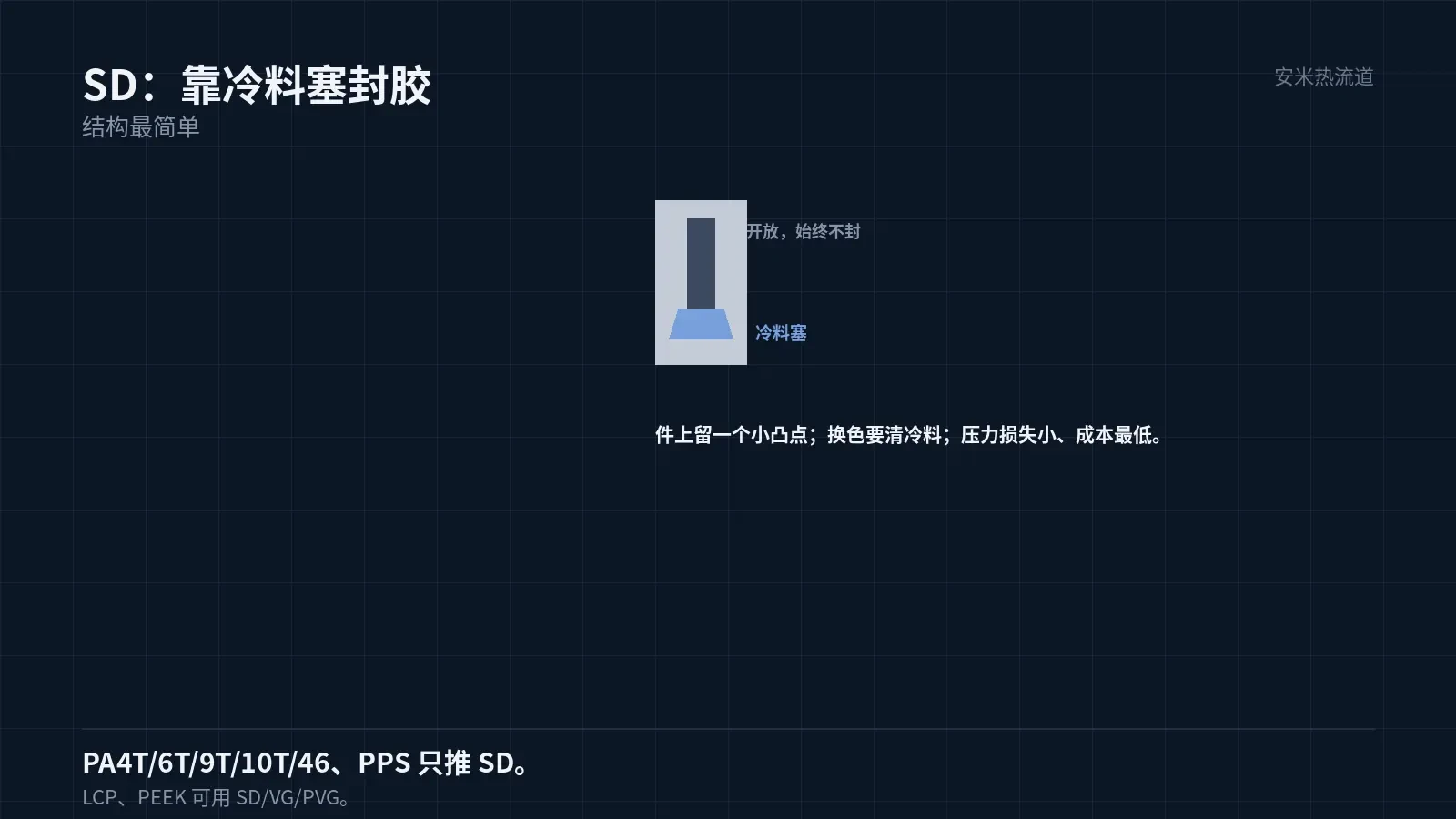
SD is a straight-through design with the gate permanently open. Melt solidifies at the gate to form a "cold slug" that creates the seal.
Benefits include a simple design, low cost, minimal pressure drop, and no mechanical failures related to valve pins.
Disadvantages include a cold slug at the gate causing a protrusion on the part, the need to purge during color or material changes, and more visible gate marks compared to valve gates.
SD is ideal for parts with general cosmetic requirements, infrequent material changes, and cost sensitivity. For materials like LCP, PA9T, PPS, and PA46, SD is the primary recommendation.
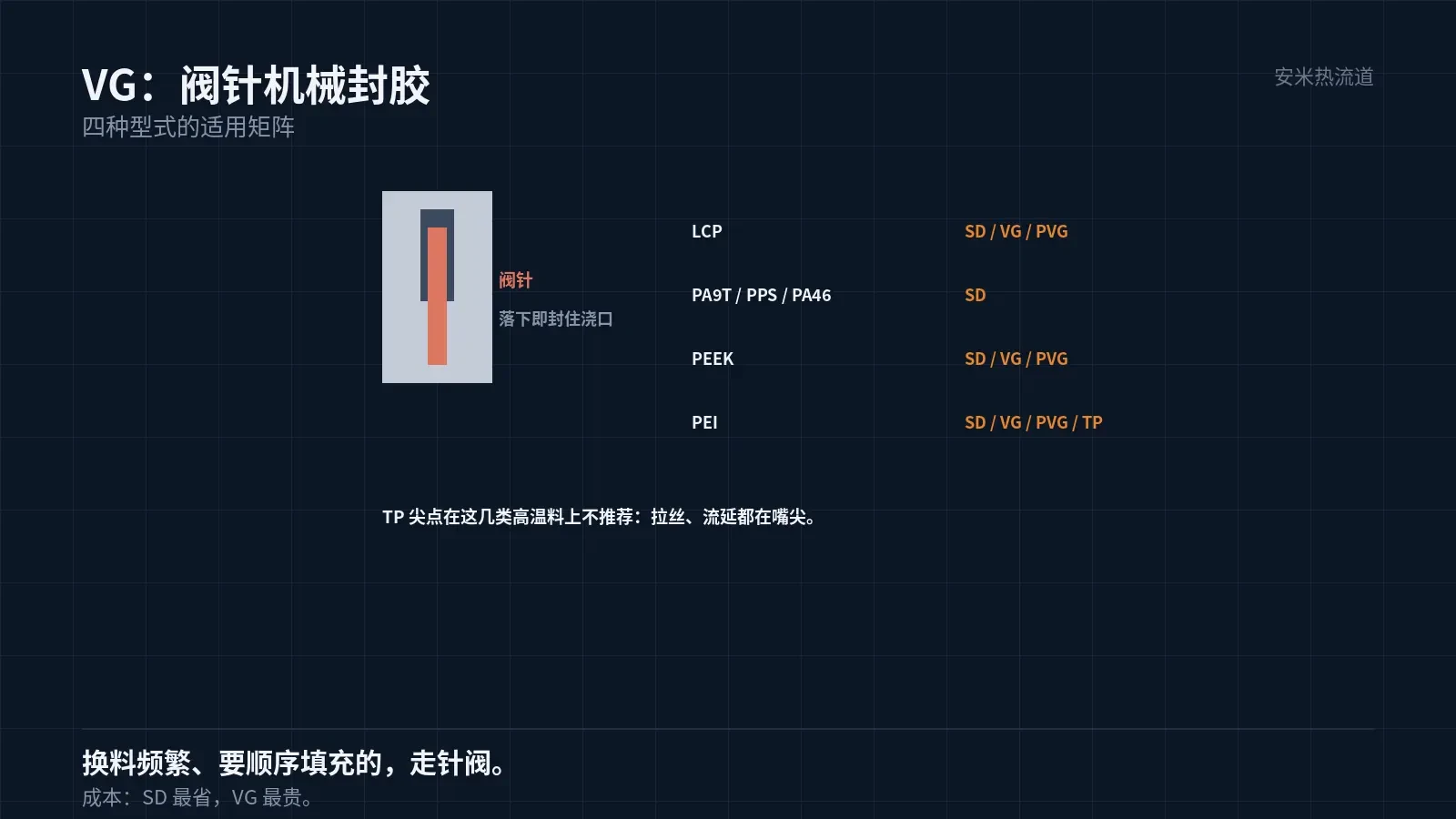
In AM Industry's product specifications, only SD is recommended for PA4T/PA6T/PA9T/PA10T/PA46/PPS. TP, VG, and PVG are not recommended. This is critical for selection.
Why is SD recommended only for these materials? Due to their high glass fiber content and high melt viscosity, valve gate runners are prone to stagnation and wear, leading to material buildup at the gate.
The SD structure features a simple straight-through runner with no mechanical clearance for a valve pin, minimizing stagnation risk. This is ideal for these materials.
TP: Pinpoint, smaller gate
TP is a pinpoint type with a tapered gate, leaving a less visible mark on the part than SD.
TP has higher pressure loss than SD because of its smaller gate cross-section, making it harder to fill thin-wall parts.
TP is also unsuitable for materials prone to stringing and drooling. High shear at the pin point raises melt temperature, increasing the risk of stringing.
Therefore, TP is ideal for applications requiring high cosmetic quality, good material flowability, and moderate wall thickness.
Other configurations besides TP can be used for LCP and PEEK, but TP is not recommended for these materials.
TP pin points are prone to stringing and drooling under high shear; this risk is higher for materials with elevated melt temperatures.
Stringing and drooling occur at the nozzle tip–gate interface. The pinpoint design features a small contact area with concentrated heat, increasing the risk of these issues.
VG Series: Valve gate with mechanical seal
The VG Series is a valve-gate type that seals via the mechanical action of the valve pin. When the valve pin closes, the gate seals completely with no cold slug.
Advantages include small gate marks, easy color/material changes, and sequential control (determining which gate opens first or last).
Disadvantages include a complex structure, higher cost, risk of valve pin wear and sticking, and the need for pneumatic or hydraulic control.
The VG Series is ideal for parts with strict cosmetic requirements, frequent material changes, and large components requiring sequential filling. Compatible with LCP and PEEK.
Sequential filling is ideal for long, large parts. Opening the far-end gate before the near-end gate creates a flatter melt front and reduces weld lines.
However, sequential control requires controller support, further increasing costs. This depends on part complexity.
Another benefit of sequential control is reduced weld lines. As multiple gates open in sequence, the melt front stays flatter and temperatures at convergence points remain higher.
This effect is significant for long and large-area parts but offers limited benefit for small parts, where it is not cost-effective.
Sequential control must also coordinate with holding pressure. Gates that open earlier require shorter holding times, while those opening later need longer times to prevent over-holding in the initially filled cavity.
Sequential control also requires independent temperature settings for each gate. Inconsistent temperatures undermine the purpose of sequencing.
This solution costs significantly more than constant-temperature hot runners but is cost-effective for high-value parts.
These parameters are hard to adjust and require mold trials. Once optimized, part quality remains stable.
PEI is compatible with SD, VG, PVG, and TP series for the widest selection.
PVG: A Valve Gate Variant
PVG is also a valve gate type but differs structurally from VG, mainly in the fit between the runner and the valve pin.
Both use mechanical shut-off. Differences lie in applicable materials and part types. Selection depends on material viscosity and part structure.
LCP and PEEK support PVG; PA9T, PPS, and PA46 are not recommended.
This criterion is not a preference but determined by material properties: high glass-fiber and high-viscosity materials cause wear and stagnation in valve gate flow channels.
Selection Order
Step 1: Inspect the material. Based on the criteria above, identify viable options.
Step 2: Verify appearance requirements. For high cosmetic standards, use valve gates; for general requirements, the SD Series is sufficient.
Step 3: Verify material change frequency. For frequent changes, valve gates reduce purge time.
Step 4: Check cost. SD Series is the most affordable, VG Series is the priciest, with a difference of over 30%.
After these four steps, typically only one option remains. The remainder involves structural verification and quotation.
Final step: validation. Perform small-batch trial molding to check for gate marks, stringing, and clogging—all of which occur at the nozzle tip. Focus on the nozzle tip during trials.
Maintain trial molding records including gate type, temperature, injection speed, and defects. Use these as references for future similar parts.
Send us the material grade, part drawing, appearance requirements, and change frequency. We'll verify based on gate type and provide a quote upon confirmation.
MATCHED BY MATERIAL AND DEFECT
This article covers stringing, drooling, clogging, and high-heat resins; refer to SD for gate freeze and break-off.
Register for a selection review and quote
Submit part, mold, and material details. Our engineers will evaluate the gate solution per part and provide a quote.
Upload a 2D layout drawing using the form.
Online selection and quote
Scan to register