
Gate Stringing and Drooling: Why Is It Hard to Adjust?
工艺参数17 min read
On this page
Stringing and drooling persist despite repeated on-site adjustments to injection speed, hold pressure, and cooling; the issue resolves for two days then recurs.
Both defects occur at the interface between the hot runner nozzle tip and the mold gate. Accurate localization is essential to identify which parameters to adjust.
First, distinguish stringing from drooling.
Stringing appears as a thin filament extending from the nozzle tip, pulled out during mold opening and breaking off on the part or mold surface.
Drooling forms a thin film that flows from the nozzle tip, hangs like saliva at the gate edge, and solidifies into a flake after cooling.
The morphologies and causes differ: stringing occurs when the melt is drawn into a filament without breaking; drooling results from failure to seal the melt at the gate, causing continuous leakage.
A similar defect is clogging, where the nozzle tip channel becomes blocked by solidified material, preventing shot delivery in the next cycle. All three issues occur at the nozzle tip but require different solutions.
First, visually identify the morphology. Photos are often insufficient; inspect on-site or examine the nozzle tip after shutdown.
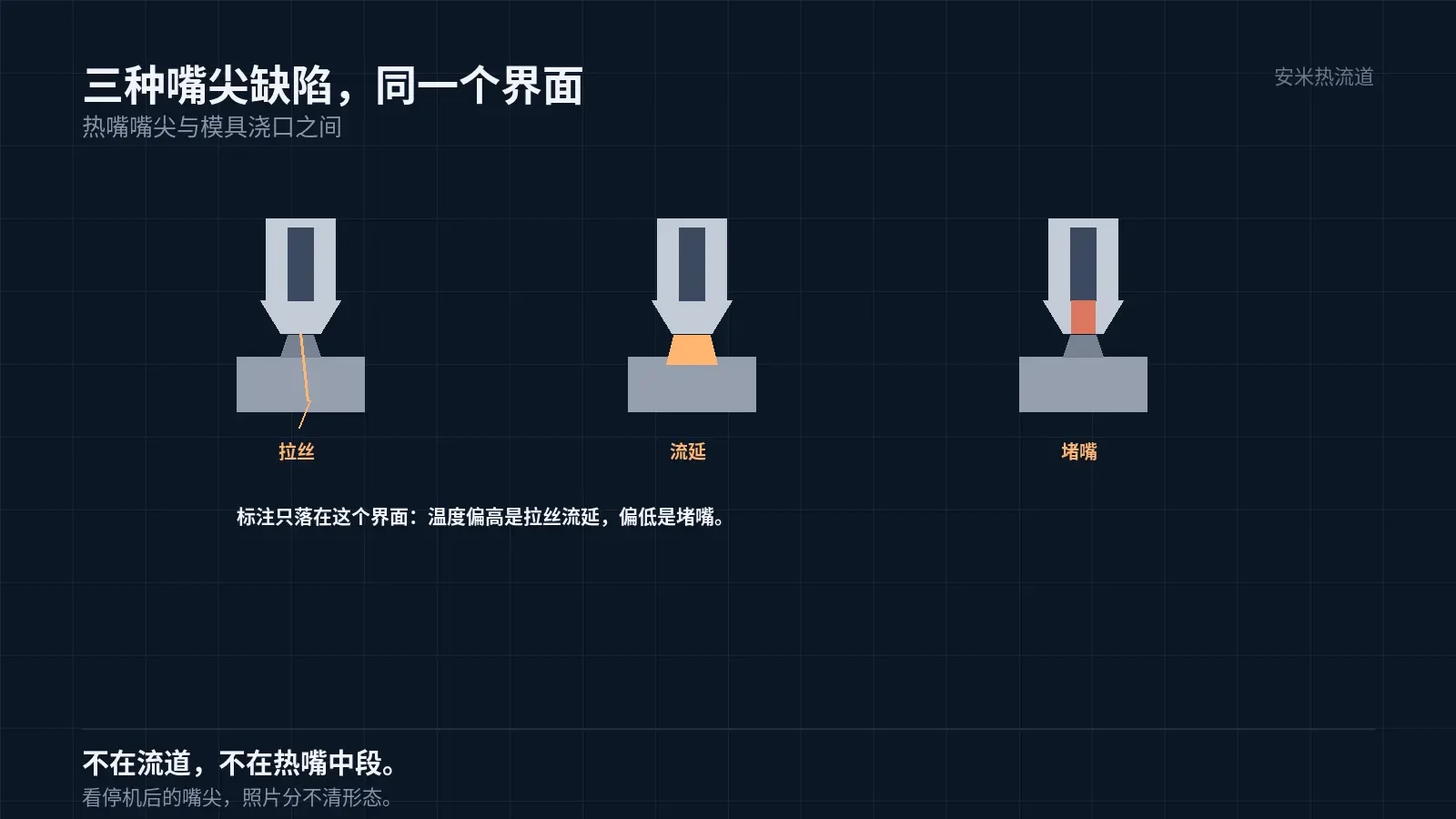
Stringing: Overheating, incomplete melt cutoff
Stringing is directly caused by excessive melt temperature at the nozzle tip. High temperatures reduce melt viscosity, causing the material to stretch instead of breaking cleanly during mold opening.
Excessive temperature results from three sources: high hot runner setpoints, inadequate heat dissipation between the nozzle tip and mold, and shear heat accumulation.
Investigate these three sources individually. If setpoints are high, lower them. If heat dissipation is insufficient, check the clearance and contact surface between the nozzle tip and gate. If shear is high, reduce injection speed.
Another factor is insufficient cooling time. If the mold opens before the melt fully solidifies, the strand will not break.
Therefore, the stringing troubleshooting sequence is: first check setpoint temperatures, then cooling time, followed by nozzle tip contact, and finally injection speed.
Drooling: Poor seal, continuous material flow
Drooling occurs when an effective freeze seal fails to form at the gate, allowing melt to continue flowing outward during the holding or cooling phase.
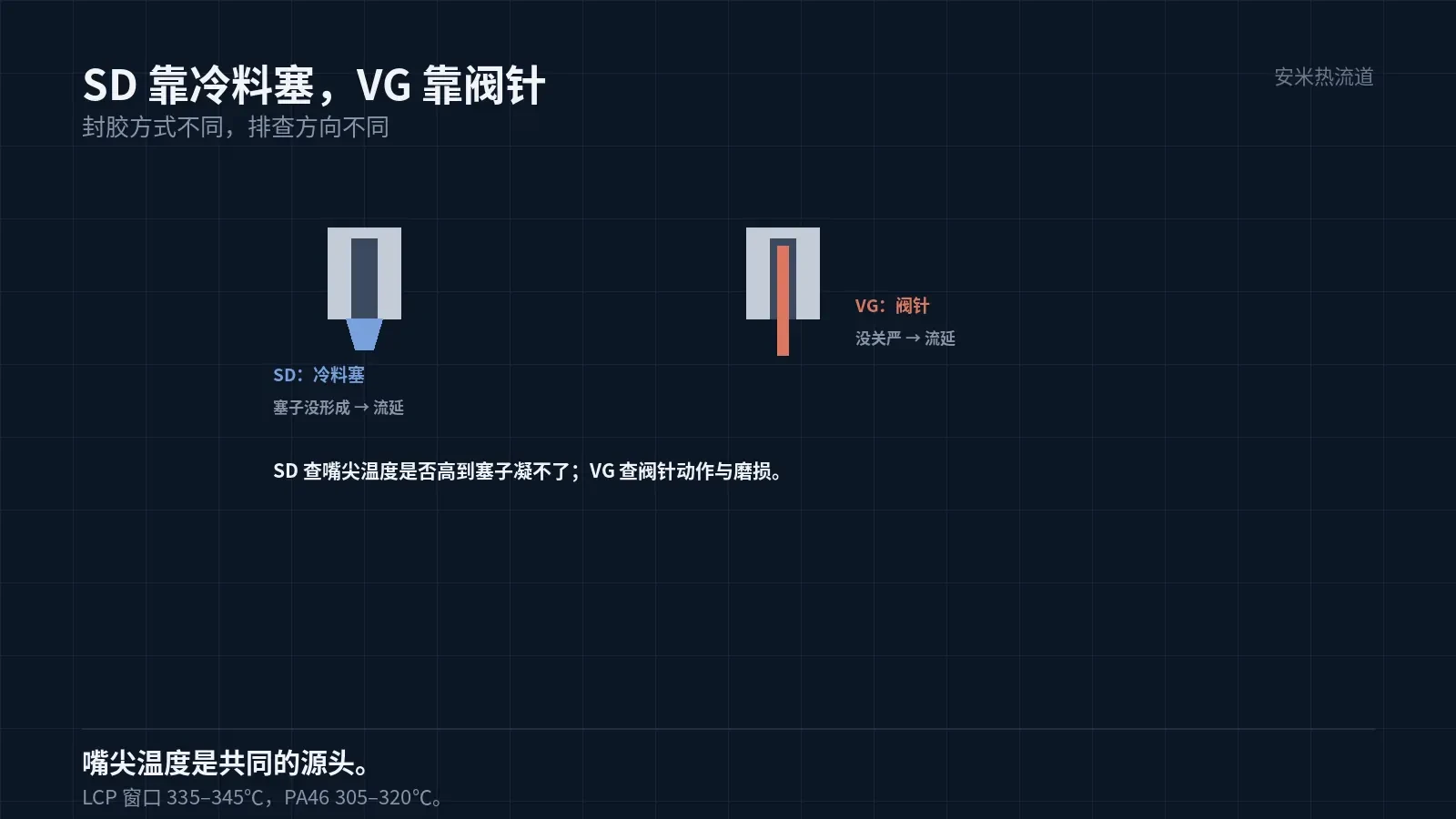
The open-type SD Series uses a cold slug for sealing. Drooling occurs if the cold slug fails to form due to an excessively high nozzle tip temperature or insufficient cooling.
The Valve-gate VG Series uses a valve pin for sealing. Drooling occurs due to improper valve pin closure, slow closing speed, or valve pin wear.
Therefore, for drooling, first verify the gate type. For SD Series, check the cold slug; for VG Series, check the valve pin. The troubleshooting steps differ completely.
The SD Series cold slug function requires the nozzle tip temperature to be below the melt solidification point. If set too high, the slug will not form. This is the most commonly overlooked factor.
Nozzle clogging: Low temperature
Unlike stringing, nozzle clogging is caused by low nozzle tip temperature. The melt solidifies inside the nozzle tip channel, blocking it.
Low-temperature causes: low setpoint, excessive nozzle tip heat dissipation, insufficient heater power, or incorrect thermocouple placement.
Another type is "intermittent" clogging: blockage occurs periodically during molding. This is mainly caused by unstable thermal equilibrium or fluctuations in ambient temperature.
Clogging troubleshooting: First, check the difference between setpoint and actual temperature. Next, verify heater power. Finally, inspect the nozzle tip structure.
Summary: Stringing and drooling occur at high temperatures, whereas clogging happens at low temperatures. A single temperature setting can trigger two opposite issues.
What Temperature to Set
Nozzle tip temperature settings must balance clog prevention with avoiding stringing. This range varies by material.
The LCP processing window is narrow: melting point 335°C, hot runner temperature 335–345°C—a range of only 10°C. This demands high-precision temperature control.
The PA46 window is also narrow: melt temperature must exceed 305°C, with an optimal range of 305–320°C. Temperatures below 305°C cause clogging; above 320°C cause degradation.
The PPS window is wider: melt temperature up to 360°C, nozzle 310–320°C. However, PPS viscosity does not increase during prolonged residence, reducing the risk of nozzle clogging.
PEEK requires the highest temperatures: nozzle 395°C, mold temperature 170–200°C. Controlling heat dissipation at the nozzle tip is most challenging under these conditions.
Therefore, "what temperature to set" is not a single value but a range. The width of this range determines how easy the mold is to adjust.
Three Structural Considerations
First, the contact area between the nozzle tip and the mold gate. A larger contact area promotes faster heat dissipation and lowers the nozzle tip temperature; a smaller contact area results in higher temperatures.
Contact surface design must be tailored to the material. Fast-freezing materials require less heat dissipation, while slow-freezing materials need more. Using a single structure for all materials will inevitably fail to suit half of them.
Second: Heater position. The heater must cover the nozzle tip, not just the mid-section. A hot mid-section with a cold nozzle tip causes clogging.
Third: Thermocouple placement. The thermocouple must be positioned near the nozzle tip to measure its temperature. Placing it in the mid-section controls only that area, leaving the nozzle tip uncontrolled.
These three factors are set during mold design and cannot be altered later. When selecting a hot runner, verify these items based on the material.
On-site Troubleshooting Steps
For stringing or drooling, follow this sequence: 1 Inspect morphology (string vs. film), 2 Check gate type (SD Series or VG Series), 3 Measure nozzle tip temperature, 4 Check cooling time, 5 Check injection speed and holding pressure.
Completing these five steps typically identifies the root cause. Skipping initial checks and directly adjusting parameters often leads to recurring issues.
After adjustment, record: setpoint temperature, measured temperature, cooling time, injection speed, and ambient temperature. This establishes a baseline for comparison if issues recur.
Records must clearly distinguish between stringing and drooling. Do not mix records for these two defects, as it obscures pattern identification.
Please provide the material grade, gate type, setpoint and measured temperatures, along with defect photos. We'll review the nozzle tip interface first before issuing a quote.
MATCHED BY MATERIAL AND DEFECT
The article covers stringing, drooling, clogging or high-heat resins; check SD for gate freeze and break-off.
Register for a selection review and quotation
Send the part, mold and material details. Our engineers assess the gate solution by part, then provide a quotation.
A 2D layout drawing can be uploaded with the form.
Online selection and quote
Scan to register