
When Is PEEK Truly Required for Wire-to-Board Connectors?
Material Applications16 min read
On this page
Wire-to-board connectors are a general-purpose category where PA9T, PA46, and PPS suffice for most projects. Few projects in this category use PEEK, each with its own specific rationale.
This article doesn't cover how good PEEK is—it focuses on when it's truly viable and the associated costs.
Prerequisite 1: Long-term temperature exceeds 150°C
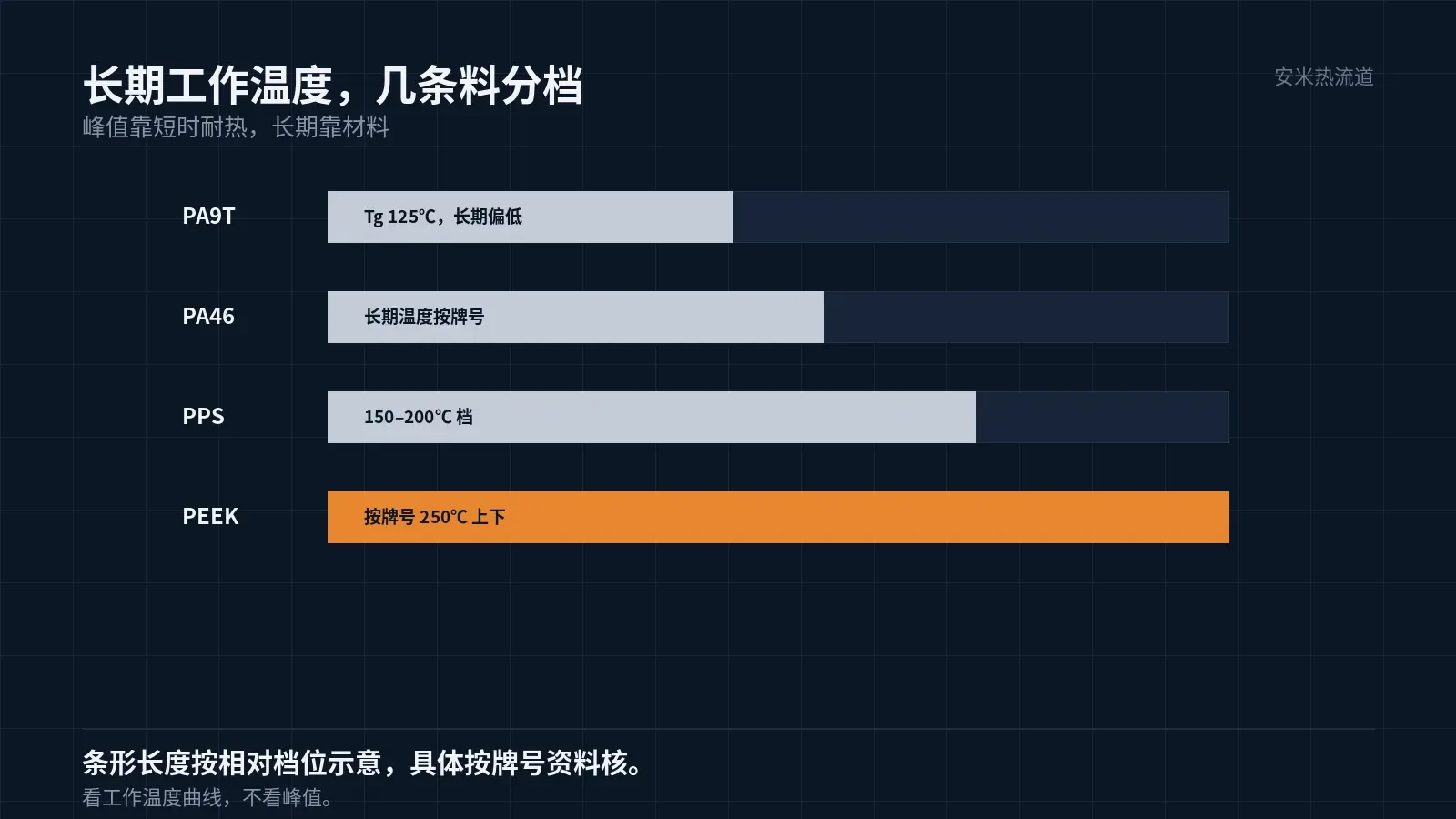
The long-term service temperature for PPS ranges from 150–200°C, while PA4T and PA9T are lower. If components operate continuously above 180°C, material options become limited.
PEEK melts at 343°C and has a long-term service temperature of approximately 250°C, depending on the grade. This thermal margin makes it ideal for wire-to-board applications.
Note the term "long-term." PPS can withstand short-term peaks at 200°C (e.g., during reflow or near heat sources), but will degrade if operated continuously at 180°C for 10,000 hours.
Evaluate based on the customer's operating temperature profile, not just peak values. Short-term heat resistance handles peaks; long-term performance depends on the material itself.
Prerequisite 2: Chemical environment
Board-to-wire connectors in automotive, industrial, and medical applications are exposed to oils, cleaners, and disinfectants. PPS is sensitive to certain cleaners, which can cause stress cracking after prolonged exposure.
PEEK delivers top-tier chemical resistance among thermoplastics, remaining virtually insoluble in common solvents. This is essential for repeated medical sterilization and close proximity to automotive fuel and oil lines.
However, chemical resistance depends on the specific medium. PEEK is not universally resistant to strong acids or highly oxidizing media. When selecting, verify each item against the specific medium list.
There is no generic answer here—only specific verification. Stating "good chemical resistance" is meaningless; specifying "resistant to which medium" is useful.
Prerequisite 3: Long-term dimensional stability
PEEK exhibits extremely low moisture absorption and minimal creep. Under high temperatures and sustained loads, part dimensions remain nearly unchanged.
Retention force in board-to-wire connectors depends on the fit between terminals and plastic housings; dimensional changes affect this force. Under prolonged high-temperature exposure, both PPS and PA46 exhibit creep, while PEEK shows the least.
This conflicts with Prerequisite 1: if operating temperatures are not high, creep is not a concern, making PEEK's advantage in this area irrelevant.
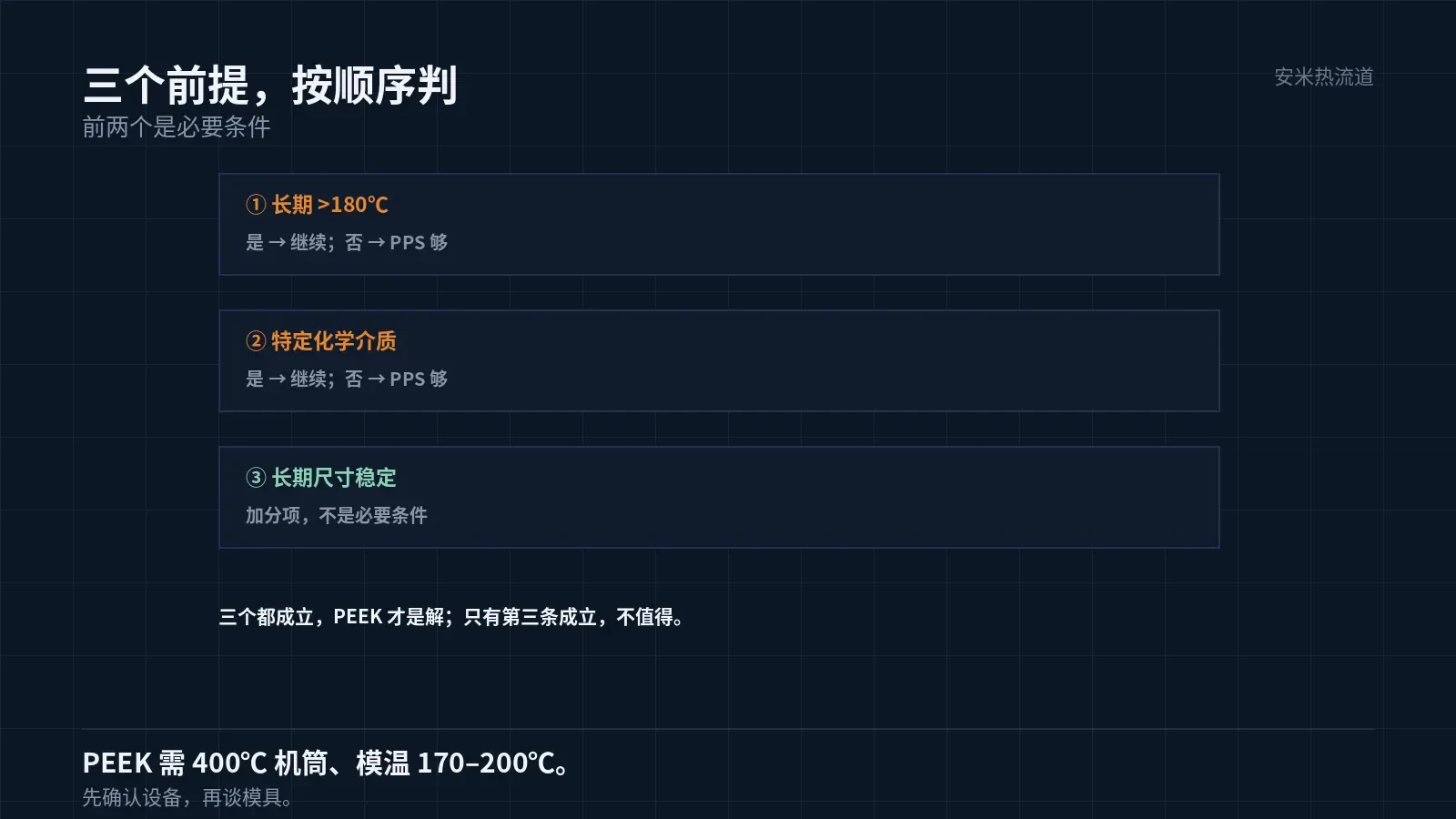
Of the three prerequisites, the first two are required, while the third is optional. PEEK is the solution only if all three conditions are met; it is not worthwhile if only the third applies.
Costs: Equipment, molding cycle, yield rate
PEEK requires high processing temperatures: nozzle at 395°C, barrel at 375/380–385/390°C, mold temperature at 170–200°C, and drying at 120–150°C for 3–5 hours. The barrel heating capacity must reach 400°C.
Many existing machines cannot heat barrels to 400°C, which is the first hurdle. If this requirement isn't met, the solution is invalid and mold discussions become irrelevant.
A mold temperature of 170–200°C increases cycle time. For line-to-board parts (larger than board-to-board), the impact is more significant. Recalculate production capacity based on the new cycle; existing quotes cannot be reused.
Yield rates must also be re-evaluated for the new material. PEEK has a narrow processing window and requires high mold temperatures. For line-to-board parts with varying wall thicknesses, initial trials will require more iterations than those for PPS.
Gate and hot runner
PEEK, SD, VG, and PVG series are suitable; TP Series is not. Line-to-board applications feature fewer cavities and larger parts, giving VG and PVG an advantage in flow capacity.
The hot runner must be designed for 395°C with adequate heating power margin. Due to PEEK's high melt viscosity, multi-cavity molds experience significant pressure drops; balancing requires new mold flow analysis.
Gate diameter should not be based on PPS experience alone. An undersized gate causes high shear, glass fiber breakage, and brittleness near the gate; an oversized gate leads to visible marks and incomplete part separation. Gate size must be verified using part weight and cavity count.
Purge material during shutdown. PEEK degrades if held at high temperatures for extended periods, causing discoloration and reduced flowability. Purge materials and procedures must be documented in work instructions.
Validation: Calculate costs before prototyping
Group 1 conducts long-term aging: Perform accelerated tests for 500h and 1000h at operating temperature to measure dimensional and mechanical retention rates. Group 2 performs chemical immersion: Test each item on the chemical list to measure weight change and strength.
Group 3 mating cycle life test: High-temperature cycling reveals issues more effectively than room temperature. PEEK's advantages are most evident in this group.
Calculate costs before prototyping: By summing material price, molding cycle time, and yield rate, a PEEK solution typically costs two to three times more than PPS. This price difference must be justified by the component's required lifespan.
If the cost difference cannot be justified, an intermediate option is a dual-material design: PPS for the body and PEEK for latches or heat-exposed areas. The trade-off is an additional mold set and assembly step.
Dual-material solutions are common in automotive applications but may not be cost-effective for small board-to-wire components. Choose this approach based on volume and tolerance requirements.
Another often-overlooked factor is certification. Switching materials for medical or automotive components requires re-certification, and the time cost frequently exceeds the material price difference. Always ask about certification lead times during selection.
Please provide the operating temperature curve, chemical compatibility list, mating cycle count, and maximum barrel temperature of your current equipment. We will first verify these three prerequisites, then review the gate design, and issue a quotation upon confirmation.
MATCHED BY MATERIAL AND DEFECT
This article covers stringing, drooling, clogging, and high-heat resins; refer to SD for gate freeze and break-off.
Register for a selection review and quote
Submit part, mold, and material details. Our engineers will evaluate the gate solution per part and provide a quote.
Upload a 2D layout drawing using the form.
Online selection and quote
Scan to register