
PPS for SMT connectors: Which comes first, warping or brittle fracture?
Material Applications16 min read
On this page
In consumer electronics, PPS is primarily used in components requiring reflow soldering: SMT connectors, camera module bases, speaker brackets, and antenna brackets. These parts are small, thin, and dense, exposing them to thermal shock during each reflow cycle.
PPS offers heat resistance, low moisture absorption, and dimensional stability. However, on small parts, two weaknesses become more pronounced: edge warping and brittle fracture. This article examines these issues step by step through the reflow process.
Reflow Stability
PPS has a high melting point, so the ~260°C reflow peak temperature remains well below it, preventing softening. Its extremely low moisture absorption minimizes blistering risk during reflow—making it easier to process than PA9T or PA46. Drying requirements are less stringent: 140°C for 3 hours or 120°C for 5 hours is sufficient.
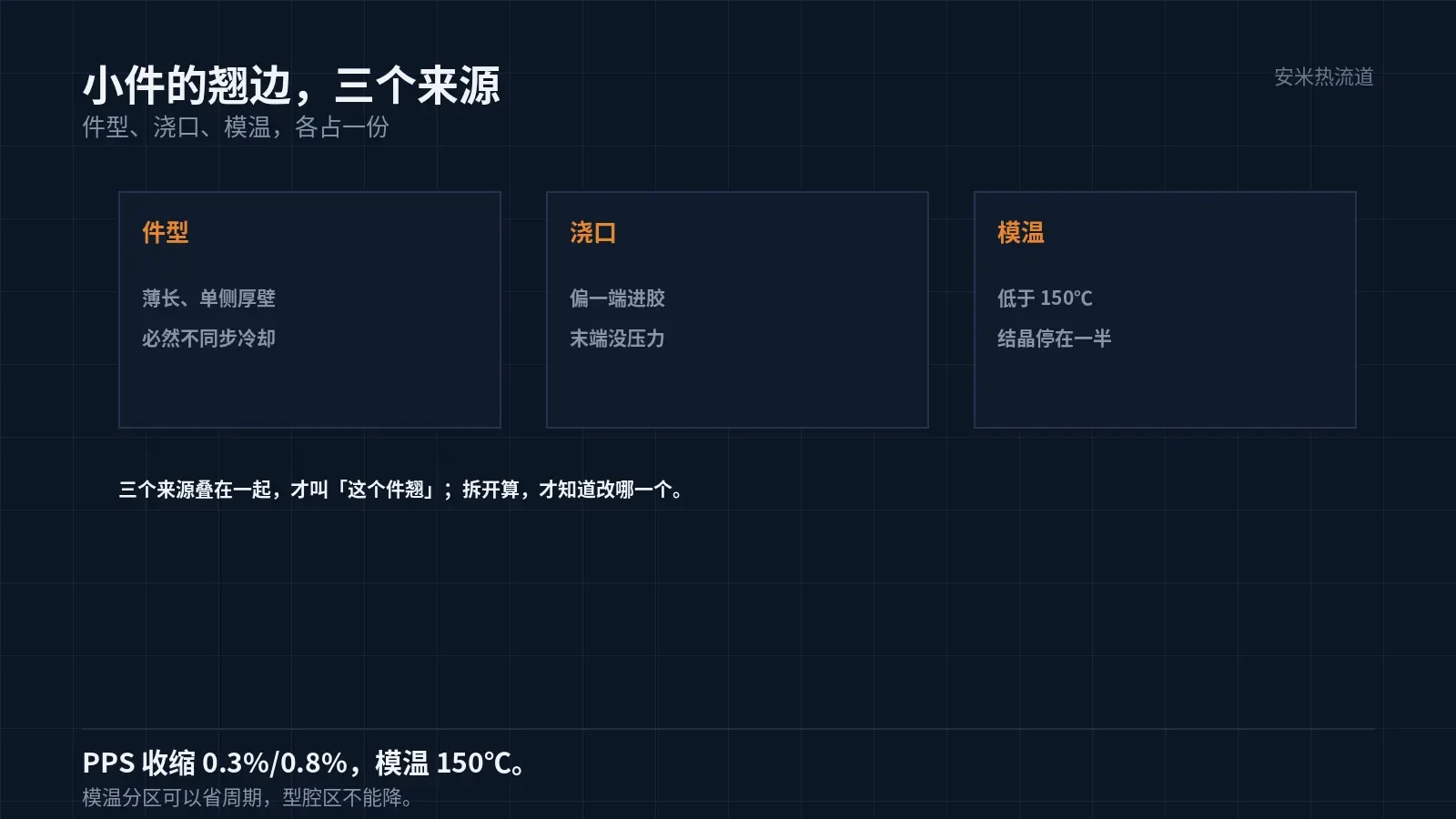
For small parts undergoing reflow, the main challenge is not heat resistance but thermal expansion. Parts expand uniformly at 260°C; as they cool after exiting the oven, surface layers cool first, creating temperature gradients that cause thin-walled parts to warp.
This warping is less dependent on material and more influenced by part geometry and gate location. Thin elongated parts, asymmetric thick sections, or gates offset toward one end all cause asynchronous cooling.
Important: PPS heat resistance alone does not ensure reflow qualification. Successful reflow requires coordinated optimization of part design, gating, and fixtures.
Mold Temperature of 150°C Optimizes Crystallinity
Common PPS mold temperatures are around 150°C, with a maximum of 130°C. This setting ensures complete crystallization rather than easier demolding. Due to PPS's high crystallinity, insufficient mold temperature results in incomplete crystallization, which reduces dimensional stability and toughness.
This effect is particularly pronounced in thin-walled parts: Fast Cooling combined with insufficient mold temperature causes the melt to solidify immediately upon entering the cavity, interrupting crystallization. Parts may appear acceptable initially but can experience dimensional drift after two days.
Raising the mold temperature to 150°C increases cycle time. For small parts, this penalty can be mitigated with zoned mold temperature control: higher in the cavity zone and slightly lower in the runner zone, avoiding heating the entire mold to 150°C.
Shrinkage of 0.3%/0.8% requires compensation via holding pressure to address directional differences. For small parts, short holding times prevent adequate compensation; therefore, gate placement must maintain melt pressure at the end of fill.
Brittle fracture typically occurs during assembly, not reflow.
Glass-filled PPS has low notched impact strength. Terminal holes, snaps, and thin-wall flanges on small components can initiate brittle fractures. Parts typically survive reflow but fail during terminal crimping, snapping, or screw tightening in assembly.
We resolved an issue with a terminal hole wall thickness of 0.4mm in 40% glass-filled PPS, where cracking occurred along the fiber direction during pressing. Increasing the wall thickness to 0.55mm and adding a reinforcing rib fixed the problem without changing the material.
Therefore, solutions for brittle fracture focus on structural changes rather than material substitution. PPS toughness is fixed; improving it requires changing the material, which compromises thermal resistance and dimensional stability.
Three structural guidelines: wall thickness ≥ 0.5mm,, corner radii ≥ R2, and avoid aligning the fiber direction perpendicular to the stress direction. The third requirement must be validated through mold flow analysis, not intuition.
Gate: Use SD Series only; account for gate marks in tolerances
Company records indicate that only the SD Series (open/hot tip) is recommended for PPS. The TP, VG, and PVG series are not recommended, particularly for small parts. Insufficient stroke space for valve gates causes concentrated shear heating; since PPS is brittle, cracking near the gate is likely.
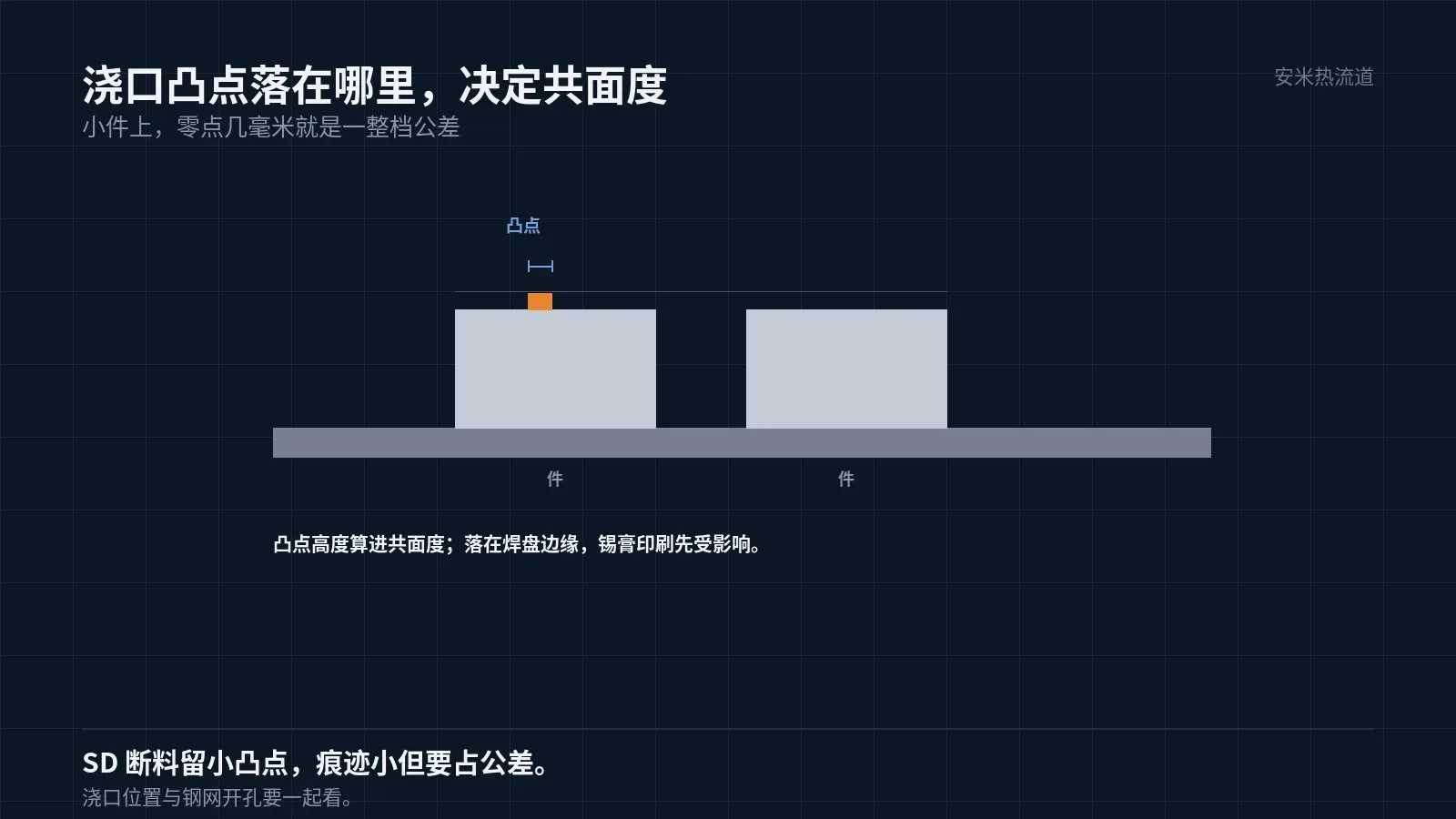
The SD Series material cutoff depends on rapid gate cooling, which leaves a small nub. For SMT components, this nub impacts mounting coplanarity; its height must be accounted for in tolerances and cannot be corrected after mold opening.
Pinpoint gates typically range from φ0.8–1.2 mm, with smaller values used for small parts. If the gate is too small, high shear can break glass fibers, reducing strength near the gate.
Vent depth should be 0.005–0.008 mm. Although small parts have small cavities, short flow lengths, and low venting requirements, do not omit this depth. PPS flows rapidly, causing instantaneous high pressure at the end of fill; poor venting results in burn marks.
Drying and storage: simpler than you think
PPS has low moisture absorption and flexible drying requirements: 140°C for 3 h or 120°C for 5 h. However, do not skip drying. If material sits in a humid workshop for extended periods, surface-adsorbed moisture can vaporize during processing, causing silver streaks on parts.
Store properly: keep dried material from exposure. If it reabsorbs moisture, dry it again. This issue is most common during seasonal changes.
PPS offers a much wider drying window than PA9T. PA9T requires 70–90°C for 4–8 hours with moisture below 0.20%; PPS needs only 3 hours at 140°C. The two processes are not interchangeable.
Three Data Sets Determine Success or Failure
Set 1: Assess coplanarity before and after reflow. Subject the same batch to three reflow cycles and measure the deviation. Set 2: Evaluate terminal insertion retention force and inspect hole wall condition. Set 3: Conduct drop and vibration tests post-assembly.
The second set is most easily overlooked. Many parts pass reflow and dimensional checks but crack during terminal insertion, leading to full batch rejection. This test must be performed during prototyping, not delayed until mass production.
Please send the part drawing, terminal specifications, and reflow profile. We'll verify gate and bump positions based on the part type and provide a quote once the solution is confirmed.
MATCHED BY MATERIAL AND DEFECT
The article covers stringing, drooling, clogging or high-heat resins; check SD for gate freeze and break-off.
Register for a selection review and quotation
Send the part, mold and material details. Our engineers assess the gate solution by part, then provide a quotation.
A 2D layout drawing can be uploaded with the form.
Online selection and quote
Scan to register