
Why Use PA9T Instead of PA66 for Heavy-Duty Connector Housings?
Material Applications15 min read
On this page
Heavy-duty connectors mounted on equipment face high ambient temperatures, frequent mating/unmating cycles, and overloads. For housing material selection, use PA9T instead of PA66 when PA66 is insufficient.
The key factors for replacement are Tg and water absorption.
Heavy-Duty Meaning
Heavy-duty connectors don't mean "heavy weight"—they mean high current rating, long mating cycle life, and durability in harsh environments. Commonly used in industrial equipment, rail transit, and machine tools.
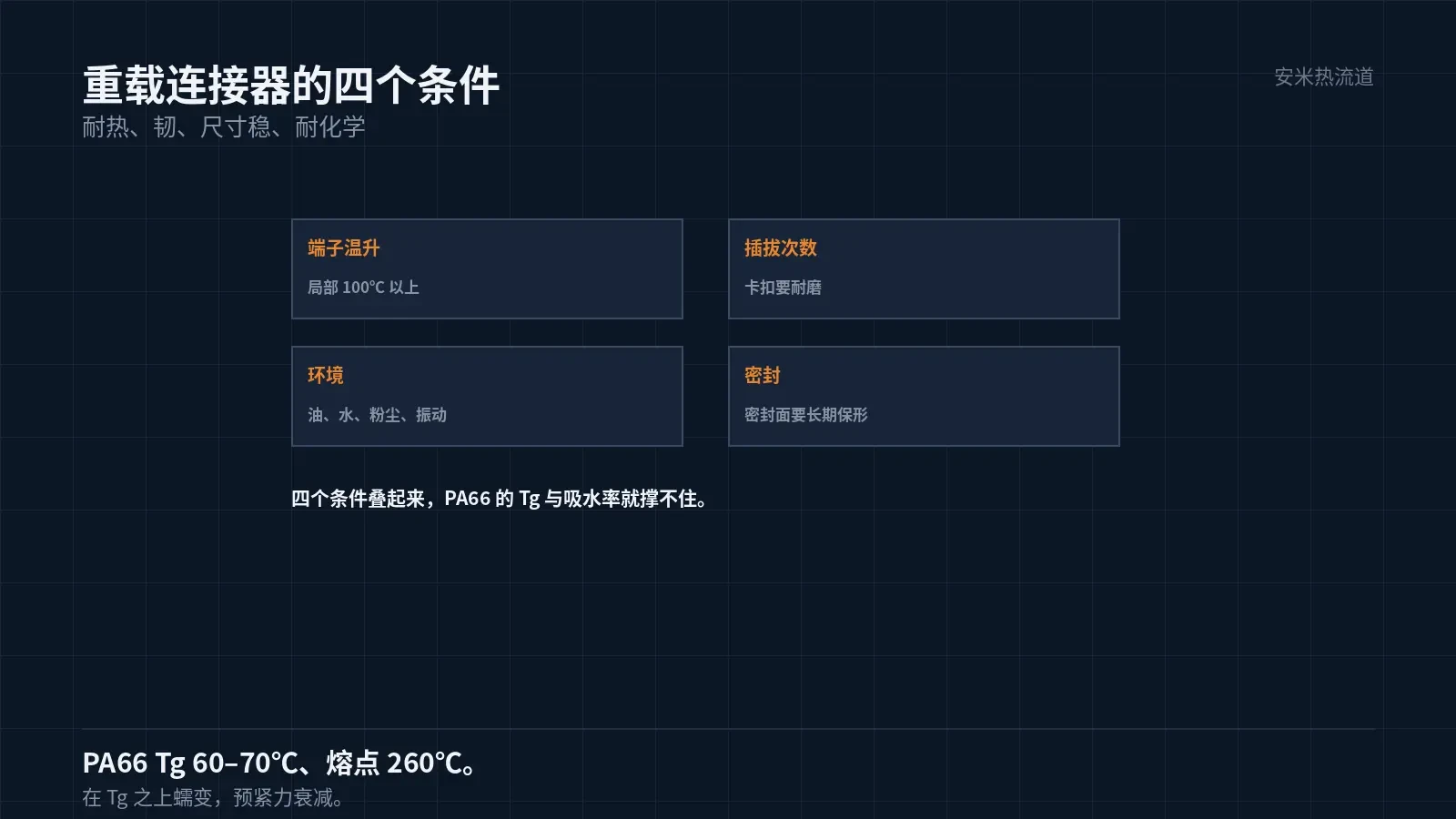
High current generates heat. Temperature rise at the terminals transfers to the housing, where local temperatures can exceed 100°C.
Frequent mating cycles require wear resistance in housing latches and guide surfaces. If the material is too soft, it loosens after a few cycles; if too brittle, it cracks after a few cycles.
Harsh environments include oil, water, dust, and vibration. The housing must be sealed, and sealing surfaces must maintain their shape over time.
Combining these four conditions, the housing material requirements are: heat resistance, toughness, dimensional stability, and chemical resistance.
When does PA66 fail?
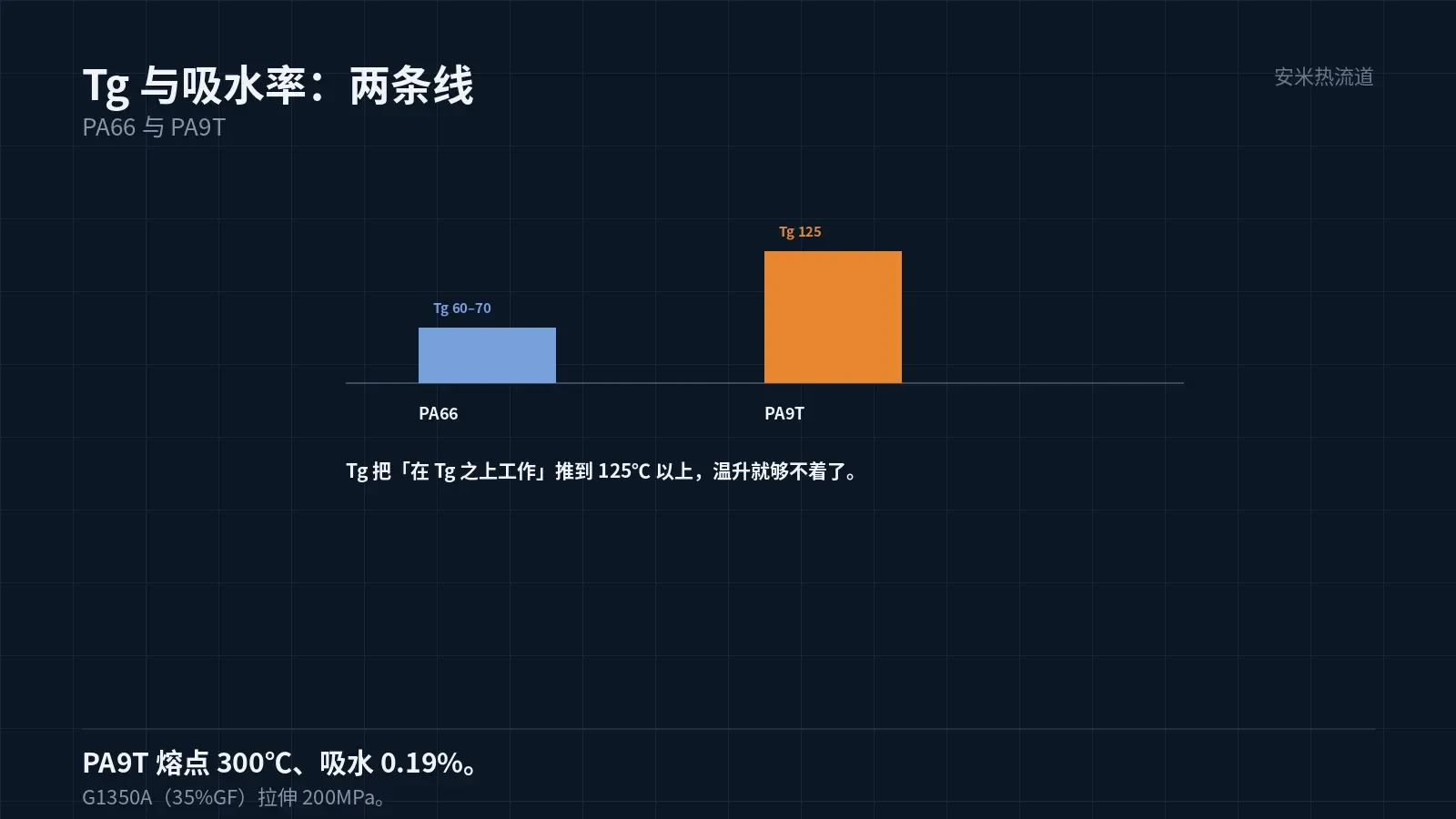
The Tg of PA66 is 60–70°C. Terminal heat rise raises the housing above 100°C, causing the material to operate above its Tg.
Above Tg, increased molecular chain mobility reduces rigidity and accelerates creep. Snap-fit pre-tension decays over time.
Moisture absorption is also a concern. PA66 expands when it absorbs moisture, deforming sealing surfaces and reducing the protection rating.
Therefore, while PA66 can be used in heavy-duty connectors, its lifespan and reliability are limited. This is why we switched to PA9T.
Note that this is a recommendation to "switch," not a mandatory requirement. For light-load, ambient-temperature applications, PA66 remains suitable and cost-effective.
Terminal material must also be considered. Copper terminals generate more heat than aluminum ones, increasing local housing temperatures; adequate design margin is required when selecting materials.
Terminal contact resistance also increases over time. Higher contact resistance causes more heating, further raising the housing temperature.
Therefore, temperature rise tests for heavy-duty connectors must include "full load + extended duration." Passing short-term tests does not ensure long-term compliance.
An intermediate option exists: PA66 reinforced with glass fiber and heat stabilizers delivers performance between PA66 and PA9T at a lower cost than PA9T.
This solution is ideal for applications with low temperature rise but long service life requirements. Do not immediately choose the most expensive material grade.
Three Key PA9T Parameters
Melting point: 300°C (ISO 11357-3), Tg: 125°C, water absorption: 0.19% (ISO 62). All three values exceed those of PA66.
Kuraray Genestar G1350A is a 35% glass-filled grade: tensile strength 200MPa,, flexural strength 285MPa,, and flexural modulus 10GPa..
The Tg of 125°C is critical. It shifts the "operation above Tg" concern to temperatures exceeding 125°C, beyond the reach of heavy-load temperature rises.
The 0.19% water absorption rate determines sealing surface performance. Low absorption ensures dimensional stability and maintains long-term protection ratings.
PA9T is chosen not for being 'more premium,' but because these two parameters precisely match heavy-duty operating conditions.
Tracking Resistance and Flame Retardancy
For high-current connectors, creepage distance is mandatory. The housing material must exhibit high tracking resistance; specific grades are defined by customer standards.
PA9T tracking resistance varies by grade; reinforced grades generally perform better. Refer to the datasheet for each grade during selection.
Flame retardancy follows similar rules. Connectors typically require UL94 V-0; specifics are verified against customer safety standards without assigning codes or values.
Do not assume all nylons are flame-retardant. Non-flame-retardant grades do not meet requirements, and flame-retardant grades have reduced mechanical properties.
Therefore, housing material selection must meet mechanical, electrical, and flame-retardant requirements simultaneously; failure in any area is unacceptable.
Molding Key Points
Drying: 70–90°C for 4–8 hours; moisture content ≤0.20%. Insufficient drying introduces moisture into the melt, degrading insulation performance.
Barrel temperatures: 280–320/285–330/290–340°C; nozzle temperature: 300–350°C. These are OEM-specified ranges; mid-range settings offer greater stability.
OEM did not specify mold temperature. For housings, use higher mold temperatures to ensure full crystallization, dimensional stability, and surface finish.
Based on AM Industry gate diameters, only the SD Series is recommended. The TP and VG Series are not recommended for PA9T due to material-gate compatibility issues.
Ensure proper venting. The housing features numerous deep cavities; trapped air can cause burn marks, often on sealing surfaces.
Validation
Validation: withstand voltage, insulation resistance, proof tracking, mating force, IP rating, thermal cycling, and vibration.
IP rating validation requires immersion or spray testing for IP67 and IP68, as specified by the customer.
Sealing failure after thermal cycling is the most common issue. Repeated cycles cause deformation of the sealing surface, allowing water ingress.
Mating force degradation must also be tested. Preload loss in latches can cause locking failure after dozens of insertions and removals.
Please provide rated current, temperature rise, IP rating, mating cycle count, and safety standard requirements. We will verify material selection and gate design before providing a quote.
MATCHED BY MATERIAL AND DEFECT
This article covers stringing, drooling, clogging, and high-heat resins; refer to SD for gate freeze and break-off.
Register for a selection review and quote
Submit part, mold, and material details. Our engineers will evaluate the gate solution per part and provide a quote.
Upload a 2D layout drawing using the form.
Online selection and quote
Scan to register