
Moisture Impact on PA9T Locking Clips in Wire-to-Board Connectors
Material Applications16 min read
On this page
The latch on a wire-to-board connector is the thinnest and most stress-cycled section of the part. Each insertion and extraction cycle bends the latch once; customer-side operations often total thousands of cycles.
PA9T offers better toughness than PPS and resists bending, making it theoretically ideal for latches. However, field feedback often reports "good performance in the first two batches, but loose in the third." This article explains this time lag.
Latch Function Depends on Elasticity
The latch features a thin plate with a front protrusion. During insertion, the protrusion deflects and snaps back to lock. The mechanism relies on the material's elastic recovery.
Elastic recovery depends on two factors: the material's modulus and the part's actual dimensions. The modulus is determined by the material, while dimensions are set by the mold and shrinkage.
PA9T reinforced with 35% glass fiber offers sufficient modulus and excellent elastic recovery, resulting in outstanding initial insertion-extraction force performance. The primary concern is dimensional stability, which varies with moisture absorption.
PA9T has a water absorption rate of 0.19% (ISO 62). Although this value is low, the latch plate thickness is only 0.4–0.6 mm, leading to rapid moisture uptake and immediate dimensional changes.
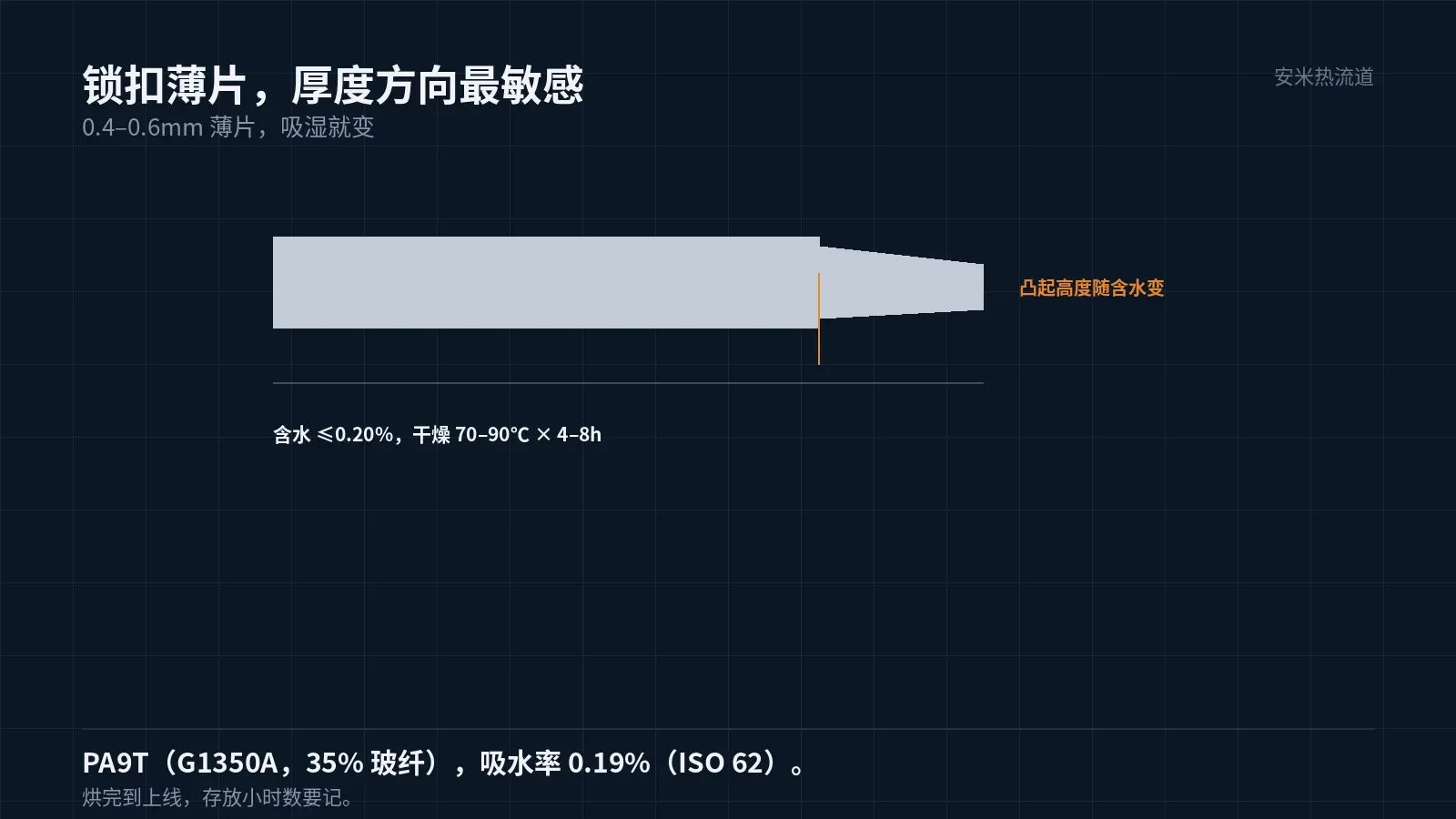
Two Paths After Moisture Absorption
Moisture absorption causes slight part expansion, increasing latch protrusion height and resulting in tighter insertion. It also reduces the gap between the latch root and the body, compressing rebound space.
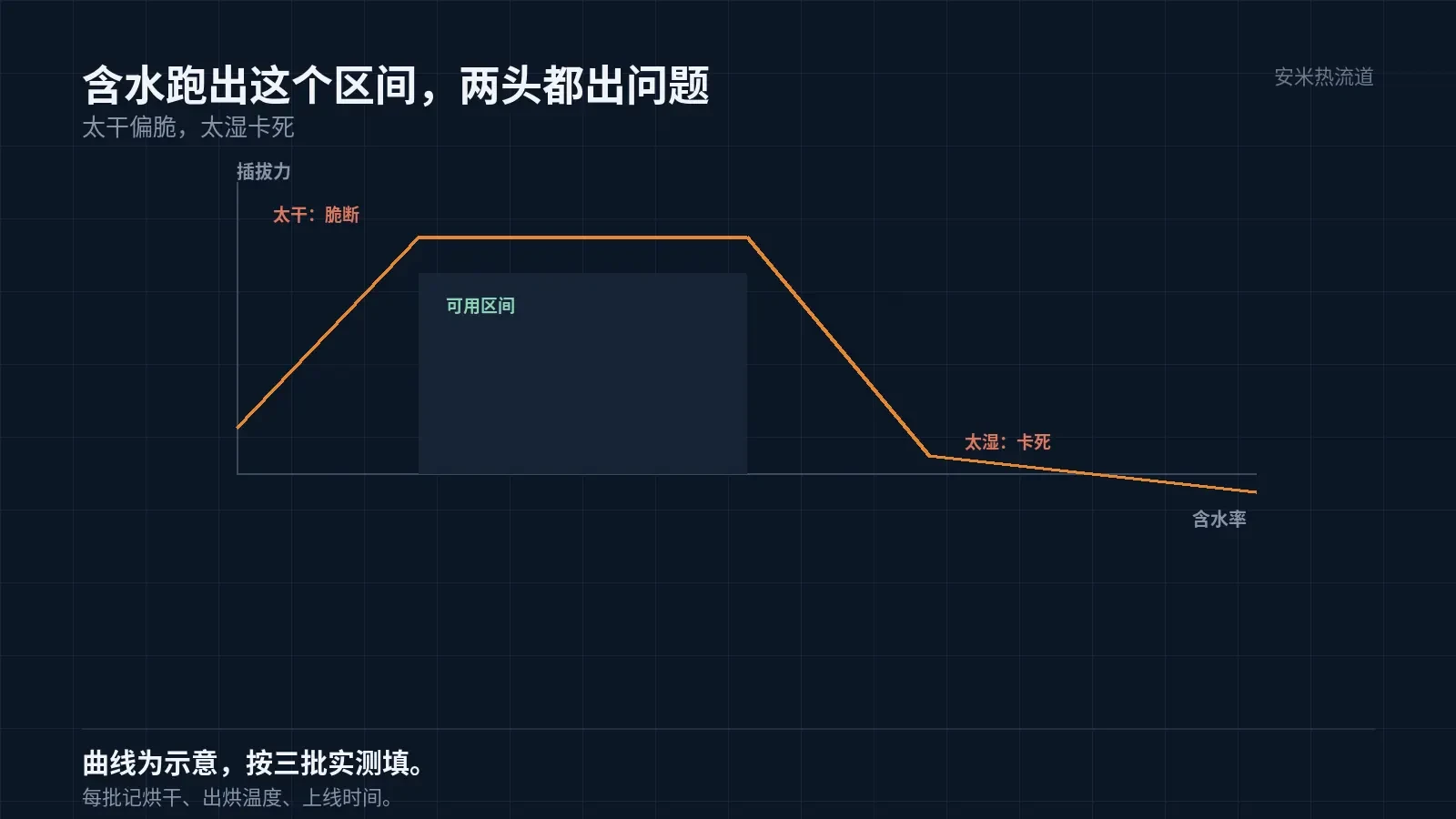
These two effects make both insertion and removal difficult. In severe cases, the latch jams, forcing customers to break it open when prying.
Conversely, over-drying is problematic. If moisture content is too low, parts become brittle and latches are prone to cracking at the root during repeated flexing.
Therefore, moisture content in PA9T latch parts must be tightly controlled: dry at 70–90°C for 4–8 hours with moisture ≤0.20%, and manage the time between drying and assembly.
In high-humidity seasons, materials reabsorb moisture after just one day on the rack. Without records, root causes remain unidentified, leading to costly batch replacements.
A simple yet effective recording method: log drying time, oven exit temperature, and line start time per material batch; log storage hours per part batch. These three data points enable quick issue tracing.
Some customers use vacuum packaging with desiccants for shipping. This low-cost measure extends the shelf life from one day to one week, making it ideal for inter-factory deliveries.
Three Mold Contributions
First, the latch root fillet radius. PA9T notched impact strength is 12kJ/m²—substantial, yet stress concentration erodes this advantage. A root radius of R0.3 or larger shifts fracture from the root to the mid-section.
The second is protrusion height tolerance. Protrusions mainly determine insertion and extraction forces; wide tolerances lead to significant force variation, while tight tolerances complicate mold fabrication. Typically specified as ±0.03mm,, stabilized by mold temperature and holding pressure.
The third factor is the clearance between the latch and the body. This clearance is determined by steel in the mold, making changes expensive. Use mold flow analysis to confirm shrinkage direction before tooling to ensure proper clearance.
Among the three factors, the third is most error-prone. If clearance is too small, moisture absorption can cause jamming; if too large, insertion/extraction force and retention force become insufficient.
Why Not Just Use PPS?
PPS offers higher modulus, lower water absorption, and superior dimensional stability. However, its low notched impact strength makes latches susceptible to cracking under repeated flexing—a known limitation of PPS in board-to-board connectors.
Therefore, for wire-to-board latches, material selection prioritizes toughness over dimensional stability, making PA9T more suitable than PPS. For board-to-board applications, dimensional stability takes precedence, making PPS the better choice.
This difference is due to part geometry and loading conditions, not material quality. Selection should be based on specific parts, not general material rankings.
If the customer requires very high mating cycles (tens of thousands), consider PA46 for its high flowability and toughness. Only choose PEEK if higher temperature resistance is needed.
Gate and Drying
For PA9T, only the SD Series is recommended based on company records. Fewer cavities from wire to board produce smaller SD marks, making them ideal for dense packing near locks.
Do not align the gate directly with the lock. Melt impingement on thin walls causes glass fiber orientation-induced brittleness, leading to cracks opposite the gate during insertion or extraction. Offset the gate by at least 5 mm to allow melt flow around it.
Barrel temperatures: 280–320/285–330/290–340°C; nozzle temperature: 300–350°C, as specified in grade datasheets. No OEM mold temperature recommendation is provided; determine based on first-article and warpage data.
Skipping the drying step is a common oversight in this process. While issues may not appear until after the third batch, loosening typically begins by then, complicating root cause analysis.
Validation: Three-Batch Comparison
Standard practice tests only the first article. For PA9T locks, test three batches: initial, after one week of storage, and after one month of storage. Use the same assembly fixture and testing machine to measure insertion/extraction force and retention force.
If data trends downward across the three batches, moisture management is inadequate—not a mold issue. The solution applies only if data remains stable.
Monitor protrusion height across batches. Increasing height tightens insertion and extraction; decreasing height reduces retention force. Both failure modes stem from moisture content.
Submit part drawings, locked dimensions, insertion/extraction cycle requirements, and workshop humidity records. We will validate drying and gate solutions against moisture ranges and provide pricing upon confirmation.
MATCHED BY MATERIAL AND DEFECT
This article covers stringing, drooling, clogging, and high-heat resins; refer to SD for gate freeze and break-off.
Register for a selection review and quote
Submit part, mold, and material details. Our engineers will evaluate the gate solution per part and provide a quote.
Upload a 2D layout drawing using the form.
Online selection and quote
Scan to register