
Black Spots in Wire-to-Board PA46 Parts Despite Adequate Melt Temperature
Material Applications15 min read
On this page
The wire-to-board body is thick with a short flow path, making PA46's high flowability ideal: at melt temperatures of 305–320°C, both thin and thick walls fill completely under low pressure.
However, after mass production started, sporadic black spots appeared on parts at inconsistent locations. Melt temperature was within limits and drying was performed, yet the cause remained unknown. This article explains the origin of these black spots: it's not temperature—it's time.
PA46 degradation accumulates over time.
PA46 melts at 295°C and processes between 305–320°C—a difference of only about 10°C. This narrow window means the melt is highly sensitive to residence time at high temperatures.
At the same temperature, a 3-minute residence is acceptable, but degradation begins after 10 minutes. Degradation initiates near the gate and in runner dead zones, with color shifting from light yellow to dark brown.
Black spots do not appear suddenly; they accumulate over time. Symptoms may include "normal at startup but appearing after two hours" or "present in the first batch after a restart following a shutdown."
These two temporal patterns serve as diagnostic criteria: if black spots correlate with machine uptime, the issue is residence time; if they correlate with material batches, the issue lies in the resin.
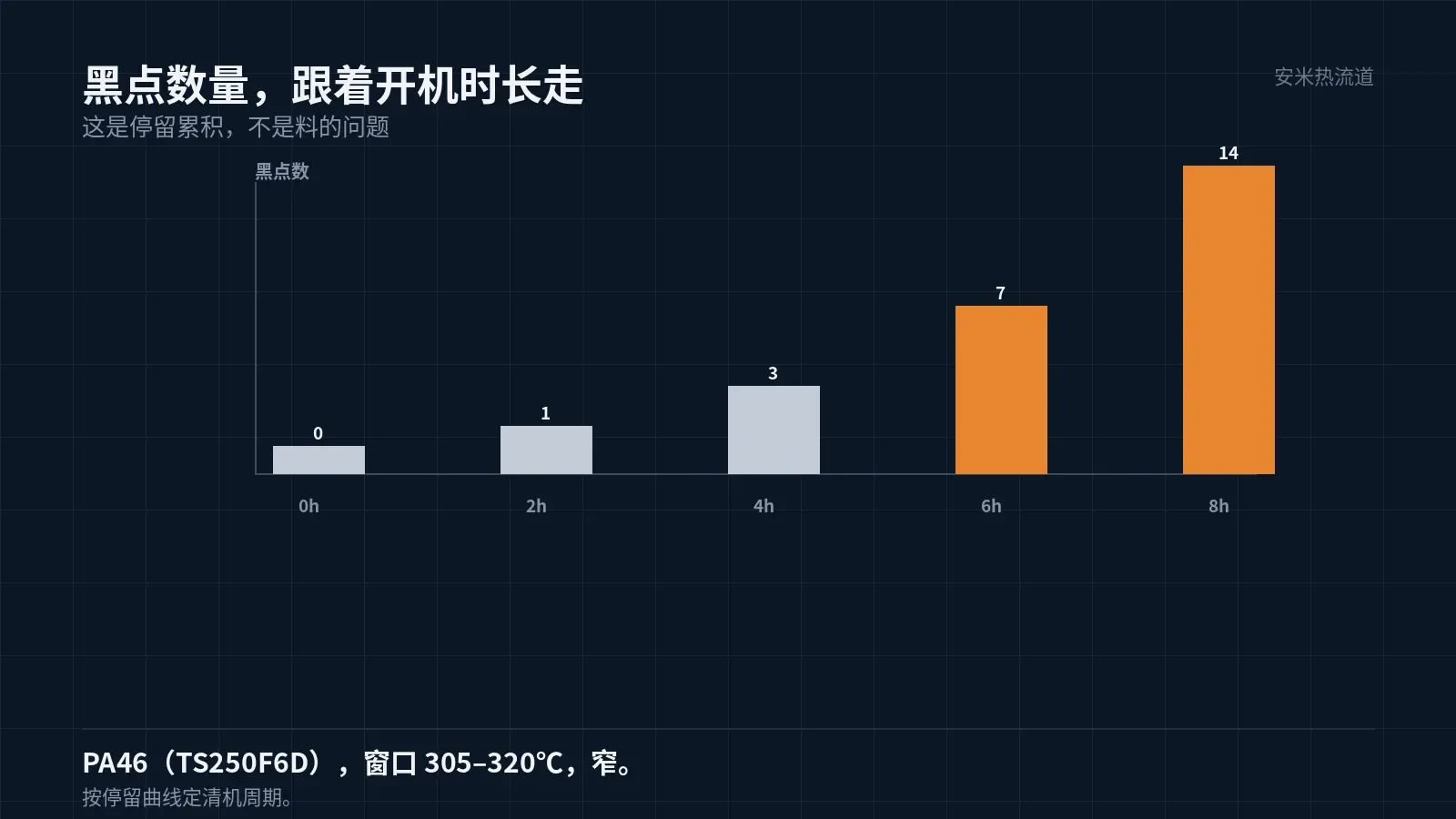
Runner volume is the primary consideration.
Larger hot runner flow volumes increase melt residence time. For low-shot-weight wire-to-board parts, using a large-runner hot runner system can multiply residence time several-fold.
When selecting a hot runner, match the runner diameter to the shot weight and number of cavities; avoid using "universal sizes." A φ8 runner for a 5 g shot weight will inevitably lead to excessive residence time.
Dead zones must also be cleared. Stagnation areas at runner bends and seams between nozzles and manifolds are prone to material buildup. Residual material in these areas cannot be fully purged during each material change.
Material changes and machine cleaning require defined procedures: specify the downtime duration that triggers cleaning, the purge material to use, and the required cleanliness level. Without these procedures, black specks will appear periodically.
Melt Temperature: Use the Lower Limit, Not the Upper
Within the 305–320°C range, use the lower limit if filling is complete. Every 5°C increase in melt temperature raises the degradation rate.
Many operators set the melt temperature to 320°C for safety, achieving fill but introducing black specks. This "safety" measure is counterproductive.
Start at the lower limit. If filling fails, incrementally raise the temperature and test after each step. Once the window's lower bound is established, allow margin for residence time.
Set barrel and nozzle temperatures to 305–320°C per OEM specifications (Grade A). Do not mark out-of-range values as "adjustable," as this compromises yield for parameter flexibility.
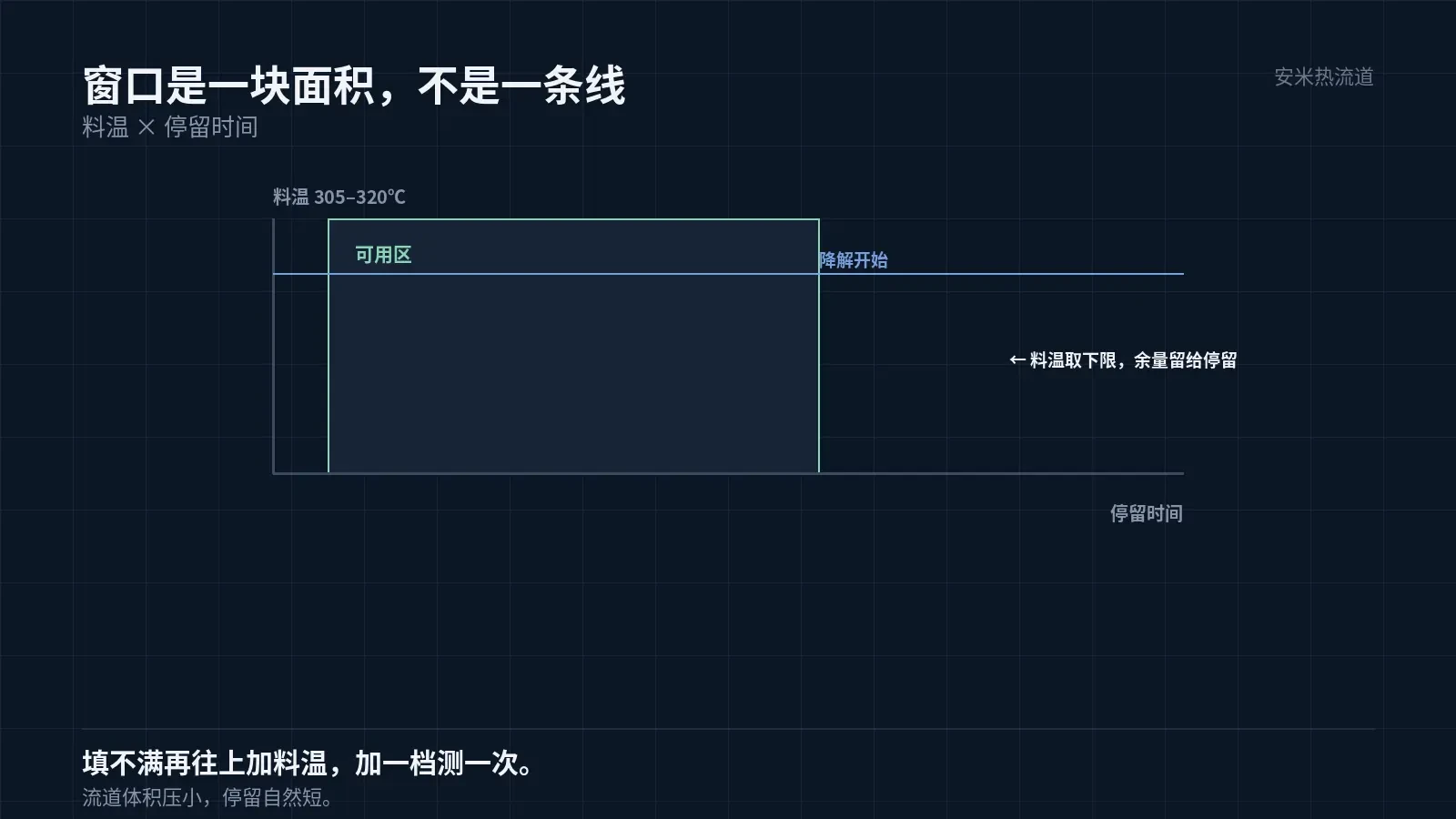
Drying: Don't Skip This Step
PA46 has high moisture absorption. Incomplete drying causes moisture to vaporize above 305°C, resulting in silver streaks on parts. Unlike black spots, silver streaks appear as fine lines along the flow direction, not as points.
These two are easily confused. Identification: Silver streaks appear filamentous under light and align with the flow direction; black spots are isolated points with random positions.
Follow grade-specific drying curves. Do not use PA9T parameters of 70–90°C × 4–8h. PA46 requires higher drying temperatures; confirm specifics with the manufacturer's data.
Dried material must be stored in a heated hopper and kept away from air. Exposure to air for 30 minutes causes surface re-moistening, resulting in silver streaks in the first batch of parts.
Another Issue in Thick-Wall Areas
Wire-to-board connectors have wall thicknesses of 1.5–2 mm. In such thick sections, PA46 cools slowly at the core, leading to significant shrinkage and a high risk of sink marks.
PA46 shrinkage is 0.4%/1.1%. Actual shrinkage in thick-wall areas often exceeds this value because holding pressure does not reach the center.
The material replenishment solution extends holding time, which also increases melt residence time at high temperatures. These factors conflict, representing the core contradiction in PA46 thick-wall parts.
The solution is to decouple the factors: enlarge the gate to delay freezing and prolong pressure transmission, while reducing runner volume to offset the increased residence time.
Another approach is to adjust the mold temperature. A higher mold temperature delays melt freezing near the gate, extending the packing window without increasing residence time. This method is especially effective for PA46, but since OEMs do not provide recommended values, trial runs are required.
Ejecting thick-walled parts also requires care. Ejecting before the center fully solidifies can cause internal voids that are invisible externally but appear when sectioned. Ejection timing must be based on the thickest section.
Purge cycles should be based on residence time curves, not shifts. Some plants purge daily yet observe black specks within two hours; others purging every six hours achieve stability.
Validation
First group: Conduct residence time tests at the same melt temperature. Mold one shot each after 3, 6, and 10 minutes, then record black speck counts. This curve determines the purge cycle.
Second group: Perform a melt temperature ladder test at 305, 310, 315, and 320°C. Record fill status and black specks. Third group: Compare standard drying versus no-drying to check for silver streaks.
After completing these three groups, 'black specks' may be caused by residence time, temperature, or moisture. Without this distinction, any adjustment is a guess.
Submit the part weight, number of cavities, hot runner cross-section dimensions, and material change records. We will verify the hot runner selection based on residence time and provide a quote upon confirmation.
MATCHED BY MATERIAL AND DEFECT
This article covers stringing, drooling, clogging, and high-heat resins; refer to SD for gate freeze and break-off.
Register for a selection review and quote
Submit part, mold, and material details. Our engineers will evaluate the gate solution per part and provide a quote.
Upload a 2D layout drawing using the form.
Online selection and quote
Scan to register