
Why Quotations for Similar Hot Runners Can Differ by Double
Material Applications16 min read
On this page
Common customer question: Why does one hot runner system cost 30,000 while another costs 15,000? The difference isn't in profit margins—it's in what we actually deliver.
Breaking down the cost structure reveals the source of the price gap.
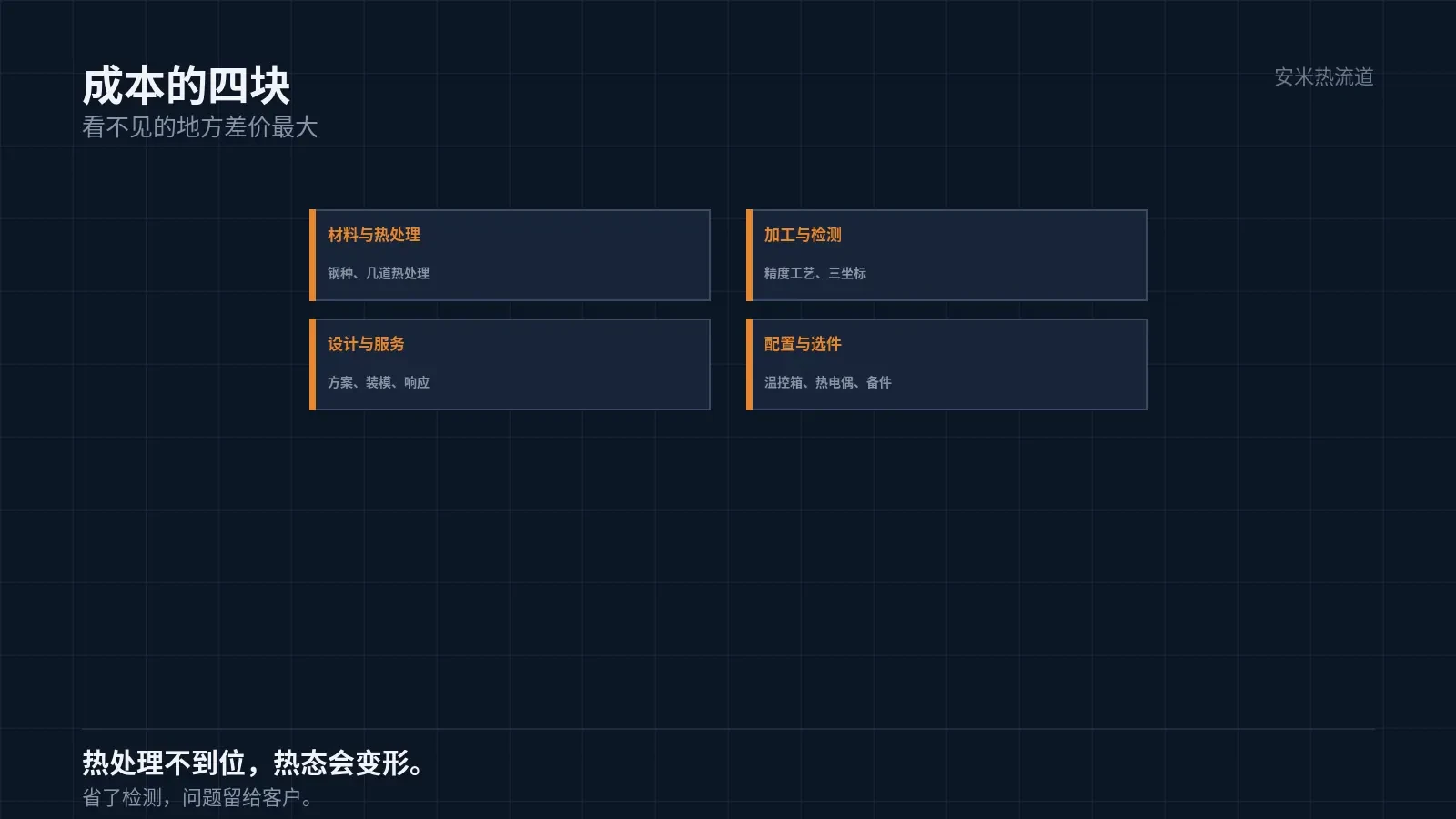
Materials and Heat Treatment
The first cost component is steel. Different grades are used for nozzles, manifolds, and gate inserts, resulting in significant price variations.
The second component is heat treatment. Whether it's performed, the number of cycles, and whether vacuum or conventional processing is used can significantly multiply costs.
Inadequate heat treatment causes deformation at operating temperatures and reduces service life. This factor is often omitted from quotations.
The third component is surface treatment. Coatings, polishing, and nitriding all increase costs.
Two nozzles with identical dimensions can differ in price by up to 2x. The difference comes down to hidden factors.
Specific comparison: One nozzle is made of standard steel with only turning; the other uses hot-work tool steel, vacuum heat treatment, and mirror-polished tip.
Both nozzles perform identically at first. After three months, however, one begins to deform with larger gate marks, while the other remains stable.
Therefore, "cheap" does not mean a low purchase price; it shifts costs to the usage phase. This must be clarified when comparing quotes.
If the customer accepts a three-month replacement cycle, the lower-cost option is viable. The key is knowing exactly what you're buying.
Quotes must specify the steel grade, number of heat treatment steps, and inspection items performed. Clear specifications enable accurate price comparisons.
Vague quotes force customers to compare only total prices. This often leads to eliminating the more expensive supplier while the cheaper one causes problems.
This also benefits suppliers: clearly stating differences helps customers understand "why it costs more," rather than feeling ripped off.
Machining and Inspection
Machining precision drives cost. Dimensional accuracy of nozzle tip bores, polishing of manifold flow channels, and flatness of mating surfaces all add expense.
Wire EDM, mirror-finish EDM, and five-axis machining are expensive but essential for ensuring flow channel smoothness and eliminating dead zones.
Inspection also incurs costs. CMM, projectors, and temperature uniformity tests require both equipment and personnel.
Products without inspection can still be shipped, but any post-shipment issues are the customer's responsibility.
Therefore, one reason for the low price is "skipped inspection." This is clear during acceptance: reports are provided only if requested.
Design and Service
Design is an invisible cost. Runner balancing, gate selection, and heat compensation are not reflected in quotes.
Well-designed solutions run smoothly; poorly designed ones require constant adjustment.
Service includes mold installation guidance, debugging support, and issue resolution. Additional fees apply.
Some quotes include service; others do not. Quotes without service are cheaper, but customers must resolve issues themselves.
Therefore, list what's included in price comparisons. Comparing only total prices doesn't reveal the true cost.
Settings and Options
The temperature controller is a major separate component. Prices vary significantly based on channel count, zones, and precision.
Thermocouple type and quantity, connector brand, and cable length are all configurable options.
Spare parts quantity affects the total price. Adding more nozzle tips increases cost but reduces production stoppage risk.
These items are typically scattered throughout the quote; the total cost is only known after summing them up.
Align configurations to the same level before comparing prices. Different configurations make prices incomparable.
Lifespan and Total Cost
The quote reflects only the "purchase price." The true cost is the "cost of ownership."
Usage costs include setup time, downtime losses, replacement part costs, and scrap rate.
Short-life hot runners require frequent component replacements and cause more downtime. These costs often exceed the purchase price difference.
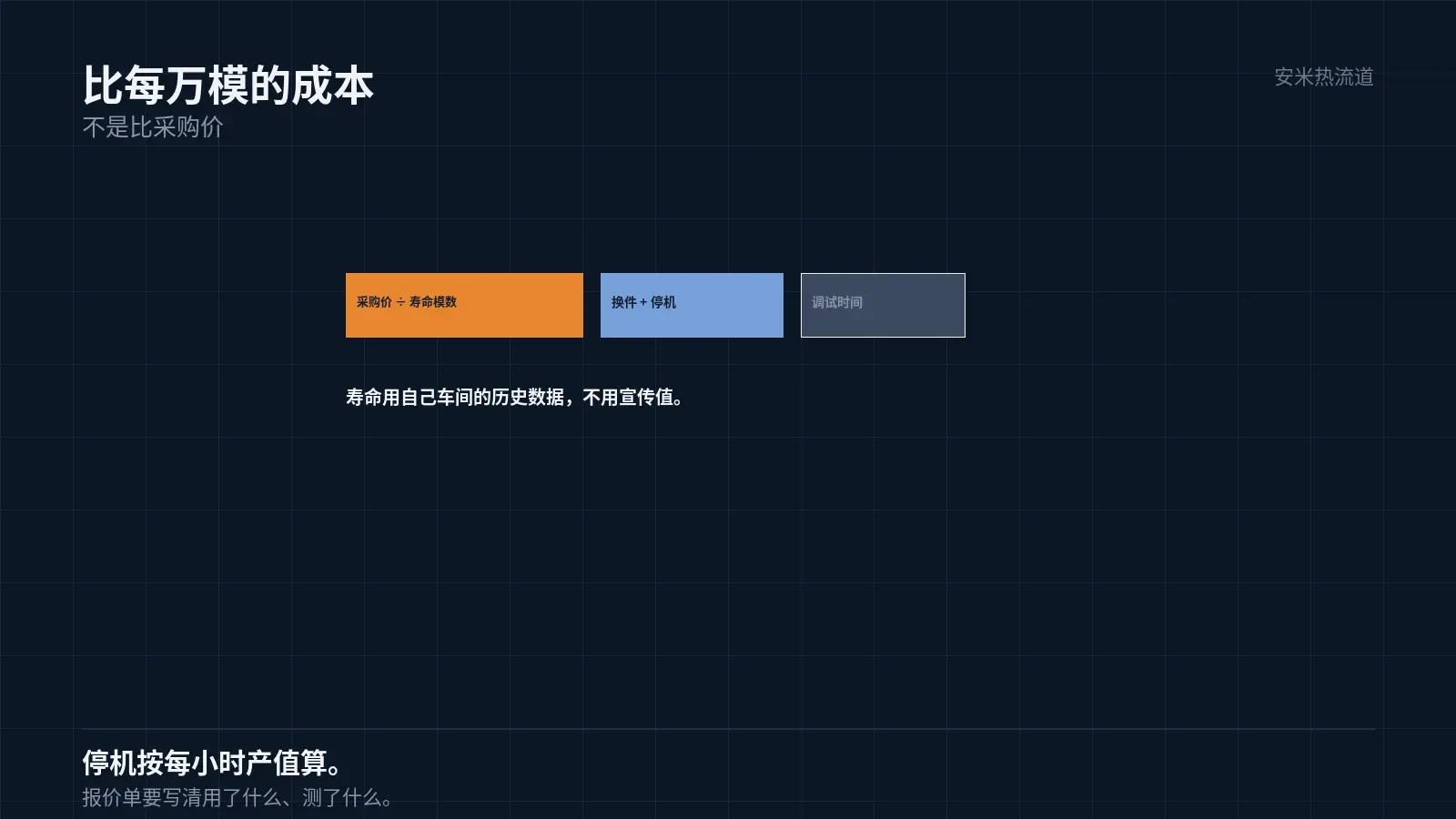
Therefore, compare prices based on "cost per 10,000 shots," not just the purchase price.
This is especially critical for multi-cavity molds, continuous production, and high-temperature materials. A single line stoppage can cost more than the price difference between hot runner systems.
Method to calculate "cost per 10,000 shots": Divide the purchase price by the expected lifespan in shots, then add replacement parts and downtime costs per 10,000 shots.
Do not use manufacturer-advertised values for expected lifespan; rely on your workshop's historical data. Comparability requires similar parts and materials.
Calculate downtime losses using "output value per hour." For multi-cavity molds, continuous production, and tight deadlines, this metric is critical.
Once these three figures are calculated, many "low-cost solutions" no longer qualify as cheap. This approach is simple but relies on actual workshop data, not intuition.
Another often-overlooked cost is commissioning time. A proper design enables commissioning in one or two days; a flawed design can take up to two weeks without achieving stability.
Commissioning costs should be calculated as "machine hourly rate + labor." Two weeks of commissioning can often exceed the purchase price difference.
To shorten commissioning time, clearly specify part requirements, mold condition, and machine conditions during the quotation stage to ensure a right-first-time solution.
Conversely, providing quotes with incomplete information results in overly optimistic estimates, forcing the customer to absorb all subsequent debugging time. Both parties must understand this clearly.
Submit your part requirements, number of cavities, material, and configuration list. We'll review the solution and provide a quote upon confirmation.
MATCHED BY MATERIAL AND DEFECT
This article covers surface gating or small precision parts; check TP for gate position and whether a dot mark is acceptable.
Register for a selection review and quote
Submit part, mold, and material details. Our engineers will evaluate the gate solution per part and provide a quote.
Upload a 2D layout drawing using the form.
Online selection and quote
Scan to register