
Who Absorbs Thermal Expansion Differences in Hot Runners?
Material Applications17 min read
On this page
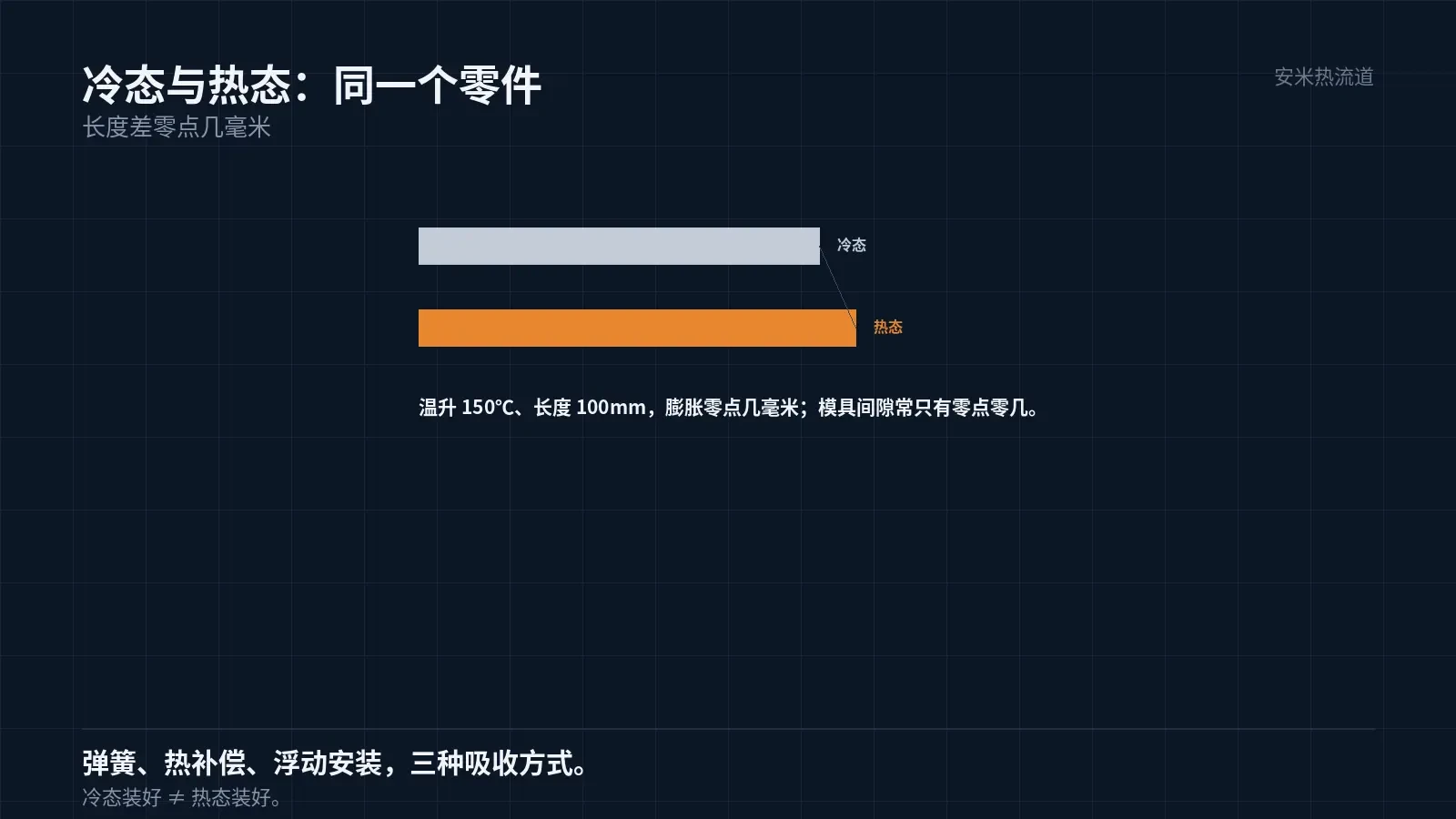
Hot runners are assembled cold and operate hot. A temperature difference exceeding 100°C causes a length change of fractions of a millimeter.
Improper management of these sub-millimeter tolerances can lead to nozzle tip damage, oozing, or part misalignment.
Expansion Magnitude
The linear coefficient of thermal expansion for metals ranges from several to tens of micrometers per meter per degree Celsius. With a 150°C temperature difference and a 100 mm length, the expansion is in the range of fractions of a millimeter.
Fractions of a millimeter matter in mold design. Mold fit clearances are often just hundredths of a millimeter.
Therefore, proper cold and hot assembly must be ensured through structural design, not assembler intuition.
Expansion direction matters: nozzles expand axially, while manifolds expand planarly. These effects superimpose differently depending on the direction.
Different directions require different compensation methods. Axial expansion is compensated by springs or pre-reserved gaps, while planar expansion is managed through thermal compensation structures or floating mounts.
A subtle effect of expansion is that nozzles centered when cold may shift off-center when hot, causing gate misalignment and part defects.
Hot-state alignment must be verified separately. A part that appears centered when cold may shift by 0.5 mm when hot, which is critical for precision components.
Misalignment causes uneven wall thickness (thick on one side, thin on the other) or an off-center gate. This issue does not self-correct and worsens with temperature changes.
No Compensation Consequences
The most common issue is nozzle tip contact with the gate insert. When hot, thermal expansion lengthens the nozzle, causing it to press against the gate insert, deform the nozzle tip, and enlarge the gate mark.
Severe contact can crack the gate insert or damage the nozzle heater. These issues occur only when hot and cannot be detected when cold.
Another issue is material leakage. Thermal expansion causes misalignment at the nozzle and gate insert interface, compromising the seal and allowing melt to escape through gaps.
A third issue is part dimensional shift. Nozzle contact with the gate insert alters gate clearance and flow rate, causing changes to part dimensions.
All three symptoms share the same root cause: unabsorbed geometric differences between cold and hot states.
Diagnostic method: Stop the operation, allow the unit to cool to room temperature, and re-inspect. If it functions normally when cold but shows abnormalities when hot, thermal expansion is confirmed as the cause.
Conversely, abnormal behavior in the cold state points to assembly or machining issues unrelated to thermal expansion. Investigate these two conditions separately.
Another scenario is "normal hot state, abnormal cold state": drooling or part misalignment occurs when cold but resolves when hot. This is rare and typically related to assembly preload.
Compensation Methods
Spring compensation is the most common method. A spring is installed beneath the nozzle tip to compress during heating, absorbing thermal expansion while maintaining contact pressure.
Spring selection depends on two parameters: compression stroke and force. The stroke must accommodate thermal expansion, and the force must be sufficient to maintain sealing without damaging the part.
Another approach uses thermal compensation structures that leverage material or geometric design to direct expansion away from critical fits.
A third method is floating installation: the nozzle has radial degrees of freedom, allowing it to expand and self-align without rigid constraint.
Each method suits specific applications: spring compensation works best for single, independent nozzles, while floating installation is ideal for multi-nozzle, densely packed layouts.

Assembly cold clearance
Calculate cold-state clearance based on temperature rise, not experience. Formula: Length × Expansion Coefficient × Temperature Rise = Expansion Amount; then add margin.
Use "actual operating temperature minus assembly temperature" for temperature rise, not "setpoint minus room temperature". Actual temperature is often lower than the setpoint.
Margin size depends on control stability. Use larger margins for high temperature fluctuations; smaller margins are acceptable for low fluctuations.
Excessive margins cause poor cold-state contact and leakage; insufficient margins lead to hot-state binding. This is a bidirectional tolerance window.
Therefore, a "perfect fit at assembly" does not guarantee a "perfect fit in operation." Assembly inspection must be performed while hot; cold-state checks are limited to geometry.
High-temperature material specifications
PEEK melt temperature exceeds 390°C, with mold temperature at 170–200°C. Temperature rise and expansion are significantly higher than for other materials.
Therefore, PEEK solutions require larger thermal compensation margins and measurable gaps that can be verified after assembly.
PA46 has a processing window of only 15°C, requiring minimal nozzle temperature fluctuation. High fluctuation causes variable expansion, making stable compensation difficult.
For PPS, with a mold temperature of 150°C and nozzle tip temperature of 310–320°C, the temperature rise exceeds 150°C; compensation is essential.
This explains why high-temperature material solutions may look structurally similar yet differ significantly in practice: the difference lies in compensation design and validation.
Validation and Maintenance
Validation method: assemble at cold state and measure geometry; heat to operating temperature, hold, then re-measure. The difference between the two measurements represents the actual expansion.
If measured values do not match calculated values, there may be an error in the estimated temperature rise or unidentified structural constraints.
During maintenance, inspect springs. Prolonged operation at high temperatures can cause spring relaxation, reducing spring force and compensation capability.
Relaxation occurs gradually and does not result in sudden failure. Therefore, springs must be replaced on a schedule rather than waiting for issues to arise.
Provide material, temperature rise, nozzle tip length, and current compensation method. We will verify via thermal balance and structural analysis before quoting.
MATCHED BY MATERIAL AND DEFECT
This article covers stringing, drooling, clogging, and high-heat resins; refer to SD for gate freeze and break-off.
Register for a selection review and quote
Submit part, mold, and material details. Our engineers will evaluate the gate solution per part and provide a quote.
Upload a 2D layout drawing using the form.
Online selection and quote
Scan to register