
Does Repeated Steam Sterilization Make PPS Parts Brittle?
Material Applications17 min read
On this page
Medical parts differ from other industries because they must withstand repeated sterilization throughout their lifespan. Steam sterilization typically occurs at 134°C for tens of minutes per cycle; a device used for five years may require hundreds of cycles.
PPS is a common choice for such parts due to its temperature resistance, chemical resistance, and low water absorption. However, withstanding 134°C and surviving three hundred cycles are two different matters. This article addresses the latter.
First, select a sterilization method
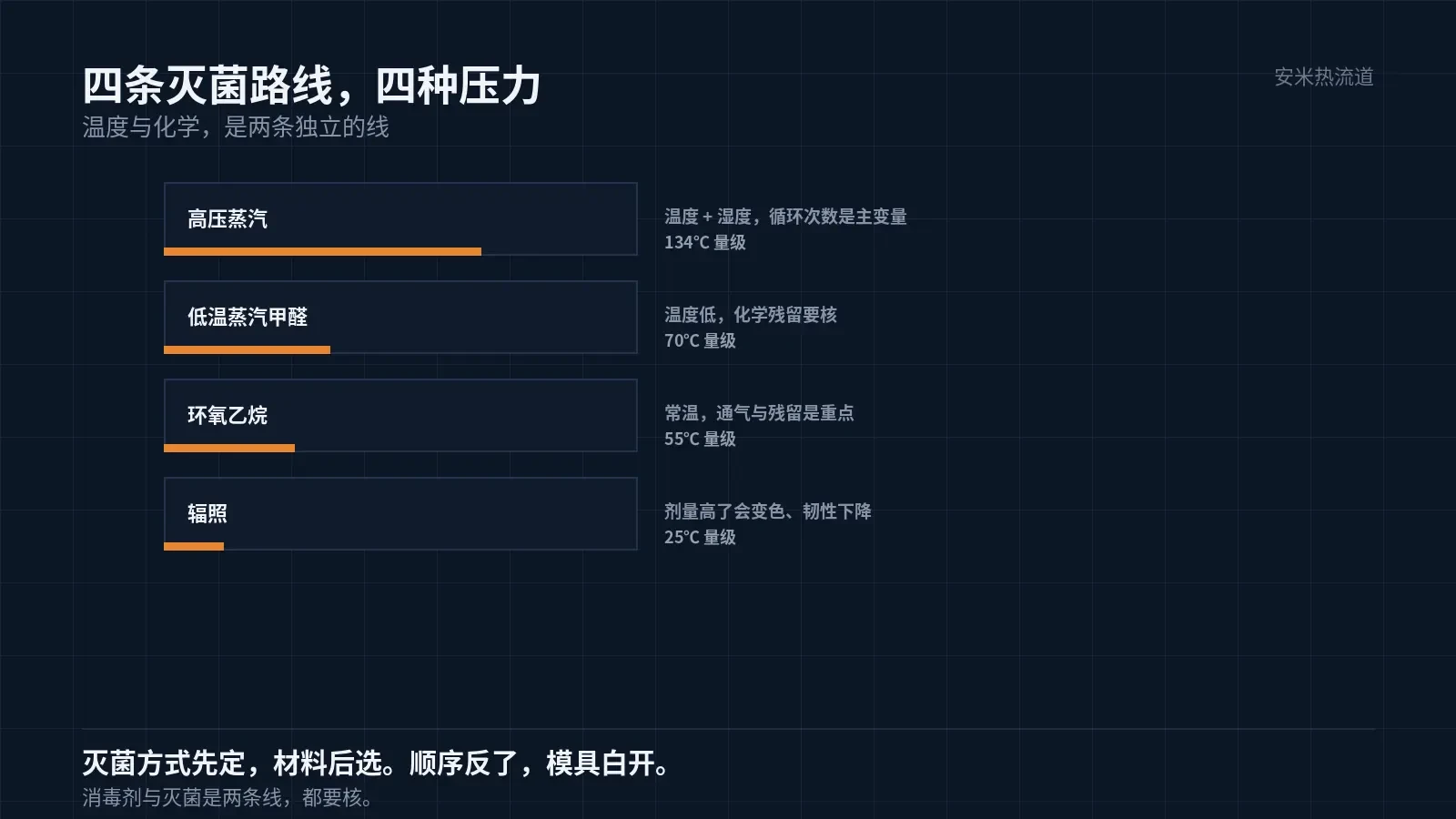
Sterilization isn't limited to steam. Options include high-pressure steam (134°C), low-temperature steam formaldehyde (60–80°C), ethylene oxide (room temperature), hydrogen peroxide plasma (low temperature), and gamma irradiation. Each method places unique stresses on materials.
Steam sterilization stress results from the combination of temperature and humidity: saturated steam at 134°C allows moisture to penetrate the material surface, which then exits during cooling. Repeated cycles cause minor swelling and shrinkage each time.
PPS exhibits extremely low water absorption, providing superior tolerance compared to PA46 or PA9T in this regard. However, low absorption does not equate to zero absorption; moisture still penetrates and exits the surface layer, making the glass fiber-resin interface a potential weak point.
Irradiation sterilization is another option: gamma rays or electron beams break molecular chains. PPS's aromatic structure provides some radiation resistance, but high doses can cause discoloration and reduced toughness. Dosage must be validated against the actual sterilization process.
134°C is not a concern for PPS; the issue lies in cycling.
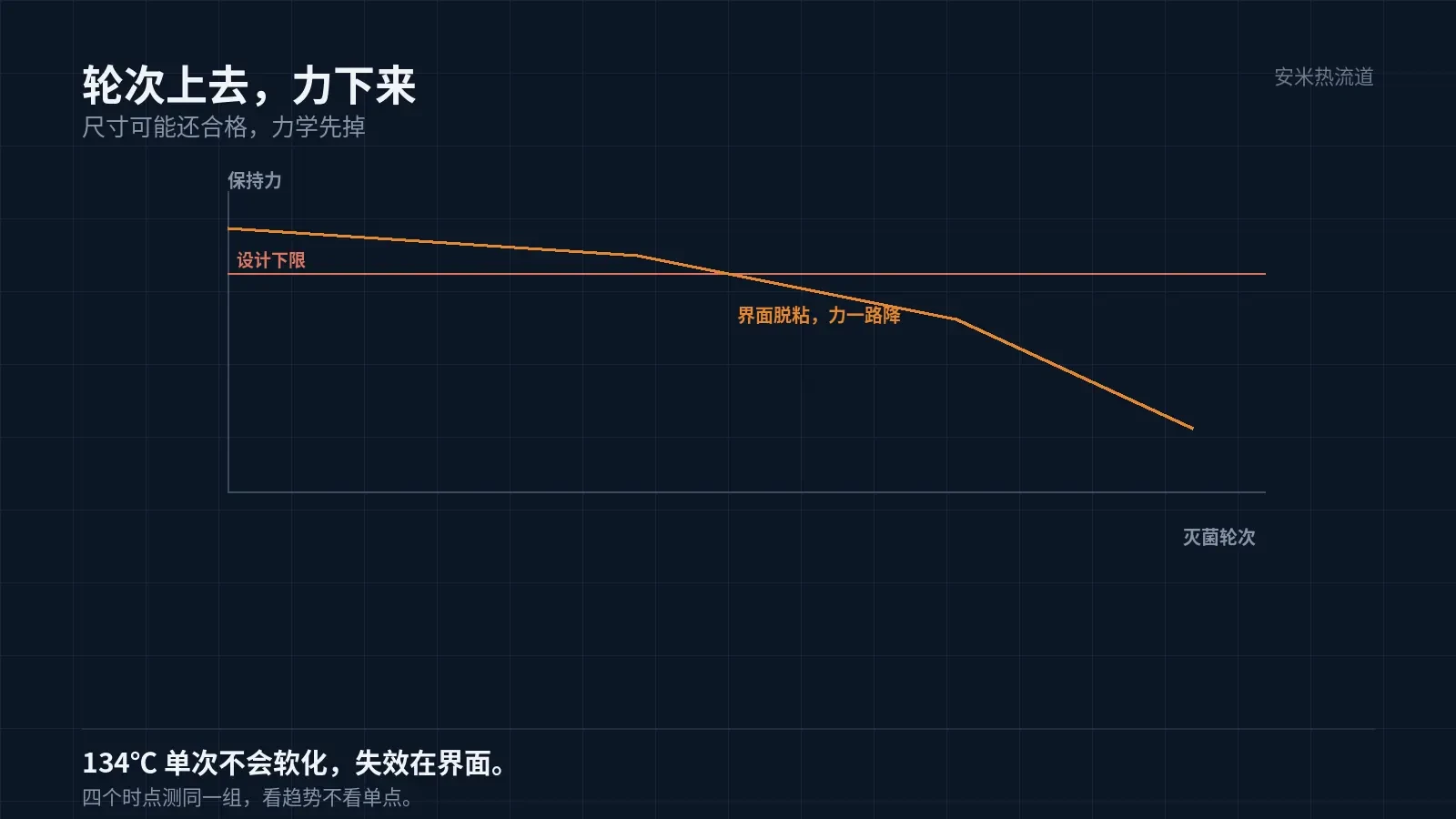
PPS has a high heat deflection temperature, well above its service limit of 134°C. Single sterilization cycles do not cause softening, so failure does not manifest as deformation.
Cycling induces changes at the interface: glass fibers and resin have different thermal expansion coefficients. Each heating and cooling cycle subjects the interface to shear stress. After hundreds of cycles, interfacial debonding reduces mechanical properties, even if visual appearance remains unchanged.
This type uses a mechanical failure criterion, not a dimensional one. Insertion/extraction force, snap-fit retention force, and thread breakaway torque degrade with cycling. Failure occurs when these values fall below the design minimum threshold.
Therefore, medical component validation must be based on mechanical design, not dimensional design. Dimensions may remain within tolerance after hundreds of cycles, but mechanical strength may already be insufficient.
Chemical Disinfectants as a Secondary Stress Factor
In addition to sterilization, parts undergo routine cleaning. Hospitals use various disinfectants, including chlorine-based agents, quaternary ammonium compounds, alcohols, and hydrogen peroxide. Chlorine-based disinfectants are generally incompatible with most engineering plastics, leading to surface chalking and discoloration over time.
PPS resists alcohols and quaternary ammonium compounds well; compatibility with chlorine-based agents depends on concentration and frequency. Stringing differs from immersion: it involves intermittent contact with alternating wet/dry conditions, which is more likely to cause surface microcracks.
This specification must be clearly defined in the proposal: permitted disinfectant types, maximum concentration, and daily application frequency. If unclear, hospitals will use the strongest disinfectant, causing rapid part failure.
We recommend avoiding the phrase "resistant to all disinfectants" on product pages. This claim carries risk, as customers may interpret it as a guarantee.
Molding: Mold Temperature and Cleanliness
For PPS, set mold temperature to 150°C. Melt temperature must not exceed 360°C, and nozzle temperature should be 310–320°C. Medical parts require high dimensional accuracy; maintaining uniform mold temperature is more critical than the absolute value. Large temperature variations across cavities lead to inconsistent crystallinity, causing regional dimensional deviations.
Drying conditions: 140°C for 3 hours or 120°C for 5 hours. Medical parts must be free of silver streaks and black spots. Document material path cleanliness and changeover procedures in work instructions.
Shrinkage is 0.3%/0.8%. For precision parts, mold flow analysis must account for the difference between these two directions. Relying solely on shrinkage rates will cause misaligned hole positions.
Only SD Series gates are recommended. For small medical components, SD gates leave minimal marks and ensure clean break-off, eliminating the need for post-trimming. Trimming generates dust and burrs, both of which pose risks to medical parts.
Material Substitution Selection
If parts require extremely high sterilization cycles or irradiation, PEI is an alternative to PPS. PEI has a Tg of 217°C, providing greater thermal margin, but requires higher processing temperatures and costs; molds must be reconfigured for melt temperatures of 350–410°C.
If high toughness is required, PPS is not suitable. Its low notched impact strength makes thin-wall snaps on medical components prone to failure. In such cases, consider PA9T or PEI, while accounting for the trade-offs in moisture absorption and cost.
Substitution is more than just changing the name. When the material changes, you must also adjust the hot runner, gate, mold temperature, drying parameters, and validation criteria. A material change requires full part re-validation, not just material testing.
We generally recommend defining the sterilization method and cycle count first, then selecting materials. Reversing this order may result in material incompatibility with the chosen sterilization method, leading to wasted mold tooling.
Validation Schedule Based on Four Time Points
Test the same set of parameters at four time points: baseline, after the first sterilization cycle, at 50% of target cycles, and after target cycles. Parameters include dimensions, appearance, insertion/withdrawal force or retention force, and breakaway torque. Analyzing trends across these four points is more meaningful than passing a single-point test.
Samples must be sterilized using the actual loading configuration. Heat exposure and pressure vary significantly between single flat items and full-box stacked arrangements. Data is invalid if the loading method does not replicate actual conditions.
Please provide part drawings, sterilization methods and cycle counts, disinfectant lists, and assembly force specifications. We will review material and gate designs against the cycle requirements and provide a quote once the solution is confirmed.
MATCHED BY MATERIAL AND DEFECT
This article covers stringing, drooling, clogging, and high-heat resins; refer to SD for gate freeze and break-off.
Register for a selection review and quote
Submit part, mold, and material details. Our engineers will evaluate the gate solution per part and provide a quote.
Upload a 2D layout drawing using the form.
Online selection and quote
Scan to register