
How Long Do PPS Parts Last in Industrial Pump Valves?
Material Applications18 min read
On this page
The key difference between industrial parts and consumer electronics is time. Consumer electronics are replaced every three months, whereas pump and valve components must operate in the same medium for five to eight years. Over this timescale, material aging, creep, and stress relaxation become critical factors.
PPS is widely used in pumps and valves for impellers, valve body liners, seal seats, and flow meter housings. It offers chemical resistance, low water absorption, and dimensional stability but is brittle with low notched impact strength. Long-term durability requires verification under each specific medium condition.
First Question: What Exactly Is the Medium?
In datasheets, "chemical resistance" is presented as a broad table listing dozens of media with symbols in each cell. This table can only be used for exclusion, not confirmation. Confirmation requires verifying four conditions: specific grade, concentration, temperature, and contact method.
Contact methods include immersion, spraying, intermittent contact, and steam. These impose vastly different stresses on materials; while intermittent contact may seem mild, wet-dry cycling often promotes stress cracking.
PPS offers top-tier resistance to acids, alkalis, solvents, and fuels—its key advantage. However, it cannot withstand strong oxidizing agents or certain high-concentration acids. Do not assume PPS has good chemical resistance when exposed to these media.
Our approach is to list a medium inventory and categorize each item into three tiers: verifiable via manufacturer data, requiring immersion testing, or excluded from the proposal. Do not mix these tiers; doing so creates risks for the customer.

Second Question: Temperature and Medium
Medium erosion rate increases exponentially with temperature. The same medium may cause no damage after one year at 80°C but lead to cracking after just three months at 120°C. Therefore, the medium list must include temperatures; a list without them is meaningless.
The PPS melt temperature limit of 360°C applies to molding conditions, not service temperatures. Service temperature is determined by heat deflection temperature and long-term aging; consult the manufacturer's grade-specific curves.
Another easily overlooked aspect of industrial parts is cleaning. Production line cleaners can be more aggressive than service media, particularly alkaline cleaners used with ultrasonics. Specify the cleaner type, temperature, and immersion duration.
After temperature and medium, stress is another critical factor. Post-assembly preload and internal pressure, when combined with the medium, initiate cracks at stress concentration points.
Question 3: Can dimensional stability be maintained for five years?
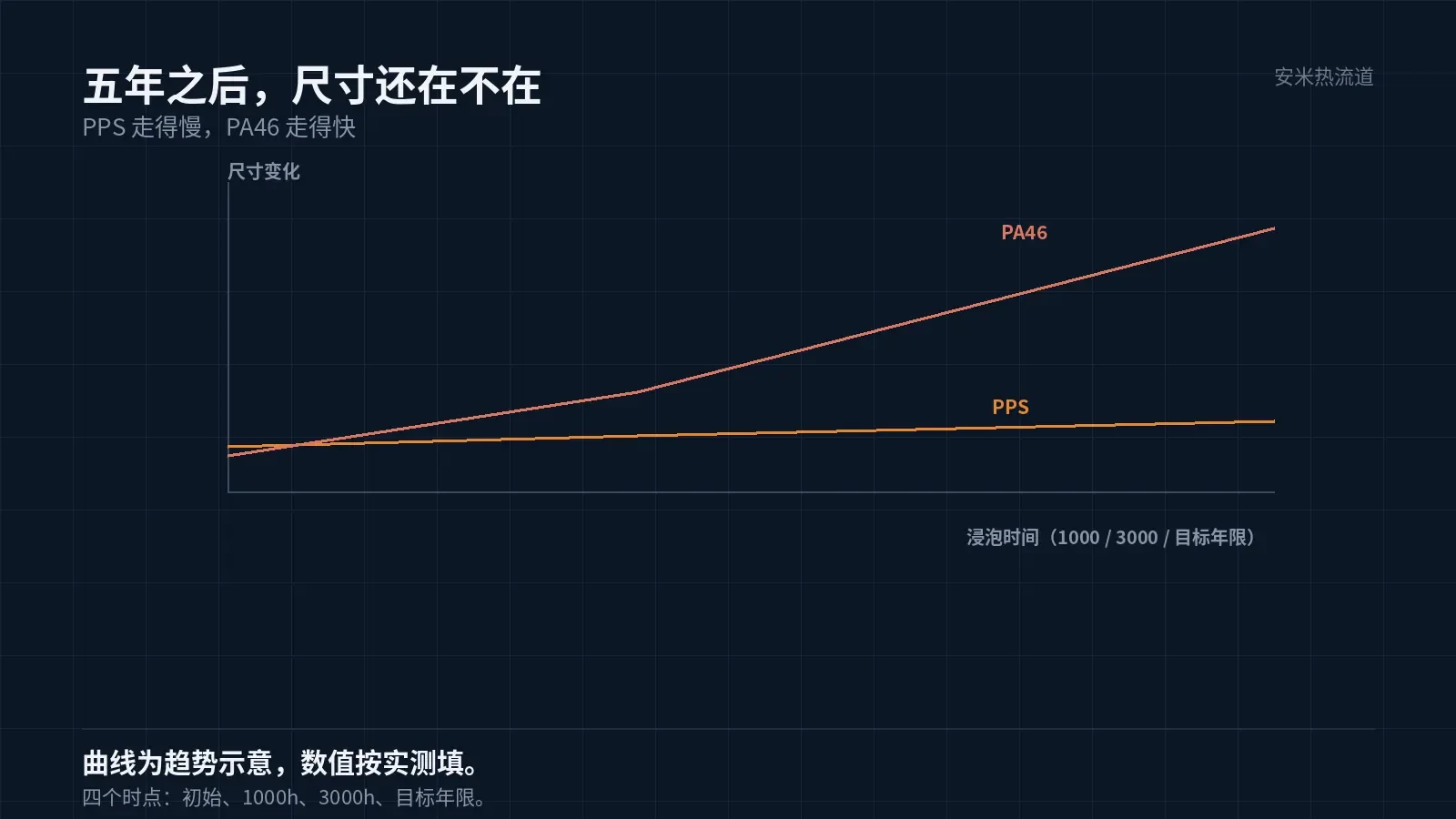
PPS has extremely low water absorption, a key advantage for industrial parts. Its dimensions remain stable with minimal variation due to humidity and show little change after long-term immersion. In contrast, PA46 and PA9T exhibit higher water absorption rates that cause shrinkage at the 1.1% and 0.19% levels, respectively, leading to dimensional drift during prolonged exposure to media.
However, dimensional stability does not imply zero change. PPS continues to creep under long-term loads, especially as temperature approaches the heat deflection temperature. Creep magnitude must be determined from curves based on load, temperature, and time—not estimated empirically.
A shrinkage of 0.3%/0.8% and a mold temperature of 150°C ensure complete crystallization. These factors determine initial dimensional accuracy. Insufficient initial accuracy, combined with subsequent creep, prevents meeting tolerances after five years.
Therefore, dimensional validation for industrial parts should be planned over time: initial, 1000 hours, 3000 hours, and at the target lifespan. Measure the same set of dimensions at these four points to determine if the curve is flat or still trending.
Fourth Question: Can the hot runner operate reliably over the long term?
Industrial part orders are typically small-batch and high-mix, with intermittent mold cycles. Residence time in the hot runner is critical: prolonged exposure causes most high-temperature materials to increase in viscosity, degrade, or clog nozzles.
PPS OEM guidance states that viscosity remains stable during extended residence times, making it ideal for hot runner systems. This is particularly beneficial for industrial parts manufactured in multi-variety, intermittent batches—no extensive purging is needed when restarting after downtime.
Usability requires: implement zoned temperature control, maintain nozzle temperatures between 310°C and 320°C without local hotspots, and ensure melt temperature stays below 360°C. Following these conditions keeps viscosity stable during residence.
Only SD Series gates are recommended per company documentation. PPS is brittle, and the shear and residence time associated with valve gate actuation are unsuitable. Industrial parts have significant shot weights; therefore, the flow capacity of the SD Series is sufficient, and gate marks are acceptable.
Question 5: Designing for Fragility
PPS reinforced with 40% glass fiber exhibits low notched impact strength. Flanges, threaded holes, and snap-fit grooves on pump and valve components can serve as initiation points for brittle fracture. Designs must incorporate fillets, smooth wall thickness transitions, and avoid sharp corners.
Threaded holes are the most challenging area. Directly tapping PPS parts with fine pitch or thin walls can cause cracking along the glass fiber direction during tightening. To resolve this, use metal inserts or increase wall thickness to 1.5 times the thread pitch.
Assembly preload must also be calculated. Excessive bolt preload on flange faces causes stress relaxation and seal failure after prolonged exposure to the medium. Determine preload based on the material's creep curve, not empirical values derived from metal properties.
If impact resistance is required, PPS may not be the best choice. PA46 offers better toughness but absorbs moisture. This trade-off is determined during material selection.
Validation order: medium first, then time, and finally assembly.
Incorrect sequencing prevents conclusive results even after three rounds. First, perform medium immersion testing under actual media, temperature, and duration conditions; then conduct time-series dimensional and mechanical property tests; finally, perform assembly and preload testing.
Immersion test specimens must retain actual molding stresses; flat plate samples are not acceptable substitutes. Flat plates lack weld lines, gates, and assembly stresses, so their immersion results do not reflect the behavior of the final part.
Please provide the part drawing, media list (including concentration and temperature), cleaning method, and target service life. We will review each item against the media, confirm the material and gate solution, and then issue a quotation.
MATCHED BY MATERIAL AND DEFECT
This article covers stringing, drooling, clogging, and high-heat resins; refer to SD for gate freeze and break-off.
Register for a selection review and quote
Submit part, mold, and material details. Our engineers will evaluate the gate solution per part and provide a quote.
Upload a 2D layout drawing using the form.
Online selection and quote
Scan to register