
Why Use PEEK Instead of Copper for Industrial Gearbox Worm Wheels?
Material Applications16 min read
On this page
Traditional worm gear pairs use copper against steel. Switching to PEEK against steel cuts weight in half and reduces noise.
Before switching materials, evaluate the impact on service life.
Copper Issues
Copper worm gears deliver high load capacity and excellent thermal conductivity. However, they are heavy, require casting or machining, and costs vary with copper prices.
Copper-on-steel pairs require lubrication. If the oil film fails, copper wears and wear particles contaminate the oil.
For reducers with small modules and low speeds, the benefits of copper are not realized, while the drawbacks in weight and cost persist.
The PEEK approach replaces copper with engineering plastics, leveraging self-lubrication and a low coefficient of friction to reduce oil dependency.
This substitution is not suitable for all applications. For worm gears under high loads and speeds, copper remains the preferred choice.
Material selection for reducers must account for starting conditions. Starting torque exceeds rated torque by over two times; plastic worm gear tooth roots must be designed to withstand starting loads.
In applications with frequent reversals, plastic worm gears wear out much faster. Repeated changes in friction direction on the tooth surfaces accelerate wear.
Backlash is also a material selection criterion. Plastic worm gears exhibit higher thermal expansion than copper, causing backlash to vary with temperature; precision reducers require compensation for this effect.
Two compensation methods are available: adjusting center distances or selecting grades with lower thermal expansion. The former is universal; the latter incurs higher costs.
The worm's helix angle must also account for shrinkage. In plastic worm gears, tooth direction deviations concentrate load at one end of the tooth.
Excessive load causes rapid wear at that end, creating steps after several hundred hours of operation. This is clearly visible upon disassembly.
Therefore, run-in tests should measure at multiple points. Measuring only total tooth thickness variation fails to detect load concentration.
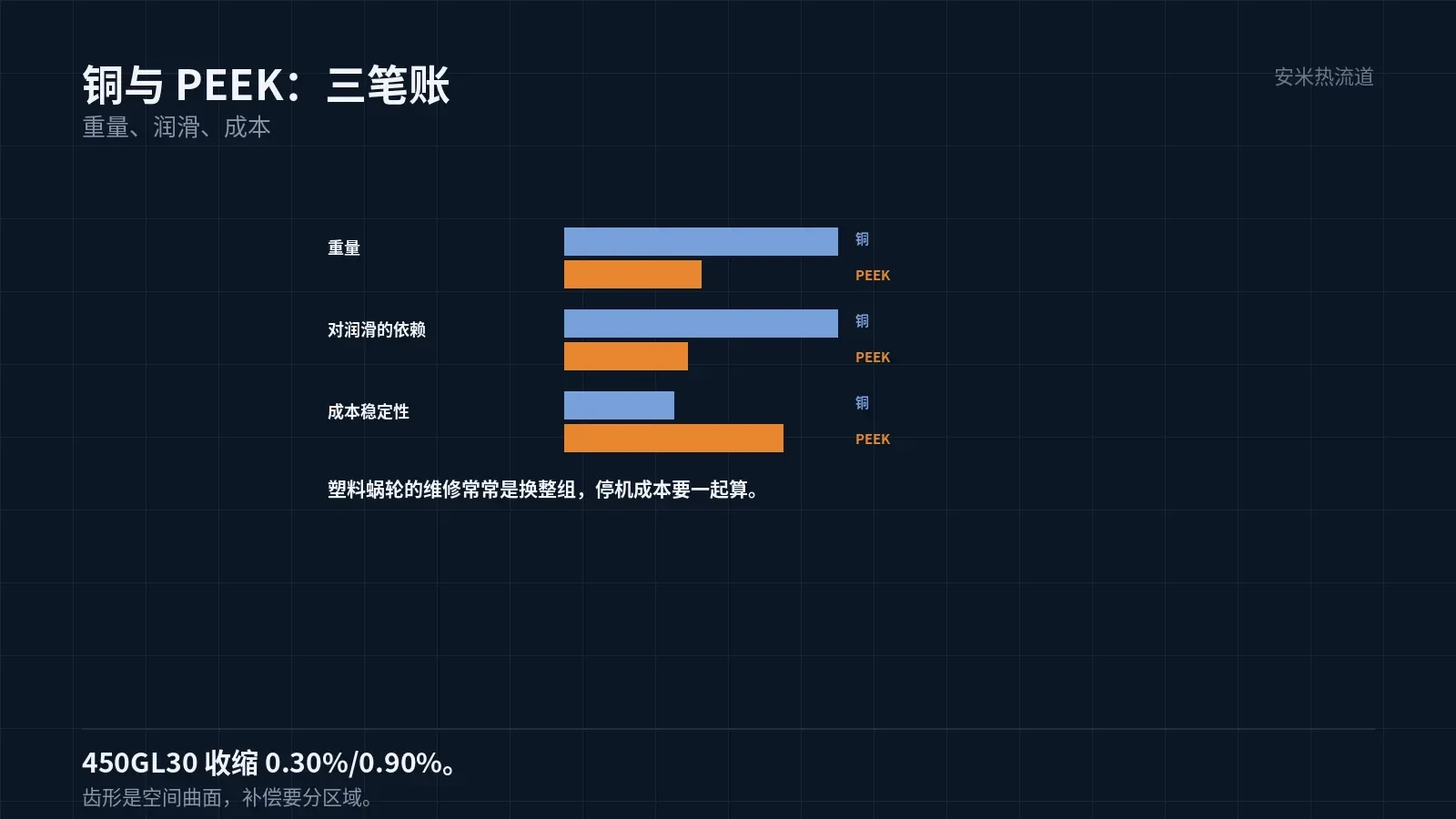
Another practical factor: repairing copper worm gears involves replacing parts, while plastic worm gears often require full set replacement. Downtime costs must be factored in.
Before switching materials, calculate the procurement cost and total lifecycle cost separately, then evaluate both together.
Three Key Metrics for PEEK in Transmission Applications
First is the coefficient of friction. Glass fiber- or carbon fiber-reinforced PEEK grades exhibit lower friction and reduced wear compared to unreinforced grades.
Second is temperature resistance. Oil temperatures in gear reducers can exceed 100°C, while PEEK's long-term service rating is approximately 250°C, providing adequate margin.
Third is dimensional accuracy. PEEK 450GL30 has a shrinkage rate of 0.30%/0, with directional differences up to three times. Gear tooth profile precision is compensated through mold adjustments.
Among these three factors, the third is the most challenging. The worm gear tooth profile is a spatial curved surface with varying shrinkage directions, requiring zone-specific compensation.
Therefore, PEEK worm gear molds typically require two to three design iterations to achieve an acceptable tooth profile.
Life Calculation
Life calculation is based on 'wear rate × operating time'. Wear rate depends on load, speed, lubrication, and mating surfaces.
PEEK exhibits a very low wear rate against steel under oil lubrication, but this increases significantly under dry friction. Therefore, 'dry running capability' is a critical concern.
For dry-running applications, use grades with lubricants (PTFE, graphite) or reduce the load.
Bench testing is the most reliable method for life verification. Run the test for several hundred hours, periodically measure tooth thickness and backlash, and plot the wear curve.
Estimating wear based solely on material data often produces overly optimistic results because actual operating conditions involve uneven load distribution.
Material Pairing and Surface Finish
For PEEK paired with steel, control the steel surface roughness. Wear drops significantly when Ra is below 0.4.
An overly smooth steel surface is also undesirable, as it prevents oil film formation and leads to boundary lubrication instead.
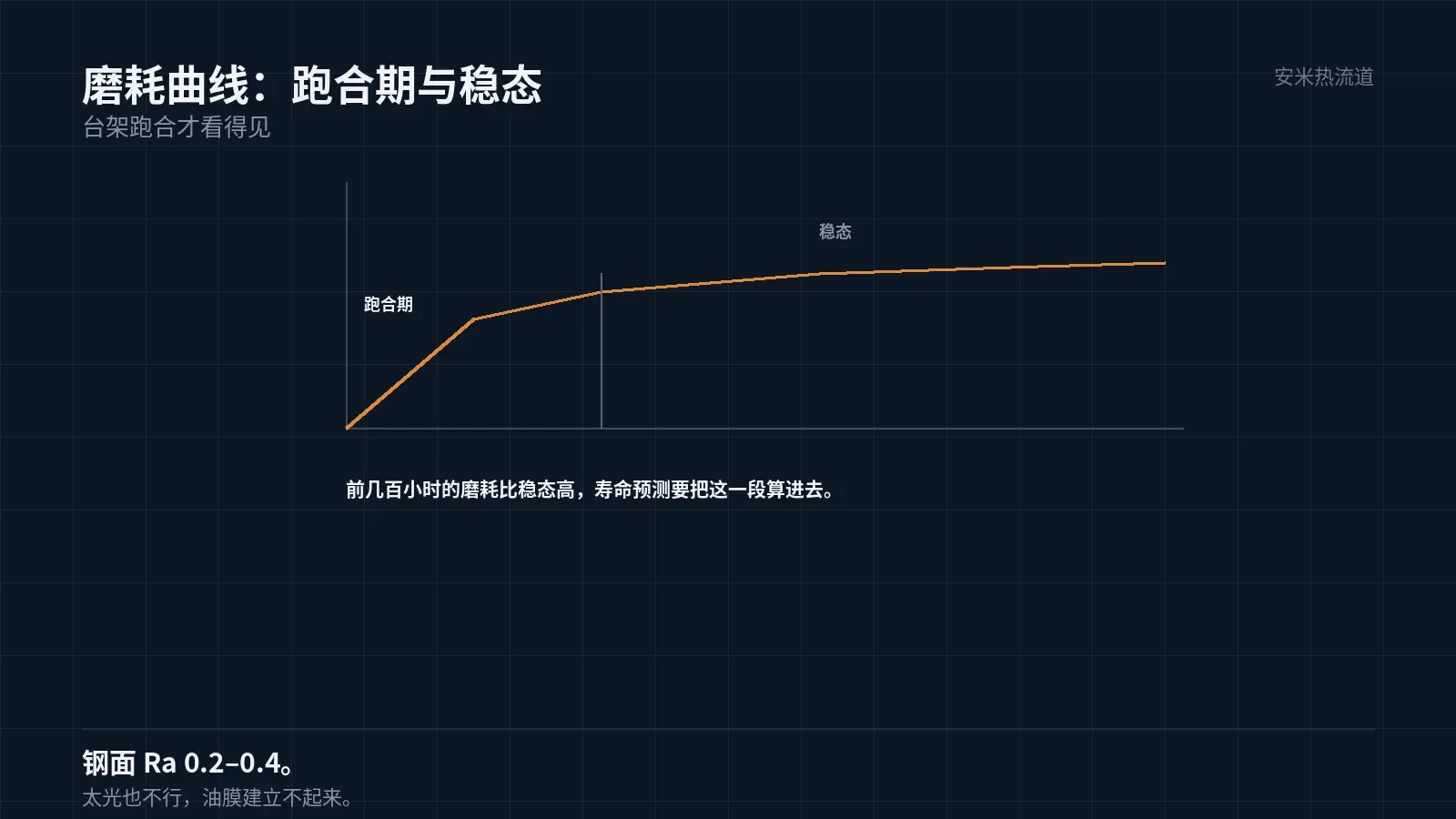
A common practice is to grind the steel surface to Ra 0.2–0.4, followed by a run-in period to stabilize the surface.
PEEK requires a run-in period. New parts have machining marks; wear rates decrease after run-in.
This factor must be included in life predictions: wear is higher during the first few hundred hours than during steady-state operation.
Molding: The Cost of High Temperature
PEEK grade 650G: rear zone 375°C, middle zone 380–385°C, front zone 390°C, nozzle 395°C, mold temperature 170–200°C.
Barrel heating capacity must exceed 400°C. Standard machines cannot process this; equipment is the main barrier.
For molds at 200°C, use high-temperature oil in the cooling channels. Insufficient water temperature prevents reaching the mold temperature and causes incomplete crystallization.
Dry at 120–150°C for 3–5 hours. Without drying, moisture in the melt causes silver streaks on part surfaces and affects tooth profile accuracy.
Demold slowly. Parts from high-temperature molds are soft; rapid ejection can cause deformation and ruin the tooth profile.
Suitable Applications
Three conditions: moderate or lower load, low speed, and general lubrication. If two are met, consider switching to PEEK.
For high-load, high-speed applications, copper or carburized steel is more suitable. PEEK may fail prematurely.
Another factor is production volume. Due to high tooling and equipment costs for PEEK, sufficient volume is required to amortize the investment.
Therefore, replacing copper with plastic is not a technical showcase—it's a cost calculation. Switch only if the economics justify it; otherwise, keep the original solution.
Please provide the module, load, speed, lubrication method, and oil temperature. We will verify operating conditions and structure before providing a quote.
MATCHED BY MATERIAL AND DEFECT
This article covers stringing, drooling, clogging, and high-heat resins; refer to SD for gate freeze and break-off.
Register for a selection review and quote
Submit part, mold, and material details. Our engineers will evaluate the gate solution per part and provide a quote.
Upload a 2D layout drawing using the form.
Online selection and quote
Scan to register