
Why Can PPS Replace Small Metal Parts in Automotive Applications?
Material Applications19 min read
On this page
Some automotive components are inconspicuous yet face the harshest conditions: fuel pump impeller seats, dedicated temperature controller housings, sensor housings, and motor end caps. These parts are constantly exposed to fuel, coolant, and oil while enduring thermal cycling.
Previously, these parts were mostly made of metal or PA66. The rationale for adopting PPS is straightforward: chemical resistance, extremely low moisture absorption, dimensional stability, and moldability at a mold temperature of 150°C. However, this comes with a trade-off—brittleness. This article defines the limits of using PPS in automotive components.
First, review the media exposure.
Automotive parts are exposed to various fluids: gasoline, ethanol-blended gasoline, diesel, coolant, engine oil, transmission fluid, and brake fluid. Each fluid affects materials differently—some cause swelling, others lead to stress cracking, and some trigger long-term oxidation at high temperatures.
PPS ranks among the top engineering plastics for chemical resistance due to its aromatic backbone and high crystallinity, with minimal swelling in most media. However, "resistance" depends on conditions: concentration, temperature, and contact time. If any of these variables change, conclusions must be re-evaluated.
We observed components used in ethanol-blended gasoline that passed 500-hour laboratory immersion tests but cracked at snap-fit stress-concentration points after one winter of vehicle use. The root cause was not material incompatibility, but the combined effect of residual stress and exposure: insufficient holding pressure during molding left internal stress at the snap-fits.
Therefore, when selecting PPS for automotive parts, the first step is not checking chemical resistance tables but verifying whether residual stress can be controlled. If uncontrolled, even highly chemically resistant materials will crack.
Three parameters determine moldability
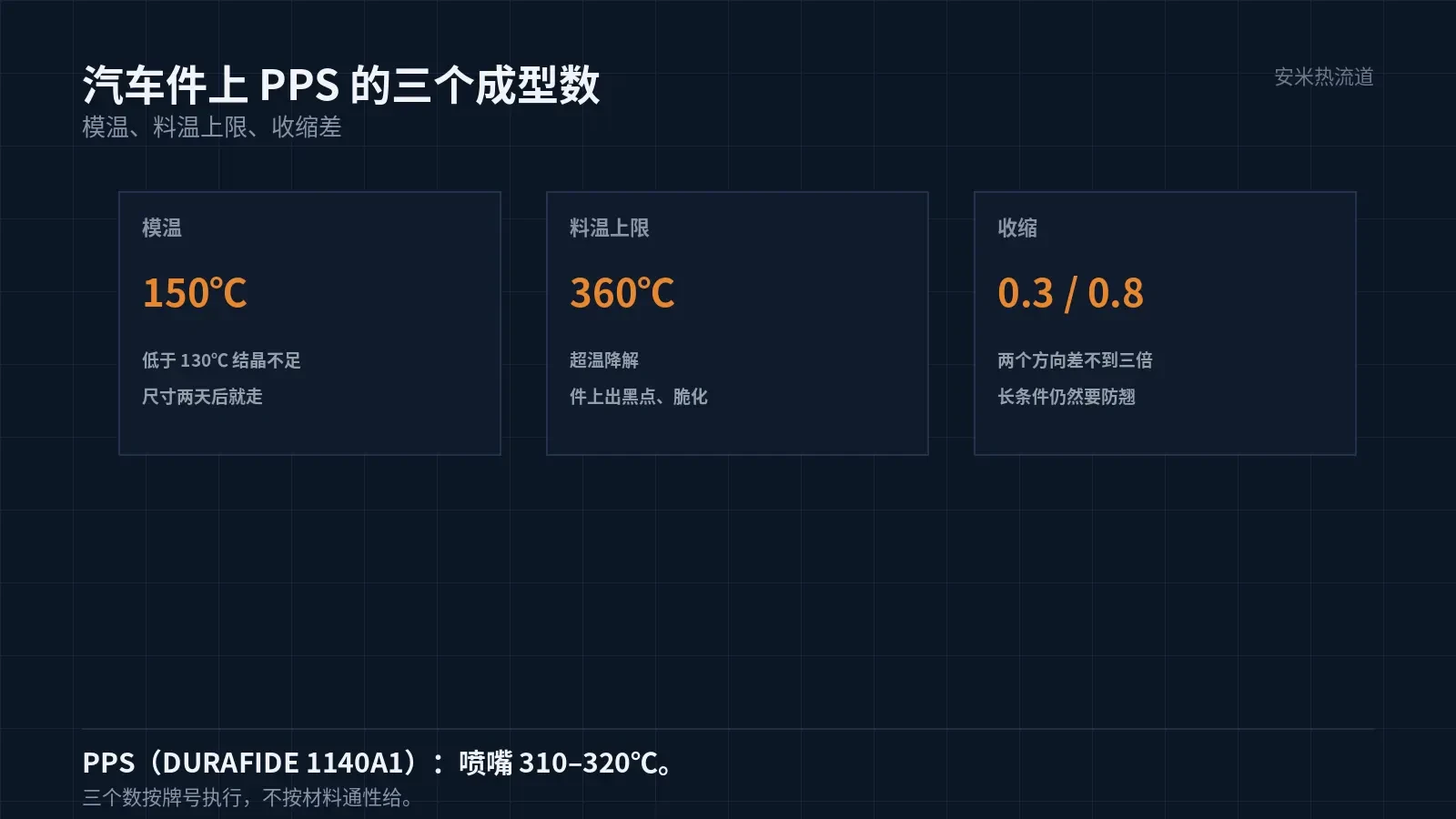
The first is a mold temperature of 150°C. PPS has high crystallinity; low mold temperatures cause incomplete crystallization, reducing part toughness and leading to dimensional instability. 150°C is a common recommended value, though actual settings should be fine-tuned based on part thickness and mold structure. Never set the temperature below 130°C.
The second limit is a maximum melt temperature of 360°C. Excessive PPS melt temperature causes degradation, which paradoxically reduces flowability and results in black spots and part embrittlement. Set barrel temperatures based on the grade; nozzle temperatures typically range from 310 to 320°C.
The third is shrinkage at 0.3%/0.8%. While the difference between flow and transverse directions is minimal, warpage still occurs under long-term conditions. This differential must be compensated through gate location and packing pressure, not just by adjusting mold temperature.
Among the three parameters, mold temperature is the easiest to adjust on-site. To reduce cycle time, lowering the mold temperature to 120°C yields parts that initially meet dimensional specs but drift after two weeks. PPS achieves dimensional stability only through full crystallization; incomplete crystallization compromises this stability.
Can hot runners be used?
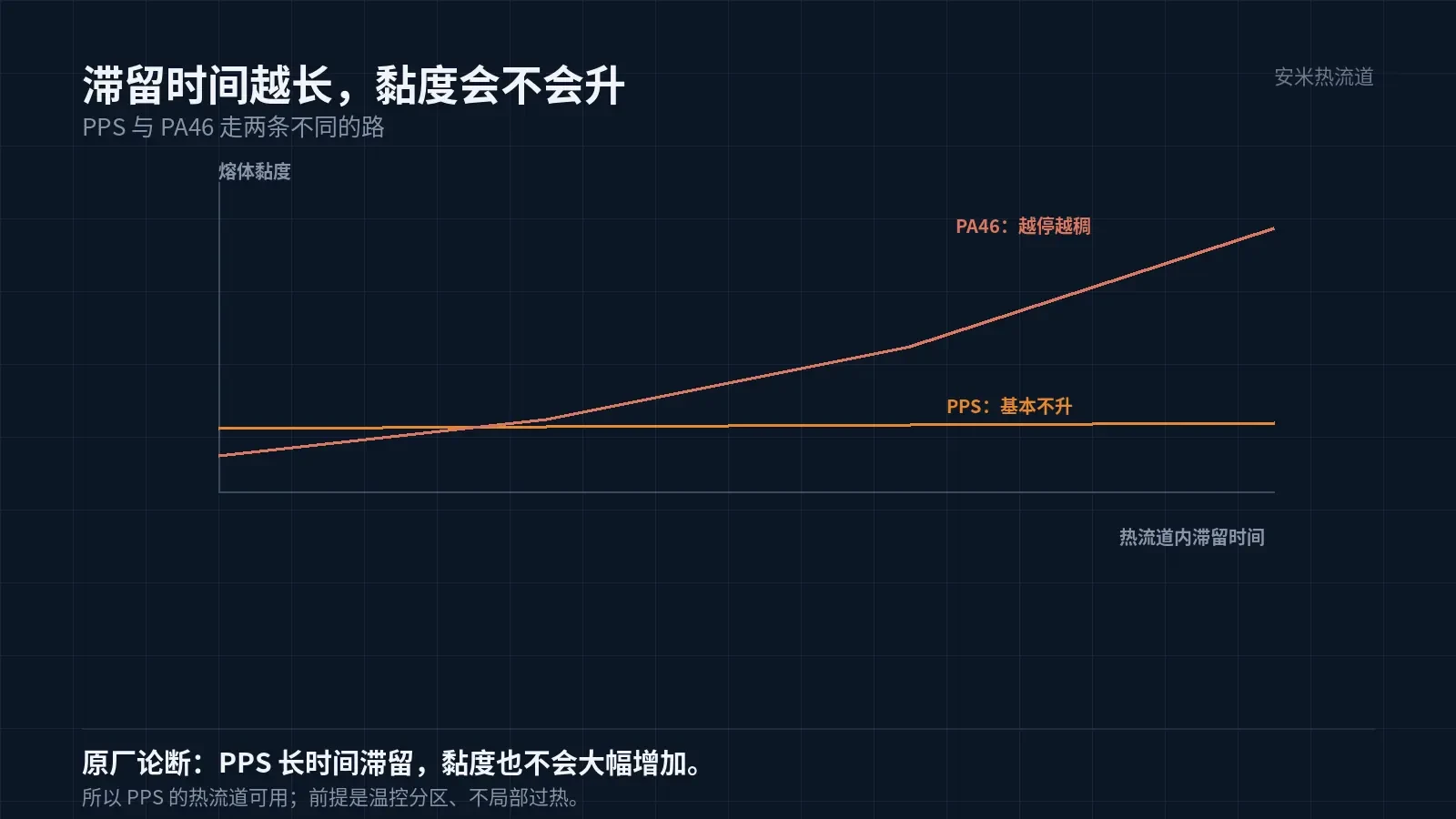
This is PPS's most distinct advantage over other materials. Most high-temperature resins degrade, increase in viscosity, and eventually clog when held too long in hot runners. However, OEM data shows that PPS maintains stable viscosity even during extended residence, making it fully compatible with hot runner systems.
This factor reshapes the entire mold design strategy. For PA46 and PA9T, hot runner designs must account for residence time, prevent backflow, and manage temperature zones. PPS can use standard hot runner designs and does not require extensive purging after shutdown restart.
Applicability does not imply unrestricted use. Temperature control still requires zoning; set nozzle temperatures to 310–320°C and avoid local overheating in any hot runner zone. OEM claims of stable viscosity do not allow repeated thermal degradation at a single point.
Gate type per company records: Only the SD Series (open/hot tip) is recommended for PPS. The TP, VG, and PVG Series are not recommended. Reason: PPS has low melt strength and is brittle; the shear and residence time associated with valve gate actuation are unsuitable.
Pin gates and venting: two key dimensions that determine yield
Pin gates typically use φ0.8–1.2mm.. Smaller sizes cause high shear and rapid gate wear; larger sizes leave visible marks and hinder break-off. This range is selected based on part weight and wall thickness: thin-wall parts use smaller diameters, while thick parts use larger ones.
Vent groove depth: 0.005–0.008mm.. PPS has low melt viscosity and flows quickly, so inadequate venting most commonly causes burn marks and weld lines. Shallow grooves are insufficient; deep grooves cause flash. This range is very narrow.
Both dimensions are mold features that determine whether the melt can fully reach the cavity end. PPS fills rapidly, creating instant high pressure at the tip. Even minor mismatches between venting and gating can cause short shots or burns.
Brittleness is the trade-off.
PPS has relatively low notched impact strength among engineering plastics, and glass fiber reinforcement further reduces toughness. In automotive parts, clips, flanges, and threaded holes are stress concentration points; designs must include fillets and wall thickness transitions.
Interference fits during assembly must also be controlled. PPS parts forced into place may not crack immediately but will fail over time due to vehicle vibration. Such failures are difficult to reproduce on test benches; accurate interference calculations during the design phase are critical.
If toughness is required, PPS is not the first choice. PA46 and PA9T offer better toughness but have higher moisture absorption and humidity-dependent dimensional stability. This trade-off must be decided during material selection, not after mold fabrication.
Validation must comply with vehicle installation requirements.
Bench tests only validate short-term performance. PPS automotive parts require three test groups: mechanical retention after medium immersion, dimensional and cosmetic stability after thermal cycling, and vibration resistance post-assembly. All three must pass.
Medium immersion testing must use the actual medium, temperature, and duration. Using generic engine oil instead of transmission fluid produces invalid results. Thermal cycling must follow the actual temperature range at the installation site; curves vary between the engine bay and chassis.
For these three datasets, we typically require customers to provide part geometry, a media list, and installation temperature ranges to determine the validation sequence. An incorrect sequence can prevent conclusive results even after three rounds.
Send the parts so we can verify the media list first.
Selecting materials for automotive parts isn't about consulting tables—it's about calculating performance based on media, temperature, and stress. PPS excels in chemical resistance and dimensional stability, but brittleness is the trade-off. A mold temperature of 150°C marks the critical threshold.
Submit part drawings, media list, installation temperature ranges, and current failure modes. We will verify each item against the media list, confirm the material and gate solution, then provide a quote.
MATCHED BY MATERIAL AND DEFECT
This article covers stringing, drooling, clogging, and high-heat resins; refer to SD for gate freeze and break-off.
Register for a selection review and quote
Submit part, mold, and material details. Our engineers will evaluate the gate solution per part and provide a quote.
Upload a 2D layout drawing using the form.
Online selection and quote
Scan to register