
Where is PEEK's thermal margin utilized in new energy tri-electric systems?
Material Applications15 min read
On this page
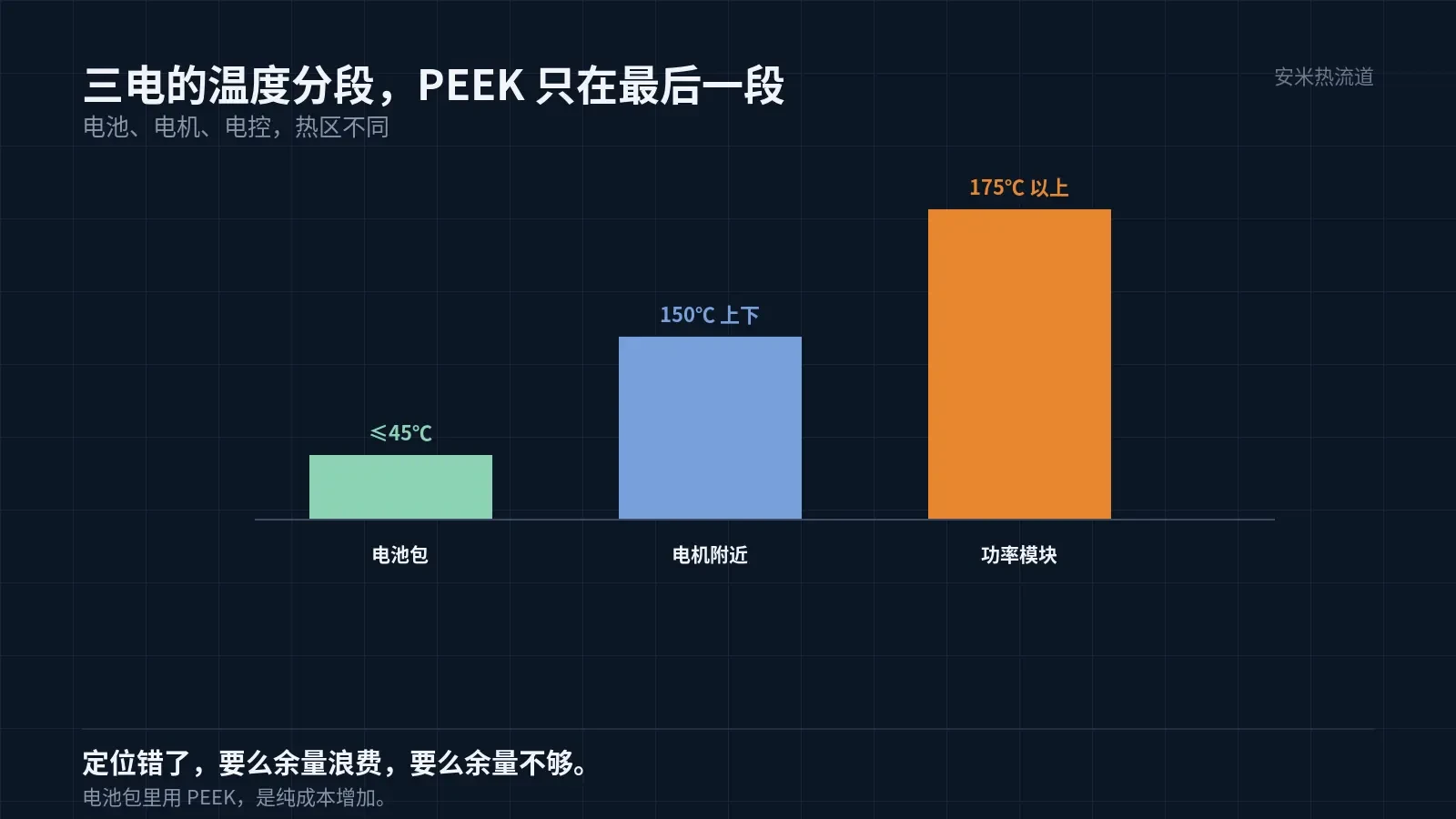
The three-electric system in new energy vehicles exhibits uneven temperature distribution: battery packs stay below 40°C year-round, areas near the motor reach 150–160°C, and power modules in the electronic control unit experience even higher junction temperatures. PEEK is typically used at the final stage.
This article avoids hyping PEEK's heat resistance and instead focuses on how to use safety margins effectively: which applications justify the cost and where its use would be wasteful.
First, examine the temperature distribution
Battery pack internal temperatures are controlled, typically staying below 45°C. Material selection in this area prioritizes flame retardancy, insulation, and weight; PEEK's heat resistance is unnecessary here.
Components near the motor endure long-term temperatures around 150°C, with short-term peaks higher. PPS is sufficient in this range, and PA9T can also handle it, though both have narrow safety margins.
Areas near power modules are true hot zones, with junction temperatures exceeding 175°C and even higher locally. In these regions, PEEK's safety margin is critical for component insulation and placement.
First, position the component in its exact temperature zone. Mispositioning causes either wasted safety margin or insufficient margin.
Another application of safety margin: reducing wall thickness
PEEK's high modulus and excellent heat resistance allow for thinner walls with the same stiffness. Thinner components take up less space, feature shorter heat dissipation paths, and enable more compact assemblies.
This is critical in electronic controls: when space around modules is extremely limited, even a 0.2 mm wall thickness may not fit. PEEK reduces wall thickness at the cost of higher material price.
Wall thinning has thresholds: PEEK's high melt viscosity demands higher injection pressure for thin-wall filling, necessitating gate and runner recalculation, as well as more precise mold venting and temperature control. Feasibility and stability are separate concerns.
Yield rates for thin-walled parts are typically one tier lower and must be factored into quotes. The space savings from using PEEK come at the cost of reduced yield.
Third Application of Margins: Dimensional Stability
PEEK exhibits extremely low water absorption, maintaining nearly unchanged dimensions even in long-term humid environments. Creepage distances for high-voltage components are determined by the component's structure; since dimensions remain stable, creepage distances stay constant.
Compared to PA9T's with a 0.19% increase and the high water absorption of PA46, PEEK's advantage here is an order of magnitude. For long-running components, this difference significantly impacts insulation margins.
However, dimensional stability does not mean zero change. Unreinforced PEEK shrinks by 0 to 1.3% during molding, and residual stress continues to release after part production.
Residual stress is controlled by mold temperature and holding pressure. Set mold temperature to 170–200°C based on grade, ensure adequate holding pressure, and delay gate sealing. Failure to meet these conditions causes part deviation within two months.
Processing Threshold: Equipment Must Meet Requirements First
PEEK nozzle at 395°C, barrel at 375/380–385/390°C, mold temperature at 170–200°C, drying at 120–150°C for 3–5 hours. Barrel heating capacity must reach 400°C; HT and ST must reach 430°C.
High-volume production of new energy components with tight molding cycles demands strict equipment performance. If the machine cannot reach 400°C, PEEK solutions are not viable.
A mold temperature of 170–200°C requires adequate controller power and effective insulation. Temperature instability causes uneven crystallization, impacting dimensions and insulation performance.
Molding cycle time is also a constraint. PEEK cycles take longer than PPS due to high mold temperatures and slow cooling, adding several percent to the cycle time per shot. Production lines scheduled based on PPS cycle times must be recalculated when switching to PEEK.
Company records indicate that SD, VG, and PVG gates are suitable for PEEK, while TP is not. For large parts, use VG or PVG to improve flow and ensure clean break-off.
When Not to Use PEEK
For battery pack interiors, low-voltage accessories, and structural brackets, PPS or PA9T is sufficient. Using PEEK adds unnecessary cost that customers won't pay for.
For high-volume simple parts, avoid PEEK. High material costs, long cycle times, and low yields make recovery impossible.
The criterion is whether the core issue of the part is "temperature" or "dimension." Choose PEEK only if applicable; otherwise, select a lower grade.
Another frequently overlooked factor is maintenance and replacement. PEEK parts and their spare components for after-sales service are costly, significantly increasing the total cost for high-volume consumables.
Validation: Thermal, Electrical, and Mechanical Lines
Thermal: Temperature cycling and prolonged high-temperature aging to verify dimensions and appearance. Electrical: Withstand voltage, insulation resistance, and partial discharge testing. Mechanical: Vibration resistance and retention force after assembly.
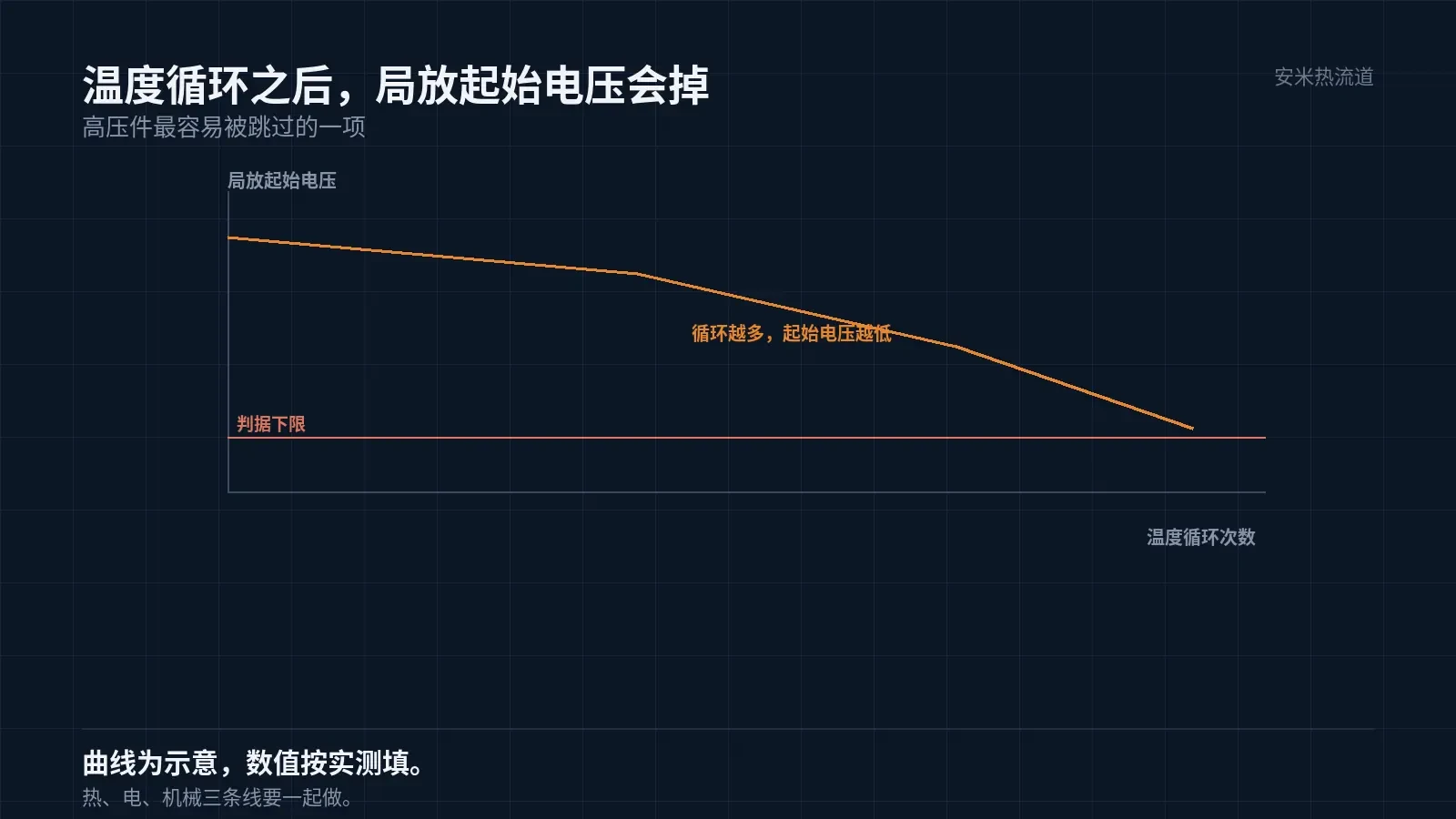
Among these three tests, partial discharge is the most easily overlooked. The inception voltage of high-voltage components drops after thermal cycling; this test must be performed post-cycling.
Define failure criteria upfront: partial discharge level, insulation resistance, and dimensional change. All three must have explicit limits; do not rely solely on whether breakdown occurs.
Please send us the part drawing, operating temperature range, voltage rating, and batch size. We will first assess whether PEEK is suitable for this application, then review the gate and mold temperature plan, and provide a quote upon confirmation.
MATCHED BY MATERIAL AND DEFECT
This article covers stringing, drooling, clogging, and high-heat resins; refer to SD for gate freeze and break-off.
Register for a selection review and quote
Submit part, mold, and material details. Our engineers will evaluate the gate solution per part and provide a quote.
Upload a 2D layout drawing using the form.
Online selection and quote
Scan to register