
When Is PEEK Justified for Consumer Electronics Parts?
Material Applications15 min read
On this page
PEEK is one of the most expensive engineering plastics, with material costs often more than 10 times higher per kilogram than standard resins. In cost-sensitive consumer electronics industries where expenses are calculated in cents, PEEK parts are rare—but each application has a clear justification.
This article does not promote PEEK; instead, it covers when PEEK should be avoided and when it is essential. The only criterion for judgment is whether the specific requirement that other materials cannot meet is central to the part's function.
Cost Analysis
For mobile phone structural components, material costs typically account for a small portion of the total part cost because tooling and processing are significantly more expensive. Thus, even if resin prices are several times higher, the impact on total part cost is less than expected—as long as the part is small, production volume is moderate, and the design is simple.
Conversely, for large-scale production runs or simple designs, PEEK resin costs may exceed budget limits. For these applications, PPS, PA9T, or PBT are sufficient; using PEEK would be wasteful.
There's also a hidden cost: processing. PEEK requires nozzle temperatures of 395°C, barrel capabilities of 400°C, and mold temperatures of 170–200°C, leading to longer cycle times and higher energy use. If equipment isn't properly configured, yield rates drop, making processing more expensive than the resin itself.
Thus, the first consideration is the part's cost sensitivity. For high-volume consumer parts, the answer is typically "do not use."

When PEEK Is Essential
First: Temperature. Parts operating continuously above 200°C leave insufficient margin for PPS, and even less for PA9T. This is not a preference but a limitation due to lack of alternatives.
Second: Dimensions. PEEK has extremely low moisture absorption, resulting in negligible dimensional change over time even in humid environments. For precision parts, this eliminates the need for compensation designs.
Third: Wear resistance. Under oil-free or minimal-lubrication conditions, PEEK forms transfer films—a key advantage for gears, bearings, and slides. Unlike other materials that require lubrication, PEEK does not.
Fourth: Weight and imaging. Medical and high-end wearable applications require these properties. PEEK can replace metal without blocking X-rays or CT scans. While rare in consumer electronics, this requirement is emerging in high-end wearables.
Three Common Pitfalls in Consumer Electronics
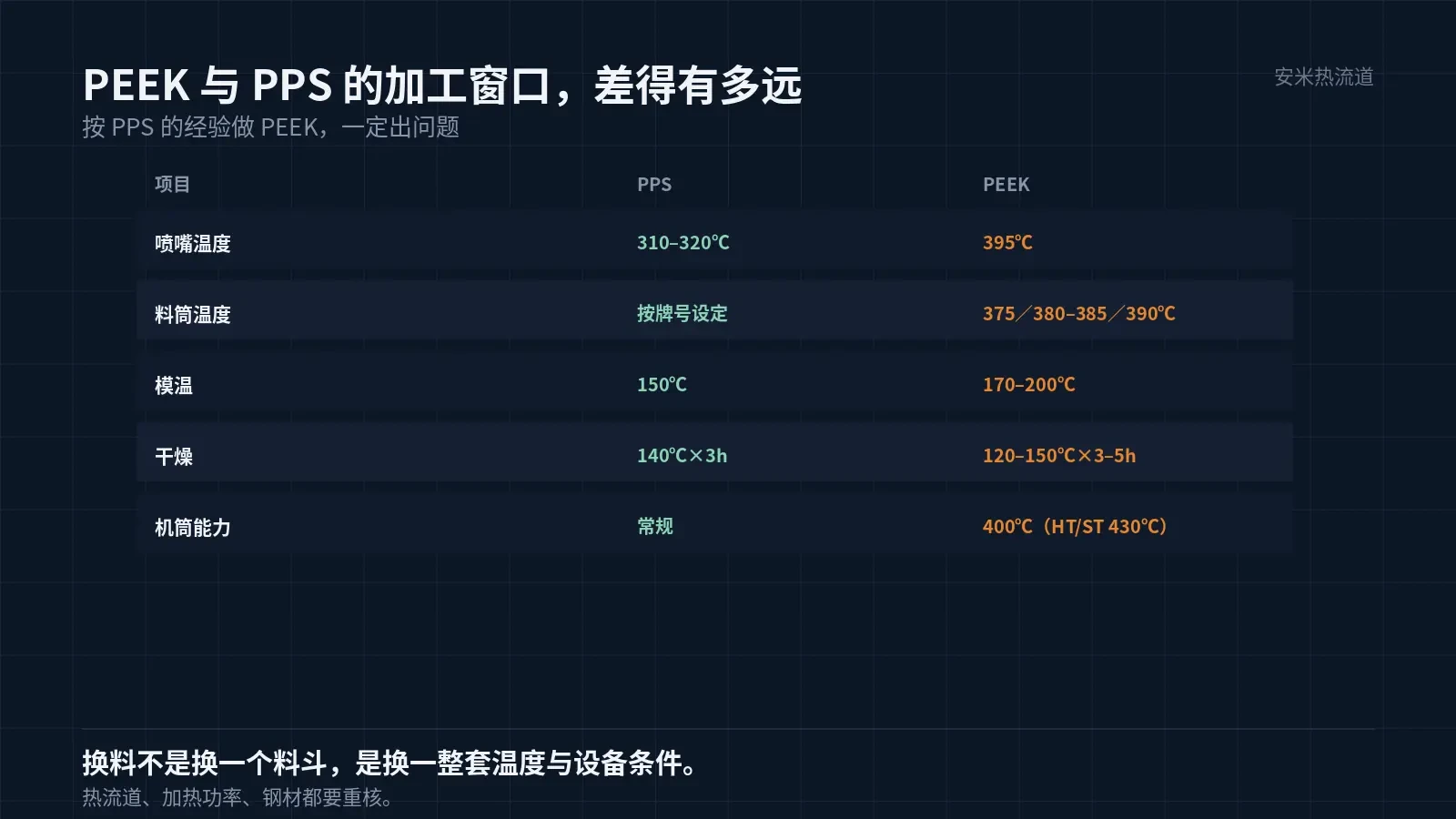
The first pitfall is treating PEEK as a higher-grade PPS. Their processing windows differ significantly: PPS nozzle 310–320°C, mold temperature 150°C; PEEK nozzle 395°C, mold temperature 170–200°C. The hot runner system, heating power, and steel selection must be redesigned and cannot be reused.
The second pitfall is thin walls. Due to PEEK's high melt viscosity, filling pressure increases in thin-wall parts, requiring gates and runners to be recalculated. Filling walls thinner than 0.4 mm with PEEK is significantly more challenging than with PPS.
The third pitfall is appearance. PEEK crystallinity depends on mold temperature; uneven temperatures lead to color and gloss inconsistencies. For high-appearance requirements, implement refined mold temperature zoning and venting.
These three pitfalls share a common root: they stem not from material issues, but from misapplying experience gained with other materials to PEEK.
Processing: Three critical parameters
Nozzle at 395°C. This is the standard setting for PEEK: temperatures below this point result in high melt viscosity, preventing complete filling of thin walls, while higher temperatures risk material degradation. Set barrel zones to 375/380–385/390°C with a proper temperature gradient; do not reverse the order.
Mold temperature: 170–200°C. Use 170°C for PEEK, 190°C for HT, and 200°C for ST, depending on the grade. Low mold temperatures can lead to insufficient crystallization, resulting in poor dimensional accuracy and surface finish.
Dry at 120–150°C for 3–5 hours. Although PEEK has low moisture absorption, it is highly sensitive to moisture during high-temperature processing; this step must not be skipped.
Equipment requirement: Barrel heating capacity must reach 400°C, or 430°C for HT and ST grades. Machines that do not meet this requirement will cause incomplete melting, leaving unmelted particles in the parts and directly compromising mechanical properties.
Gate selection: All three types are supported. Choose based on part requirements.
According to company records, the SD, VG, and PVG series are compatible with both PEEK and LCP materials, while the TP series is not. This offers greater flexibility compared to PPS and PA46, for which only the SD series is recommended.
Use the SD Series for small or cosmetic parts to minimize gate marks; use the VG or PVG Series for large or thick parts to improve flow and ensure cleaner material break-off.
The hot runner system must be designed for 395°C. Calculate the runner diameter based on melt viscosity, not empirical values from standard materials. The same principle applies to gate diameter: a diameter that is too small creates excessive shear stress and breaks glass fibers.
Validation: First Article, Then Pilot Batch
The first PEEK part is critical. It reveals mold temperature uniformity, fill completeness, and gate suitability. If the first article fails, subsequent parts are scrap.
The pilot batch requires three checks: full dimensional inspection, appearance (color difference and gloss), and assembly. Mass production begins only after all three pass.
Mass production stability depends on mold temperature control and flow channel cleanliness. These are often insufficient in consumer electronics lines, leading to most PEEK part defects.
Submit the part drawing, process temperatures, wall thickness, and appearance requirements. We'll first evaluate PEEK suitability, then verify the gate design, and provide a quote upon confirmation.
MATCHED BY MATERIAL AND DEFECT
This article covers stringing, drooling, clogging, and high-heat resins; refer to SD for gate freeze and break-off.
Register for a selection review and quote
Submit part, mold, and material details. Our engineers will evaluate the gate solution per part and provide a quote.
Upload a 2D layout drawing using the form.
Online selection and quote
Scan to register