
How Do PEEK Washers in Transmissions Work Without Lubrication?
Material Applications16 min read
On this page
In gearboxes, certain components are often overlooked: thrust washers, oil seal armatures, bearing cages, and clutch separator plates. While they don't carry heavy loads, they must withstand long-term wear in oil at temperatures exceeding 200°C.
These parts previously used metal or modified PA66. With PEEK, many designs no longer require "lubricating oil"—not because oil is unnecessary, but because the part can operate with minimal or no lubrication.
First, check the operating temperature.
Gearbox oil temperatures typically range from 120–150°C, with localized hotspots on clutch plates briefly exceeding 200°C. This temperature is already at the upper limit for PA66 and near the threshold for PPS.
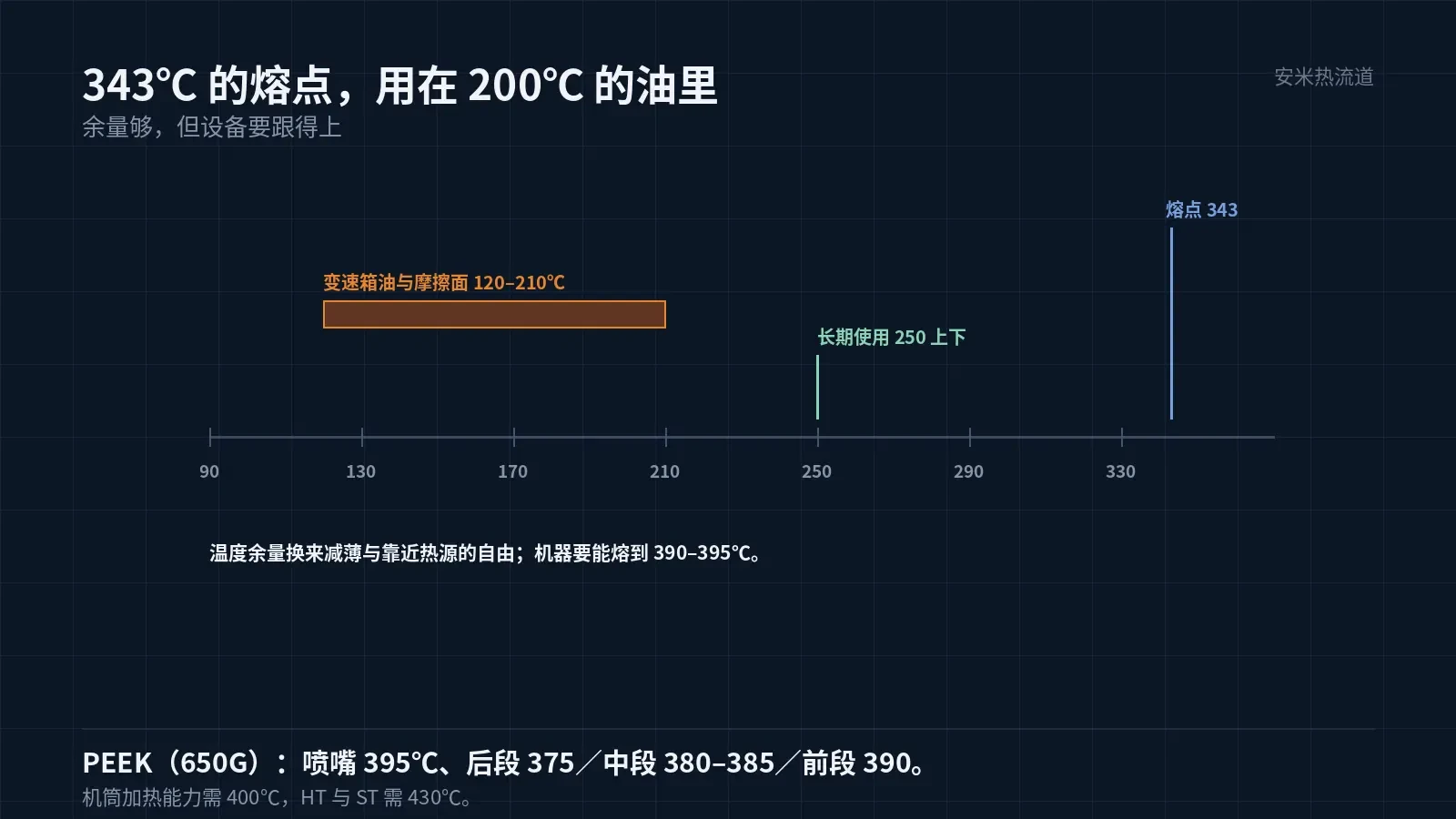
PEEK melts at 343°C and maintains continuous service up to approximately 250°C, depending on the grade. This margin ensures the material does not soften in oil at 200°C, with dimensional stability that is not solely dependent on crystallinity.
The large temperature margin provides design flexibility: components can be made thinner and positioned closer to heat sources without adding thickness for thermal resistance. Reduced thickness lowers weight and moment of inertia.
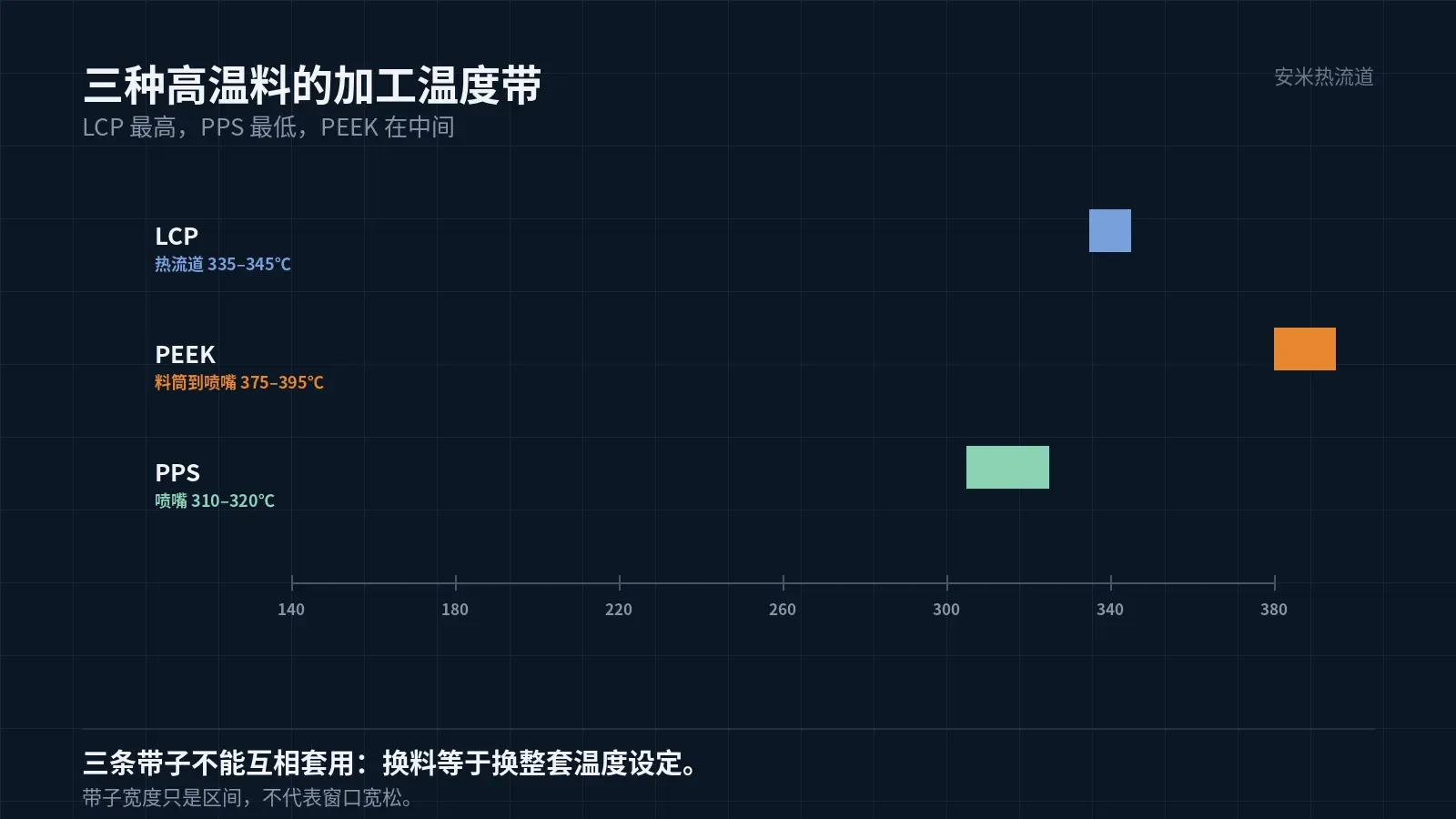
However, a large margin does not mean unrestricted use. PEEK has a narrow processing window: rear barrel 375°C, middle barrel 380–385°C, front barrel 390°C, nozzle 395°C; the barrel heating capacity must reach 400°C. Insufficient equipment capability leads to incomplete melting.
Wear resistance depends on mating pair compatibility, not hardness.
Many assume wear resistance depends solely on material hardness. In reality, PEEK's wear resistance comes from forming a transfer film on the mating surface, which provides self-lubrication and reduces friction.
Therefore, mating surface roughness, material, and pressure must all be matched. PEEK behaves differently against steel, aluminum, or itself. Switching the mating surface for the same grade can result in a tenfold difference in service life.
Unreinforced PEEK offers superior toughness, impact resistance, and a lower coefficient of friction. Adding glass or carbon fiber enhances rigidity but increases wear on the mating surface. Gasket-type components typically use unreinforced or low-filled grades.
This is often overlooked during selection: using wear data from one grade to answer questions about another will yield incorrect results. Wear data always depends on the combination of "material + mating surface + operating conditions," not just a standalone material property.
High Shrinkage Is a Challenge
Unreinforced PEEK has a shrinkage rate of 0–1.3% in the most critical direction. Although directional variation is minimal, absolute shrinkage values are high. Adding 30% glass fiber (450GL30) reduces shrinkage to 0.30–0%. This difference determines whether precision parts can be manufactured.
Gasket-type parts have strict thickness tolerances; high-shrinkage grades require precise mold temperature and holding pressure control. The standard mold temperature range is 170–200°C: 170°C for PEEK, 190°C for HT, and 200°C for ST, depending on the grade.
Higher mold temperatures increase cycle times and energy usage, driving up PEEK part costs beyond just material price. Include these factors in your quotes to avoid losses.
Directional shrinkage differences also require compensation through gate placement. For ring-shaped gaskets, weld lines on load-bearing surfaces create weak points; position gates to avoid these areas.
Drying and Contamination: Two Critical Rules
Although PEEK absorbs little moisture, it must be dried before processing: 120–150°C for 3–5 hours. Residual moisture vaporizes at the nozzle (395°C), causing silver streaks and bubbles on parts—especially at high temperatures.
Cleanliness requirements for the melt flow path are stricter than for general materials. Due to PEEK's high processing temperature, residues from previous batches can carbonize and appear as black spots in subsequent parts. Purging is required when switching materials; use high-temperature purging compounds, not PE or PP.
Control regrind ratios. Repeated heating degrades PEEK, reducing molecular weight and thus wear resistance and toughness. Typically, regrind should not exceed 20% and must be sieved.
These three points relate to equipment and process, not the material itself. Poor PEEK part quality is primarily due to inadequate machine and process setup rather than material issues.
Gate Types: SD, VG, and PVG Are Allowed
Per company records, like LCP, PEEK is compatible with SD, VG, and PVG gates but not TP. PEEK has sufficient melt strength to withstand shear from valve gates without damage; however, the pointed structure of TP nozzles lacks high-temperature wear resistance.
Selection depends on the part. For thin, gasket-like parts, use SD to minimize gate marks and ensure clean break-off. For thick or cosmetic parts, VG provides more uniform gate marks.
Hot runner systems must be designed for a nozzle temperature of 395°C with adequate heating power headroom. Due to PEEK's high melt viscosity, runner diameters cannot be sized using standard material assumptions; undersized runners cause excessive pressure drop and shear stress.
Validation: Bench tests cannot determine actual service life.
Bench testing of PEEK washers yields relative rankings, not absolute values. Actual service life depends on lubricant type, temperature, load spectrum, and mating surface roughness—conditions that are difficult to fully replicate in bench tests.
A practical approach is comparative testing: run PEEK and current parts side-by-side under identical conditions to measure wear. Use relative values for selection, then validate with vehicle or assembly-level testing.
Wear measurement requires care: gravimetric methods need controlled cleaning and constant temperature; dimensional methods require fixed measurement points. Perform both methods at the same intervals to ensure data comparability.
Please provide part drawings, operating temperature, mating material and surface roughness, current material, and expected service life. We will review the fit relationships, confirm material and gate solutions, and then issue a quotation.
MATCHED BY MATERIAL AND DEFECT
This article covers stringing, drooling, clogging, and high-heat resins; refer to SD for gate freeze and break-off.
Register for a selection review and quote
Submit part, mold, and material details. Our engineers will evaluate the gate solution per part and provide a quote.
Upload a 2D layout drawing using the form.
Online selection and quote
Scan to register