
Can PA9T Be Used When Sterilization Temp is 134°C but Tg is Only 125°C?
Material Applications16 min read
On this page
High-pressure steam sterilization for medical components typically uses two settings: 121°C and 134°C. Since the Tg of PA9T is 125°C, the 134°C setting exceeds this threshold. This raises a critical question: Is it usable?
The outcome depends on cycle count, part geometry, and validation. Tg is not a hard limit; exceeding it does not cause immediate failure but defines the material's applicable range.
What Happens After Exceeding Tg
Tg is the glass transition temperature. Below Tg, the material is rigid and in a glassy state; above Tg, molecular chain segments begin to move, reducing stiffness and increasing dimensional instability.
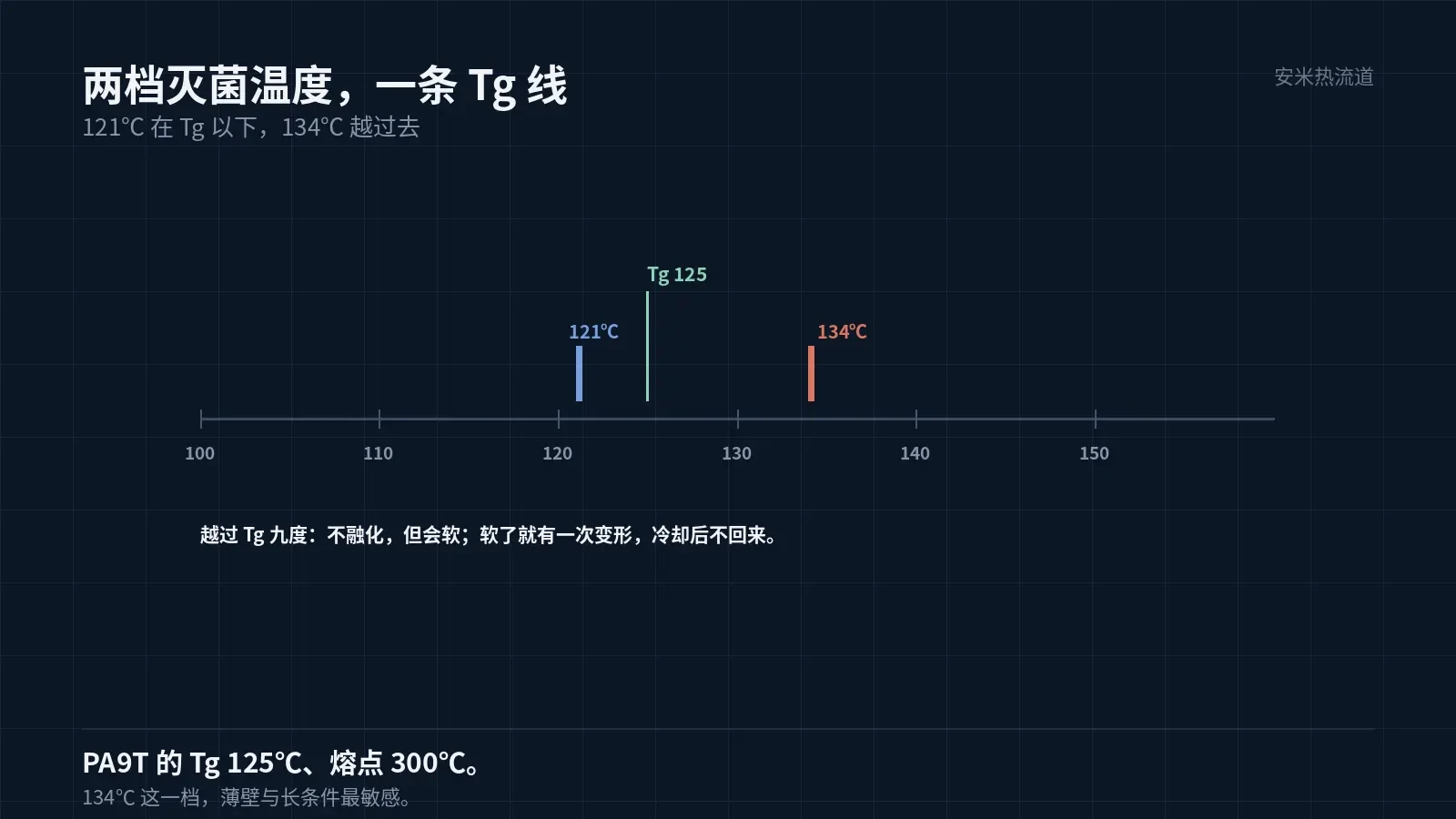
During 134°C sterilization, the entire part exceeds Tg by 9°C. This 9°C difference will not melt the part but may soften it inside the sterilizer: thin-walled parts may deform, pre-tensioned parts may relax, and dimensions may shift permanently.
After cooling outside the chamber, the part returns to a glassy state with restored rigidity, but any deformation incurred will not recover. Therefore, the key concern is not whether it melts, but whether the deformation remains within acceptable limits.
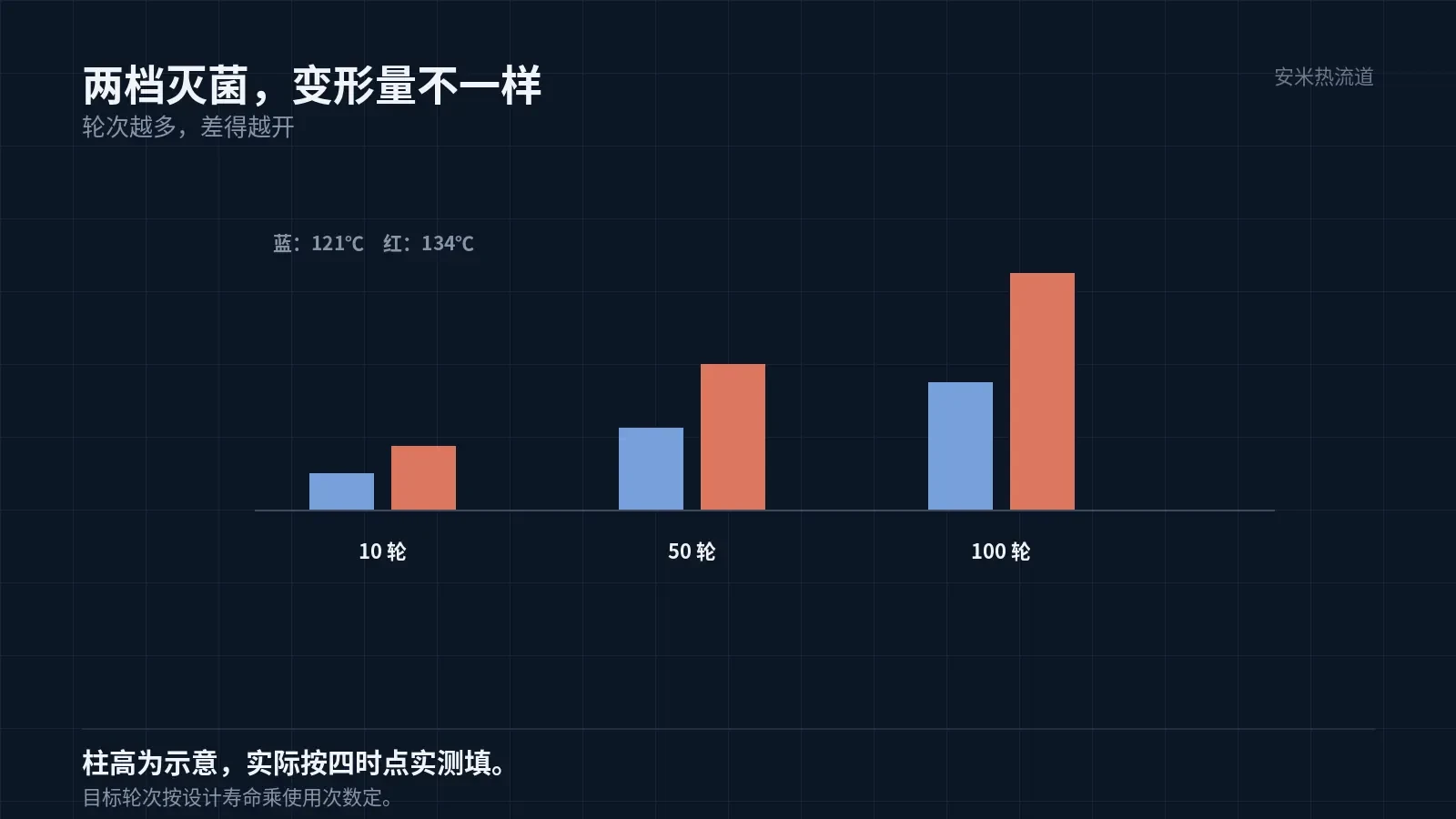
This assessment requires empirical testing: measure dimensions and insertion/extraction forces at four time points—before sterilization, after the first cycle, after ten cycles, and after the target number of cycles—to verify if the curve remains within tolerance.
Another factor to consider is the stress state of the part inside the sterilizer. If parts are compressed or stacked, they will deform in the direction of the applied force while above Tg, and this shape will be retained upon cooling. Loading methods must reflect actual conditions rather than simple flat placement.
121°C vs. 134°C: Different Scenarios
At the 121°C setting, PA9T stays approximately 10°C below its Tg. Dimensional changes are mainly due to moisture absorption, not softening. Using PA9T at this setting carries relatively manageable risks.
At 134°C, parts exceed Tg; combined softening and moisture absorption significantly increase deformation. Exercise caution at this level, especially for thin-wall and long-flow conditions.
If 134°C is required by customer standards, evaluate alternative materials in advance. PPS offers higher temperature resistance and better dimensional stability, while PEI's Tg of 217°C exceeds this threshold; both are viable options.
Substitution is more than just a name change: PPS lacks toughness and is brittle, while PEI requires high processing temperatures and higher costs. Part geometry and mold design must be adjusted accordingly. Changing materials necessitates full part re-validation.
If part toughness is required, PEI is more suitable than PPS: PEI's Tg of 217°C is well above 134°C, so it remains stable during sterilization. The trade-off is higher processing temperature and cost; the hot runner system must be configured for melt temperatures of 350–410°C.
A compromise solution involves separating load-bearing and sealing sections in the part design: use high-temperature-resistant materials for load-bearing areas and elastomers for seals. This controls material costs and prevents deformation from concentrating on the same interface.
Don't Ignore Moisture Absorption
PA9T has a water absorption rate of 0.19% and absorbs moisture more rapidly in steam environments. Moisture ingress during sterilization can cause dimensional expansion and alter insertion/extraction forces.
Parts removed directly from the chamber are hot and wet; measuring them at this stage produces inflated results. Measurements taken after thermal equilibration and moisture stabilization reflect actual service conditions.
Validation records must specify when measurements are taken. For the same part, immediate post-chamber readings versus those taken after 24 hours can differ enough to lead to incorrect conclusions.
Cleanliness and Gate
Medical components allow virtually no black spots, flash, or burrs. Gate locations are a common source of contamination risks.
For this material group, only SD open hot-tip nozzles are recommended. SD achieves cutoff via fast cooling, leaving a small burr that is easy to remove without generating debris.
VG mechanical cutoff can cause tearing with these materials. Torn flash may fall inside the part or remain on the assembly line, which is unacceptable for medical components.
The hot runner must be disassemblable for cleaning. Medical parts require frequent material changes and color switches; residual old material in the manifold can carbonize at high temperatures, causing black spots.
Two Actions for Small-Batch Production
Action 1: Purge the machine once per batch using a heat-resistant purge compound. Incomplete purging leads to color contamination and black spots in the next batch.
Action 2: Run multiple dry cycles at startup until color stabilizes before engaging the mold. Record the number of dry cycles; after ten batches, calculate the startup cost for this machine.
Both actions are production-line-level measures and must be included in work instructions to be effective. If documented only in validation reports, they will not be executed during shift changes.
Validation and Documentation
Validation must cover: sterilization method, temperature, duration per cycle, total cycles, and loading configuration. If any of these five parameters change, re-validation is required.
Documentation must be traceable: material grade, batch number, drying records, mold temperature, and sterilization cycles. Data is valid only if all five items match.
Data from similar parts can be reused, but part geometry, wall thickness, and gate location must be verified as comparable. Significant differences invalidate reuse, as applying another's conclusions to your case is inappropriate.
Please provide the sterilization temperature, number of cycles, part geometry, wall thickness, and current material. We will verify against Tg and moisture absorption criteria before confirming the solution and providing a quote.
MATCHED BY MATERIAL AND DEFECT
This article covers stringing, drooling, clogging, and high-heat resins; refer to SD for gate freeze and break-off.
Register for a selection review and quote
Submit part, mold, and material details. Our engineers will evaluate the gate solution per part and provide a quote.
Upload a 2D layout drawing using the form.
Online selection and quote
Scan to register