
Which Factor Keeps PA9T Dimensionally Stable in Industrial Parts After Three Years?
Material Applications16 min read
On this page
One device has been in operation for three years, with cabinet temperatures consistently around 70°C and relatively high humidity. Measured connectors showed dimensional deviations of less than 0.05mm from factory specifications. This type of feedback is exactly what we look for when selecting materials for industrial components.
PA9T's's reputation in industrial applications stems from two factors: its 0.19% moisture absorption rate and the thermal margin provided by its 300°C melting point. Explaining these separately clarifies where it fits best.
What does a 0.19% moisture absorption rate actually mean?
Moisture absorption is an equilibrium value: the percentage weight gain after a part reaches hygroscopic balance under specific temperature and humidity conditions. A 0.19% rate means a 10g part absorbs less than 0.02g of water.
Water ingress causes dimensional expansion. In semi-aromatic polyamides, moisture absorption occurs primarily in amorphous regions; lower amorphous content leads to less absorption and less expansion. The high rigidity of PA9T's molecular chains is the fundamental reason for its dimensional stability.
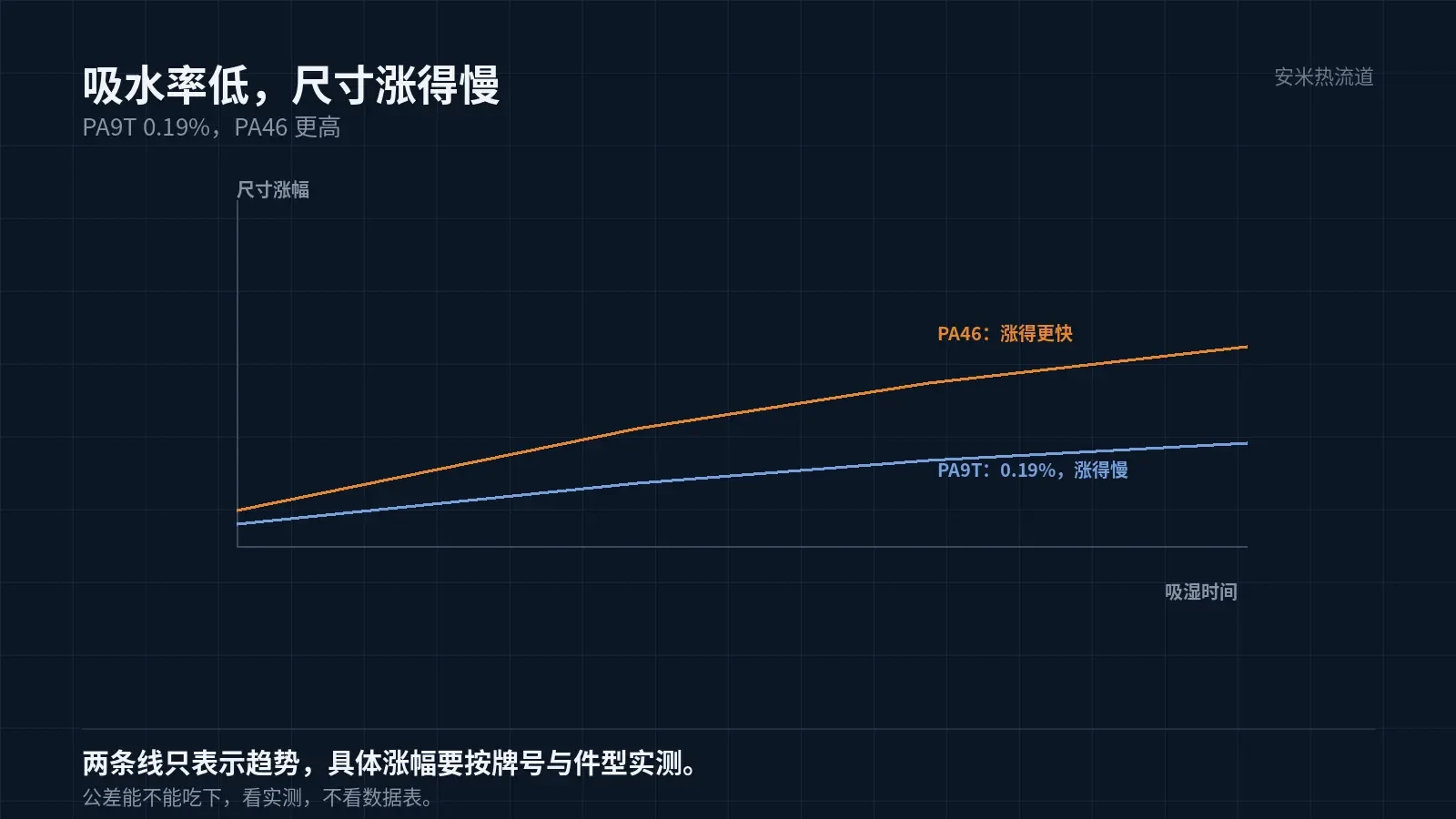
However, 0.19% is not zero. Parts exposed to high-temperature, high-humidity environments for sufficient time will still change dimensions—just less and more slowly. If industrial component tolerances can accommodate this variation, no additional compensation is needed.
Compared to PA46, PA46 absorbs more moisture and experiences greater dimensional changes, making it ideal for parts near heat sources where tight tolerances aren't critical. This key difference largely defines how these two materials are used in industrial applications.
The margin provided by the 300°C melting point
Ambient temperatures inside industrial cabinets are typically low, but local hot spots near components can result from self-heating, radiation from adjacent parts, or occasional short-term impacts.
With a melting point of 300°C, PA9T retains over 100°C of margin between its long-term service temperature and melting point. This margin ensures resistance to softening and maintains mechanical properties after prolonged thermal aging.
Barrel temperatures are 280–320/285–330/290–340°C; nozzle is 300–350°C. These settings exceed those for PA46. When switching materials, fully reset the barrel, hot runner, and nozzle—do not reuse previous parameters.
The OEM does not specify recommended hot runner temperatures. Industrial parts often involve small batch sizes and intermittent machine operation, resulting in extended melt residence times. Temperature settings must be validated against residence time, not just barrel temperature.
Verify chemical resistance for specific media
Industrial environments involve diverse media: cutting fluids, lubricants, cleaners, and mold release agents. Chemical resistance data in datasheets are broad; conclusions may vary significantly based on the specific medium, concentration, and temperature.
List all contact media and verify grade-specific data. If unavailable, conduct immersion tests. Test conditions (temperature, concentration, duration) must reflect actual field scenarios.
Do not claim "chemical resistant" without data or testing. This applies to both content standards and material selection criteria.
Another often-overlooked factor for industrial parts is cleaning. Pre-assembly cleaners can be more aggressive than in-service media. Verify the production line cleaning agents, temperatures, and soak durations.
Gate and long-term conditions
For this material group, only the SD open hot tip is recommended. Industrial connectors are typically elongated, with gates located at one end, the middle, or both ends—each configuration presents specific challenges.
Gating at one end creates long flow paths and low pressure at the far end, resulting in the lowest density and weakest strength there. Gating in the middle places weld lines centrally; if this area carries load, adjust the gate location. Gating at both ends makes temperature balancing difficult, leading to the lowest pressure at the central convergence point.
The SD nozzle leaves a small protrusion. Since industrial parts have less stringent cosmetic requirements than consumer electronics, this mark is generally acceptable. For multi-gate setups, each gate requires independent temperature control; a 10°C difference causes uneven shrinkage on that side.
Start vent depth testing at 0.005mm and increase in 0.001mm increments. If slight flashing occurs, revert to the previous setting. Increasing the depth all at once can cause both overflow and scorching.
Four Verification Points
Measure three samples at each of four time points: initial, post-stabilization, after 24 hours, and after moisture equilibrium. Plotting these four points on a single chart reveals the respective contributions of crystallization and moisture absorption.
Moisture Equilibrium Procedure: Condition parts to match shop floor temperature/humidity or customer-specified standards until weight stabilizes before measuring. Testing after only overnight conditioning yields invalid data.
Insertion and extraction forces must also be measured. Dimensional changes impact insertion force, making this metric a stronger indicator of quality than appearance.

Hidden Costs of Material Changeover
Switching from PA66 to PA9T requires increasing the melt temperature above 290°C, adjusting drying conditions to 70–90°C for 4–8 hours, and re-verifying gate design, venting, and mold temperature.
Drying is often oversimplified. Adequate hopper temperature with insufficient dew point yields no effective drying; inadequate drying time leaves internal moisture that manifests during post-curing or long-term use.
List the four cost factors for material changeover: temperature, drying, mold, and validation. Evaluate all four before deciding to switch materials.
Provide the part geometry, length, contact media, cavity count, and customer-specified tolerances. We will validate the solution based on hygroscopicity and crystallization behavior, then provide a quote after confirming the plan.
MATCHED BY MATERIAL AND DEFECT
This article covers stringing, drooling, clogging, and high-heat resins; refer to SD for gate freeze and break-off.
Register for a selection review and quote
Submit part, mold, and material details. Our engineers will evaluate the gate solution per part and provide a quote.
Upload a 2D layout drawing using the form.
Online selection and quote
Scan to register