
How Many Sterilization Cycles Can PA46 Withstand for Medical Parts?
Material Applications17 min read
On this page
For medical connector material selection, the primary consideration is often not strength but the sterilization method. Autoclave, ethylene oxide (EO), and irradiation each impose distinct material requirements.
PA46 is used in autoclave sterilization because it resists hydrolysis. However, "resistance" is relative; conclusions vary when cycle conditions, temperature, and time change together.
Confirm Sterilization Method First
Autoclave temperatures typically range from 121°C to 134°C. Each cycle lasts tens of minutes, with parts undergoing dozens to hundreds of repetitions.
Ethylene oxide is a low-temperature process with mild temperature and pressure; material challenges primarily involve residue and gas permeability.
Irradiation doses break molecular chains, affecting both color and mechanical properties. The three methods cannot be mixed during validation; choosing the wrong method renders expensive materials unusable.
First, define the sterilization method, temperature, duration per cycle, and total number of cycles. Material selection follows only after these four parameters are established.
Target cycle counts must not be estimated. Multiply the part's design life, sterilizations per use, and spare part ratio to determine validation cycles. Underestimating cycles means passing validation will not guarantee performance through end-of-life.
Division of Labor Between PA46 and PPS in Medical Components: PPS offers superior chemical and thermal resistance along with dimensional stability but is brittle. PA46 provides excellent toughness and mature hydrolysis-resistant grades, making it ideal for parts requiring repeated sterilization and mating/unmating cycles. We recommend the SD Series for both materials.
Hydrolysis Resistance: The Foundation of PA46
PA46 has a high amide group density. Standard grades exhibit non-negligible moisture absorption, while hydrolysis-resistant grades maintain stability in steam environments. Select hydrolysis-resistant variants and avoid using general-purpose grades as substitutes.
Hydrolysis resistance does not equate to zero moisture absorption. Moisture can penetrate components during sterilization, leading to dimensional swelling and changes in insertion/extraction force. These parameters must be measured during validation; visual inspection alone is insufficient.
Color is also an indicator. Significant yellowing after repeated sterilization signals material aging. Even if mechanical properties remain within spec, the safety margin is minimal.
Sterilizer loading configuration affects results: part stacking, orientation, and packaging cause uneven heating. Validation must reflect actual loading conditions; data from single flat-laid parts cannot represent a full load.
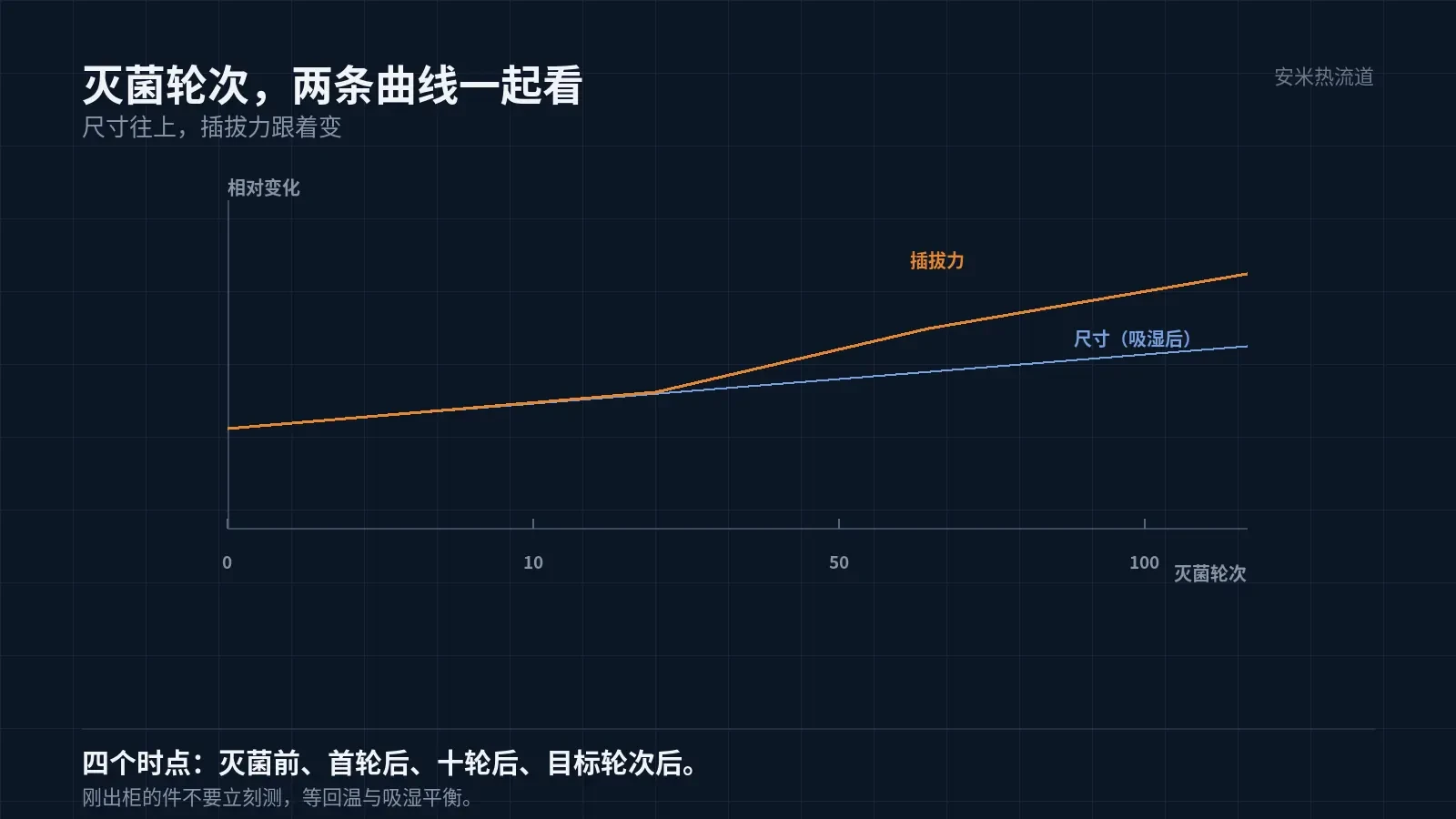
Validation procedure: measure dimensions and insertion/extraction force at four time points—pre-sterilization, after the first cycle, after 10 cycles, and after target cycles. Curve stability is more reliable than single-point data.
Sterilization validation detail: Do not measure dimensions immediately after each cycle. Allow parts to cool to room temperature and reach moisture equilibrium before measuring. Parts fresh from the sterilizer are hot and dry, which can lead to undersized measurements with no valid reference value.
Gate and Cleanliness
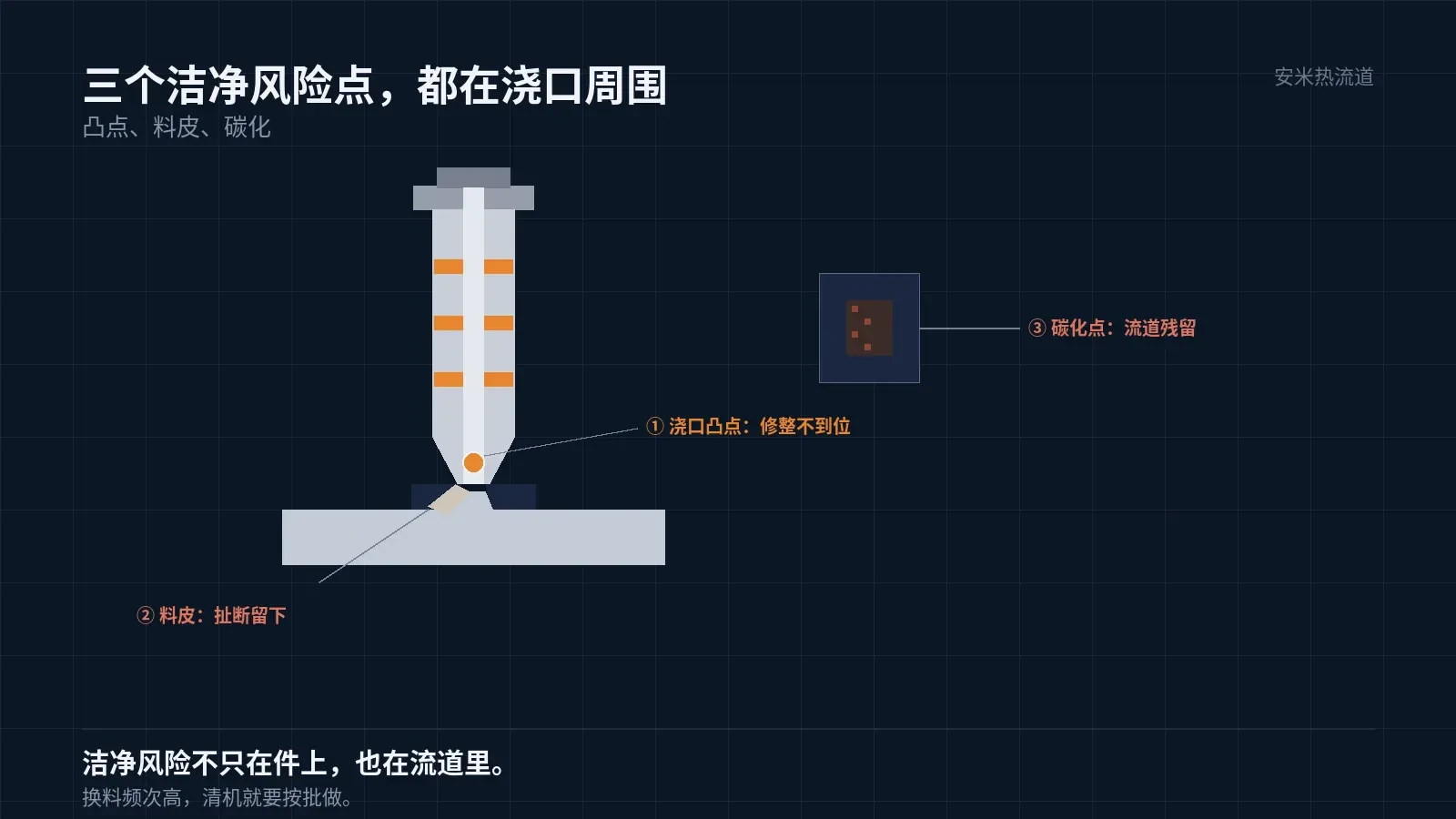
Medical components must be free of black spots, flash, and burrs. Gate placement is a common source of contamination risk.
For this material group, only the SD open hot tip is recommended. The SD gate freeze relies on fast cooling and leaves a small bump; subsequent deburring is simple and generates no debris.
Mechanical valve pin cutting tends to cause tearing in this material group. Tearing leaves flash, creating a cleanliness risk: small debris may fall onto the assembly line or remain inside the part.
The hot runner must be disassemblable for cleaning. Medical parts require frequent material changes and color switches; residual old material in the flow channels carbonizes at high temperatures, causing black spots.
Cleanliness control: Wipe molds each shift, clean the hot runner per batch, and prohibit trimming in the assembly area. These requirements must be included in work instructions to be effective.
Melt Temperature and Degradation
PA4 6 melt temperature must exceed 305°C, with an optimal range of 305–320°C. Medical parts typically involve small batches and diverse varieties, causing machines to start and stop frequently. This results in significantly longer melt residence times in the hot runner compared to mass production.
Longer residence times increase degradation risk. Color darkening is the earliest warning sign; by the time black spots appear, carbonization has already occurred inside the flow channels.
For small-batch production: Purge at the end of each batch using heat-resistant purge material. On startup, run several dry shots until color stabilizes before engaging the mold.
Key records for small batches include: shots from startup to color stabilization, purge frequency per batch, and carbonization point locations. After collecting data from ten batches, the machine's purge cycle can be determined.
A common oversight is packaging. The pre-sterilization packaging method affects steam penetration; overly dense packaging causes uneven heating, leading to artificially favorable validation data. Data is only meaningful if it reflects actual packaging conditions.
Documentation and Traceability
Validation data for medical components must be traceable: material grade, batch number, drying records, mold temperature, and sterilization cycles must all align.
Mold steel and polishing also impact cleanliness. Poor cavity polishing creates drag during ejection, leaving debris on the part. These issues are undetectable before assembly but surface at the customer's end.
Changing the material, mold, or sterilization method requires re-validation. This is not procedural redundancy but a practical necessity for these components.
Archiving validation data by part number enables direct reference for future similar parts, eliminating one trial molding cycle.
Please provide the sterilization method, cycle count, part type, number of cavities, and current gate design. We will evaluate based on hydrolysis resistance and cleanliness standards, then provide a quote once the solution is confirmed.
MATCHED BY MATERIAL AND DEFECT
This article covers stringing, drooling, clogging, and high-heat resins; refer to SD for gate freeze and break-off.
Register for a selection review and quote
Submit part, mold, and material details. Our engineers will evaluate the gate solution per part and provide a quote.
Upload a 2D layout drawing using the form.
Online selection and quote
Scan to register