
Why Must EV Charger Housings Withstand 10,000 Insertions?
Material Applications17 min read
On this page
EV charging guns are plugged and unplugged several times daily, totaling over 10,000 cycles in ten years. Each cycle subjects the housing clips and guide surfaces to stress.
Material fatigue resistance and wear resistance here determine lifespan, not just parameters.
Mechanics of Plugging and Unplugging
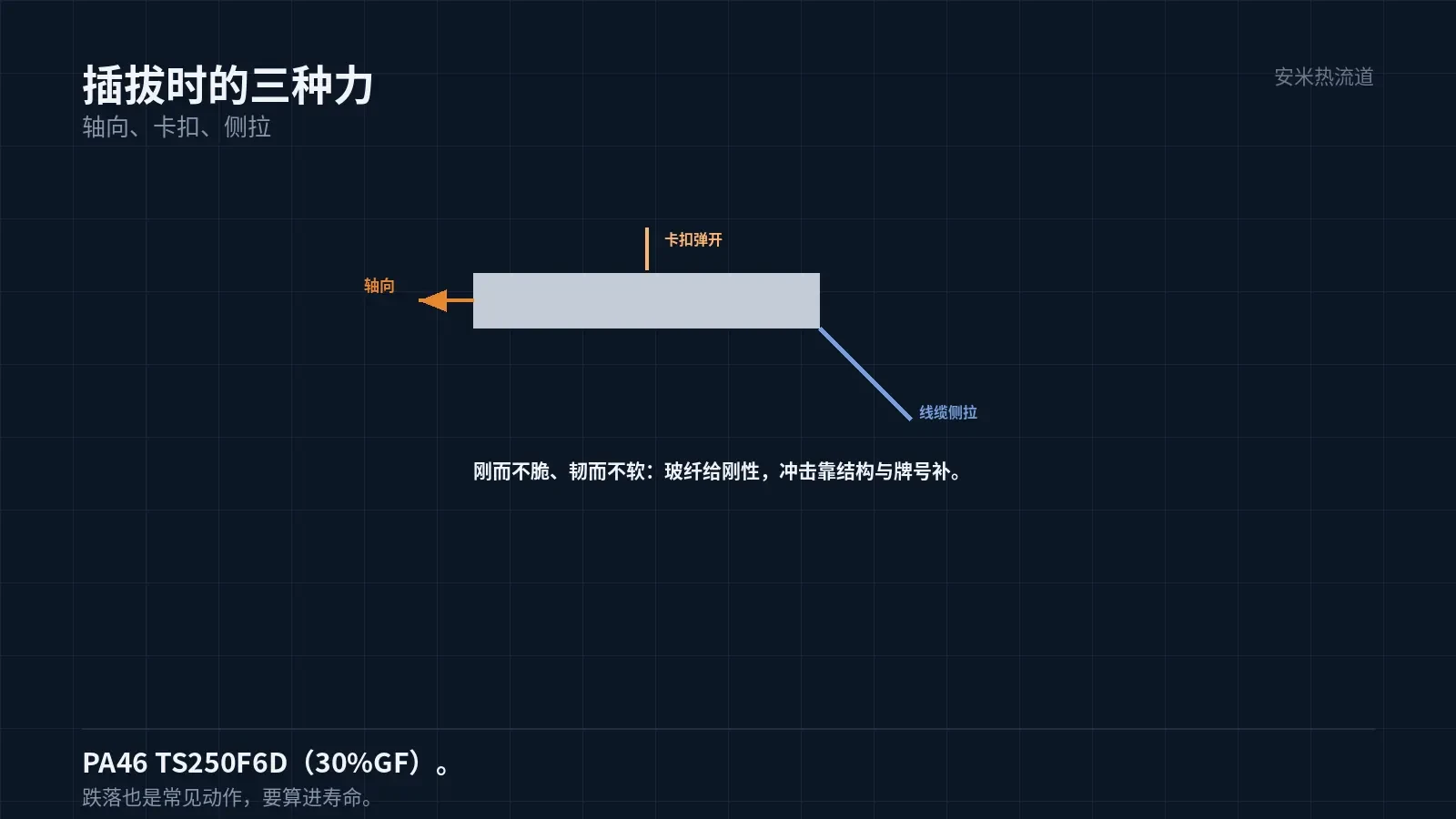
During plugging/unplugging, the housing withstands three forces: axial insertion/extraction force, clip spring-back force, and lateral cable tension.
Axial force arises from friction between pins and sockets. For 16A or 32A guns, insertion/extraction force is tens of Newtons, which is relatively low.
Clip spring-back force is cyclic. Each plug/unplug cycle bends and rebounds the clip, creating fatigue loading.
Lateral cable tension is continuous. When the gun head hangs on the station, cable weight constantly pulls one side.
Combined, these forces require the housing material to be "rigid yet non-brittle, tough yet not soft." This balance is difficult to achieve.
Another often overlooked factor is dropping the gun head. Dropping during removal/replacement at the station is common; impact loads must be included in lifespan calculations.
Drop impacts typically occur at the gun head tail and cable interface. Wall thickness and fillet radii at these locations affect corner chipping more than material grade.
The cable interface has another layer: sealing. The nozzle tip requires IP protection; the O-ring at the interface is under long-term compression, and material creep can cause seal failure.
The O-ring compression rate must be calculated according to standards. The groove in the plastic part changes with temperature, causing the compression rate to vary; this margin must be accounted for in the design.
Insertion and removal of the nozzle tip also wear the O-ring. After several cycles, the O-ring surface becomes fuzzy, reducing sealing performance; this must be tested during life testing.
The O-ring material must also be determined together with the housing. If the housing creeps, even a soft O-ring cannot maintain pressure; they are a matched pair.
Therefore, nozzle tip sealing involves three factors: "material + structure + assembly." Changing only one factor will still result in leakage over long-term operation.
The press-fit force during assembly must also be controlled. Excessive force causes permanent deformation of the O-ring; insufficient force results in incomplete contact of the sealing surfaces.
Trade-offs with PA46
PA46 with 30% glass fiber grade offers good rigidity, with tensile strength on the order of 200 MPa, resulting in minimal deformation during insertion and removal.
However, glass fiber reinforcement reduces impact strength. Corner chipping during drop or crush tests is a weakness of PA46 glass-filled grades.
Two solutions exist: structurally, add fillets and thicken vulnerable areas; materially, select tougher grades (e.g., with impact modifiers).
Both approaches incur costs. Structural changes require mold modifications; grade changes increase material costs. These must be decided early in the project.
Therefore, "using PA46" is not a single decision but a set of decisions: grade, structure, mold, and validation must be determined together.
Snap-fit Design
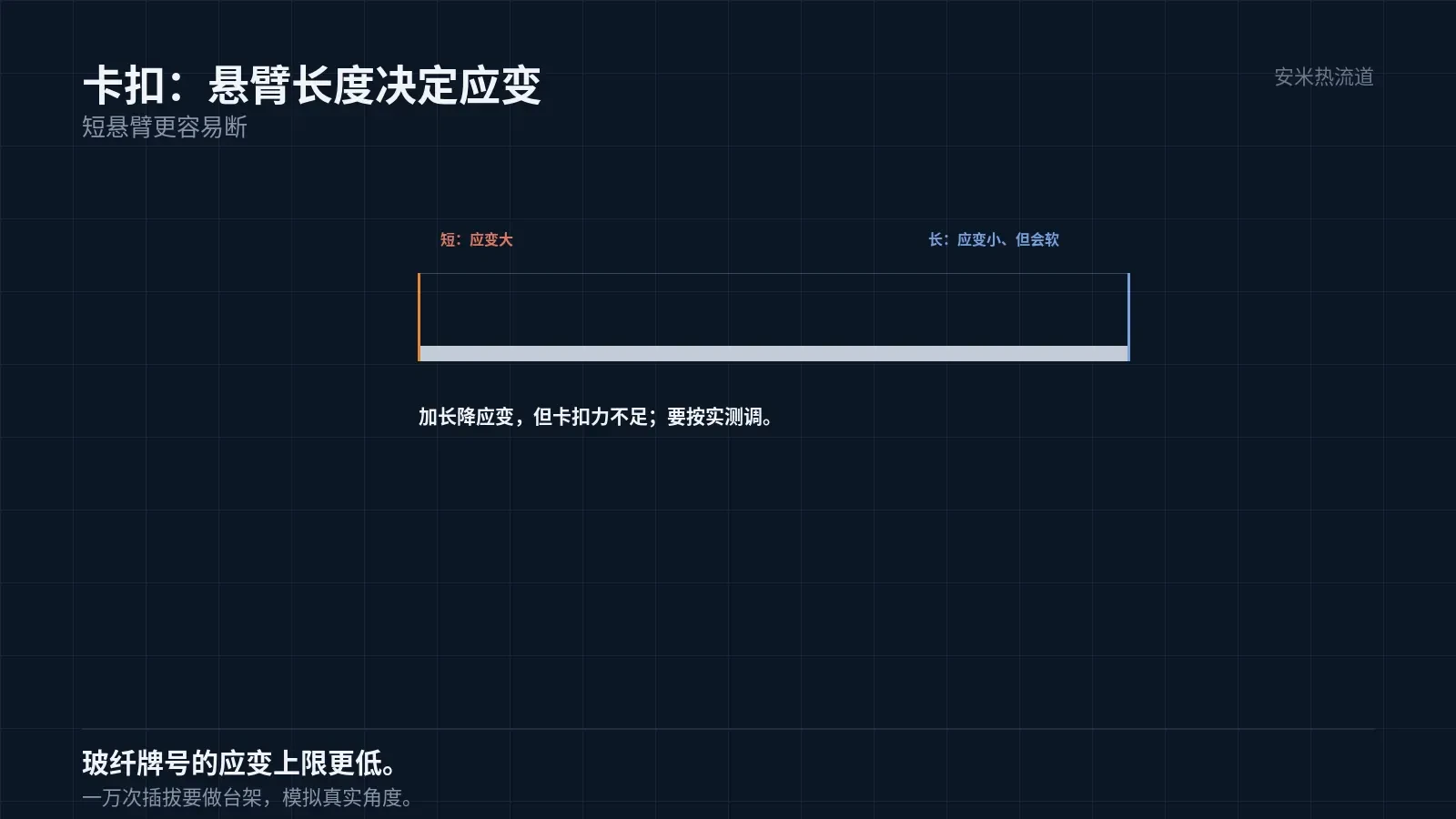
Snap-fit life depends on strain amplitude. Higher strain per insertion/removal cycle results in shorter life.
Empirically, snap-fit strain must remain within the material's allowable range, typically maintaining a safety margin below the material's strain limit.
Glass-fiber reinforced materials have lower strain limits than unreinforced ones. Thus, for the same snap-fit geometry, glass-filled grades are more prone to fracture.
The solution is to lengthen the snap-fit cantilever. A longer cantilever yields lower strain for the same deflection.
However, longer cantilevers become softer, reducing retention force and failing to lock during insertion/removal. This trade-off requires adjustment based on actual measurements.
Weather Resistance: Outdoor and UV Exposure
Charging stations are installed outdoors, with the gun head hanging on the station, exposed to long-term sunlight. UV aging must be considered.
PA46 has moderate weather resistance and requires UV stabilizers. Dark-colored parts offer better weather resistance than light-colored ones because pigments themselves block UV radiation.
Therefore, the color of outdoor components is not merely an aesthetic choice but also part of the weather-resistance design.
The housing must also withstand cleaning. High-pressure water guns and detergents used in car washing cause surface erosion and chemical effects.
This requirement is often overlooked during acceptance testing. Outdoor components should undergo aging tests under combined conditions of rain, cleaning, and sun exposure.
Flame Retardancy and Safety Regulations
The housing of charging equipment must be flame-retardant. Specific ratings should be verified against the customer's safety standards, typically requiring V-0.
Flame retardancy in PA46 relies on flame retardants, which affect mechanical properties, especially impact strength. Review both data sets when selecting grades.
Glow-wire resistance is another requirement. Charging piles contain heat-generating components; housings must withstand glow-wire tests without burning through upon contact.
Glow-wire temperature and duration vary by standard. This requires separate verification and cannot be inferred from flame retardant ratings.
Therefore, "V-0 flame retardant" does not equate to full safety compliance. These are distinct dimensions, and both must be addressed.
Molding Key Points and Verification
The processing window for PA46 is only 15°C: 305–320°C. Below 305°C causes short shots; above 320°C causes degradation.
OEM mold temperature recommendations are unavailable. Due to uneven wall thickness in the housing, use zoned mold temperatures—higher for thick sections, lower for thin sections—to ensure consistent shrinkage.
Purge material during shutdowns. Dwell times exceeding 20 minutes cause degradation, making degraded parts more prone to breakage during insertion and extraction.
Verification includes: insertion/extraction life (tens of thousands of cycles), drop test, weatherability, flame retardancy, glow-wire resistance, dimensional accuracy, and cleaning resistance.
Insertion/extraction life test benches must simulate actual tactile feel and angles. Axial-only testing fails to detect latch fatigue.
Please provide the current rating, mating cycles, safety compliance requirements, operating environment, and latch structure. We will verify based on materials and structure before quoting.
MATCHED BY MATERIAL AND DEFECT
This article covers stringing, drooling, clogging, and high-heat resins; refer to SD for gate freeze and break-off.
Register for a selection review and quote
Submit part, mold, and material details. Our engineers will evaluate the gate solution per part and provide a quote.
Upload a 2D layout drawing using the form.
Online selection and quote
Scan to register