
Why Use PEEK for Micro Connectors?
Material Applications15 min read
On this page
PEEK is rarely used for micro-connectors in consumer electronics. Cost and processing difficulty are key factors. However, there are specific scenarios where it remains indispensable.
This article covers these scenarios and the costs associated with using PEEK.
Scenario 1: Multiple Reflow Cycles
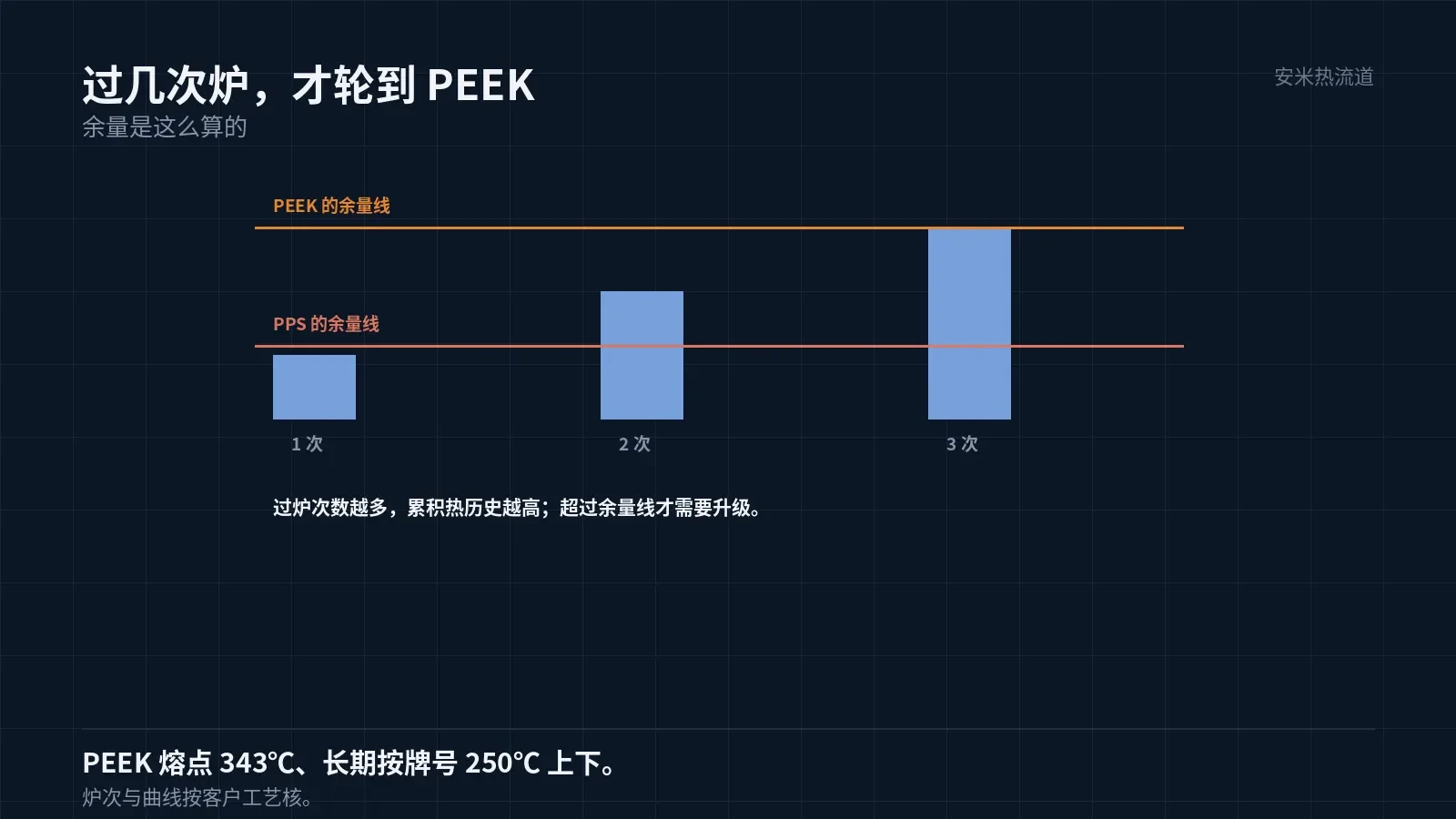
Some connectors undergo multiple reflow soldering cycles or must withstand higher furnace temperatures. PPS performs well in a single cycle, but three cycles lead to cumulative deformation.
PEEK has a melting point of 343°C and a long-term service temperature around 250°C, depending on the grade. This provides greater margin for multiple reflow cycles than PPS.
This requires verification against the customer's reflow count and profile. Not all parts with multiple reflows need PEEK; the decision depends on cumulative thermal history.
Thermal history is calculated by summing the product of peak temperature and duration for each reflow cycle. Upgrade the material only if this value exceeds its tolerance.
Reflow cycle impact is non-linear. Damage accumulates differently across cycles; dwell time matters too, as short intervals hinder proper heat dissipation.
Scenario 2: Chemical Resistance
Connectors may come into contact with cleaners, fluxes, and sealants. PPS is sensitive to certain media; PEEK offers the best chemical resistance in this category.
Verify each media item individually. A material may be stable in one medium but susceptible to stress cracking in another.
Stress cracking requires three factors: a specific medium, residual stress, and temperature. Their combination can cause cracking at stress levels far below the material's strength.
For parts exposed to chemicals, reduce residual stress by using higher mold temperatures, slower cooling, or annealing. This is especially critical for PEEK.
Flux is a common factor. Residual flux during reflow, combined with furnace temperature, affects plastic parts in two ways. Verify this against the customer's process.
Cleaners are another factor. Some lines use solvent cleaning. Micro-parts have small surface areas and numerous crevices where residues are difficult to remove, accelerating aging through prolonged exposure.
Scenario 3: Long-Term High Temperature
Micro-connectors installed near power modules or motors may be exposed to ambient temperatures exceeding 150°C. At this level over extended periods, PPS approaches its thermal limit.
PEEK offers higher margin and better strength retention under prolonged high temperatures. Calculate based on the part's lifespan requirements.
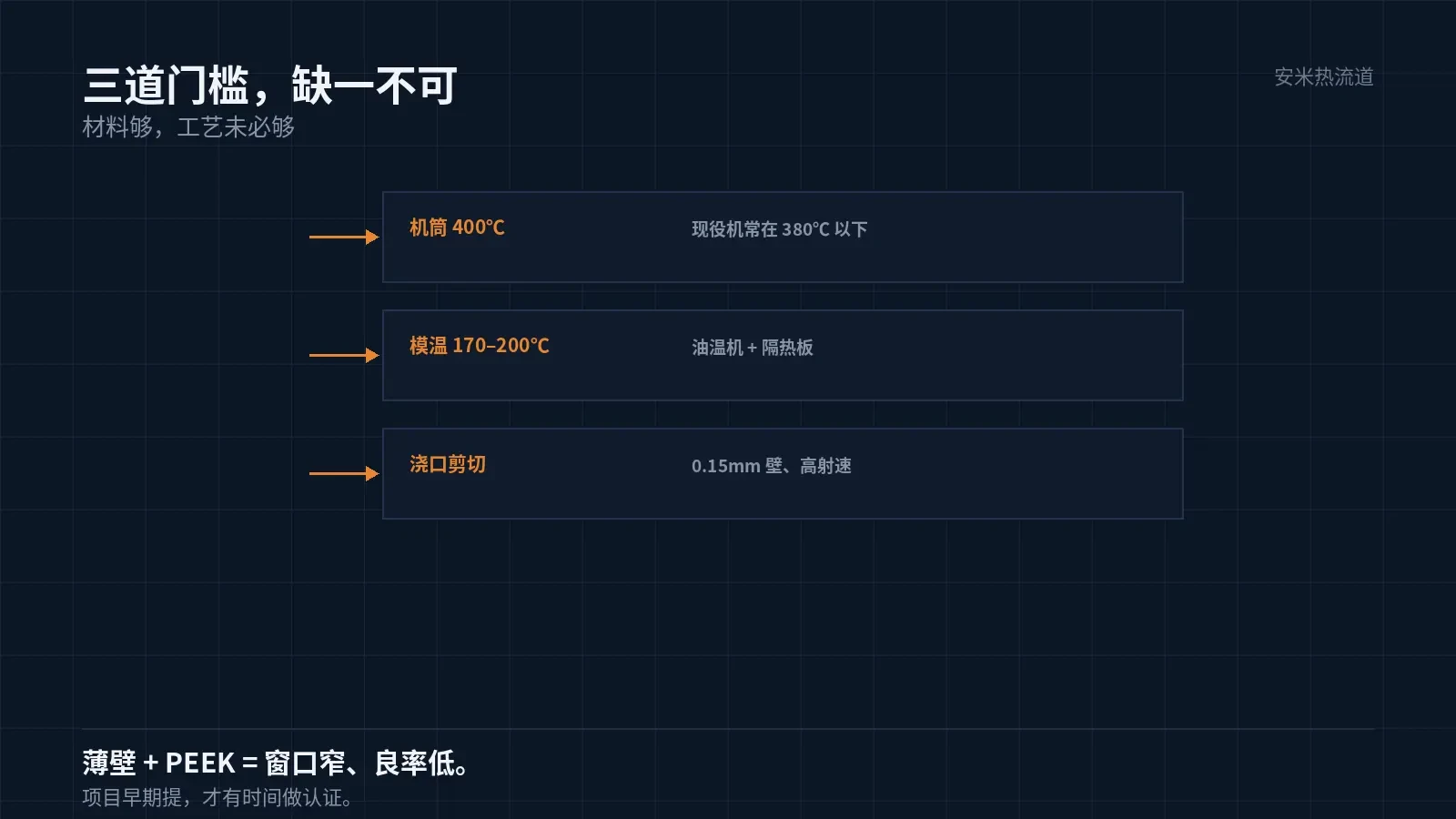
Micro parts have wall thicknesses of only 0.15mm;. Filling thin walls with PEEK is more challenging than with PPS due to high melt viscosity and short flow paths.
Therefore, using PEEK for micro parts often means "the material is sufficient, but processing is challenging." Three hurdles must be overcome: barrel temperature at 400°C, mold temperature between 170 and 200°C, and gate shear.
Barrel temperature is the most common bottleneck. Existing machines often heat below 380°C, failing to reach the required 20°C. Replacing or retrofitting equipment incurs costs.
Mold temperatures of 170–200°C require oil temperature controllers and insulation plates. Higher mold temperatures increase thermal expansion, so cavity dimensions must be adjusted based on operating temperature.
Shear in thin walls demands special attention. With 0.15mm walls and high injection speeds, shear rates at the gate are very high. Due to PEEK's high melt viscosity, shear effects are more severe than with LCP.
Costs: Expenses and Yield
PEEK has high material costs, requires elevated processing temperatures, needs heat-resistant molds and oil temperature control, and results in longer cycle times. These four factors make the per-part cost one tier higher than PPS.
Yield is also lower. The process window for thin-wall filling is narrow; minor parameter deviations can cause short shots or flash. Micro part molds require high precision, leading to high tooling modification costs.
Another hidden cost is certification. Switching materials requires redoing reliability certification, which takes months. For projects with tight schedules, this alone makes PEEK unviable.
Therefore, propose PEEK solutions early in the project. Waiting until just before mass production is not feasible due to time and cost constraints.
Conversely, if a project is already in mass production and the PPS solution works, do not change it. Stable mass production provides greater value than upgrading to a higher material grade.
Therefore, using PEEK for micro parts is typically a last resort. When alternatives exist, prioritize PPS or LCP.
Selection criteria: Multiple reflow cycles, exposure to specific chemical media, and long-term use above 150°C. Choose PEEK only if at least two of these conditions are met.
For the condition "long-term exposure above 150°C," evaluate the component's actual temperature, not the ambient temperature. Components within power modules may locally exceed ambient temperature by 20°C.
If one condition applies, try PPS first. Upgrade only if testing shows it is insufficient. This approach saves significant costs.
Validation: Based on Customer's Actual Operating Conditions
Group 1 (Reflow): Follow the customer's actual reflow profiles and curves. Group 2 (Chemical): Perform immersion tests per the media list, then conduct stress cracking tests. Group 3 (Long-term): Carry out high-temperature storage tests based on lifespan requirements.
After completing all three groups, the need for PEEK becomes clear. For most projects, conclusions are reached after the first group.
Submit the part drawing, wall thickness, lot and curve data, media list, and operating temperature. We will first determine if PEEK is required, then review the process plan.
MATCHED BY MATERIAL AND DEFECT
This article covers stringing, drooling, clogging, and high-heat resins; refer to SD for gate freeze and break-off.
Register for a selection review and quote
Submit part, mold, and material details. Our engineers will evaluate the gate solution per part and provide a quote.
Upload a 2D layout drawing using the form.
Online selection and quote
Scan to register