
Sterilization Trays: Switching from Stainless Steel to PEI
Material Applications16 min read
On this page
Sterilization trays for hospital instruments were traditionally made of stainless steel. In recent years, transparent PEI trays have started to be used in clean operating rooms.
Transparency isn't about looks—it lets you see the instruments inside without opening the lid.
Three Common Issues with Stainless Steel
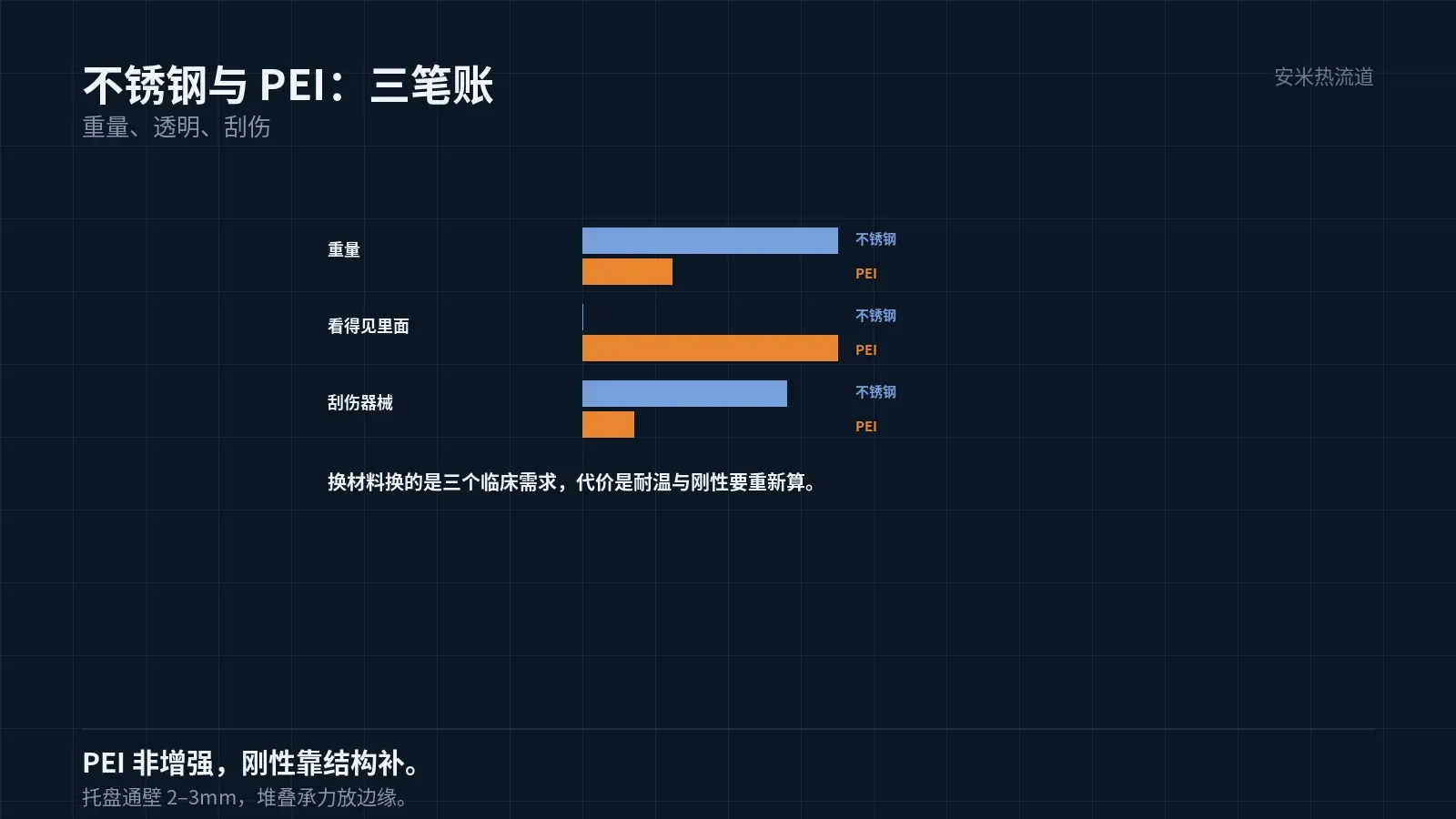
Stainless steel trays are heavy. A tray full of instruments weighs over 10 kg, leading to high physical strain from repeated handling by nurses.
Stainless steel is opaque. Opening the lid to verify proper instrument placement and check for residues introduces contamination risks.
Stainless steel can scratch tools. Metal-to-metal contact damages the cutting edges of precision instruments.
Plastic trays solve these three problems: they are lightweight, transparent, and won't scratch. The trade-off is that temperature resistance and rigidity must be re-evaluated.
Therefore, "material substitution" fundamentally translates three clinical requirements—visibility, portability, and instrument protection—into engineering specifications.
The 134°C Challenge
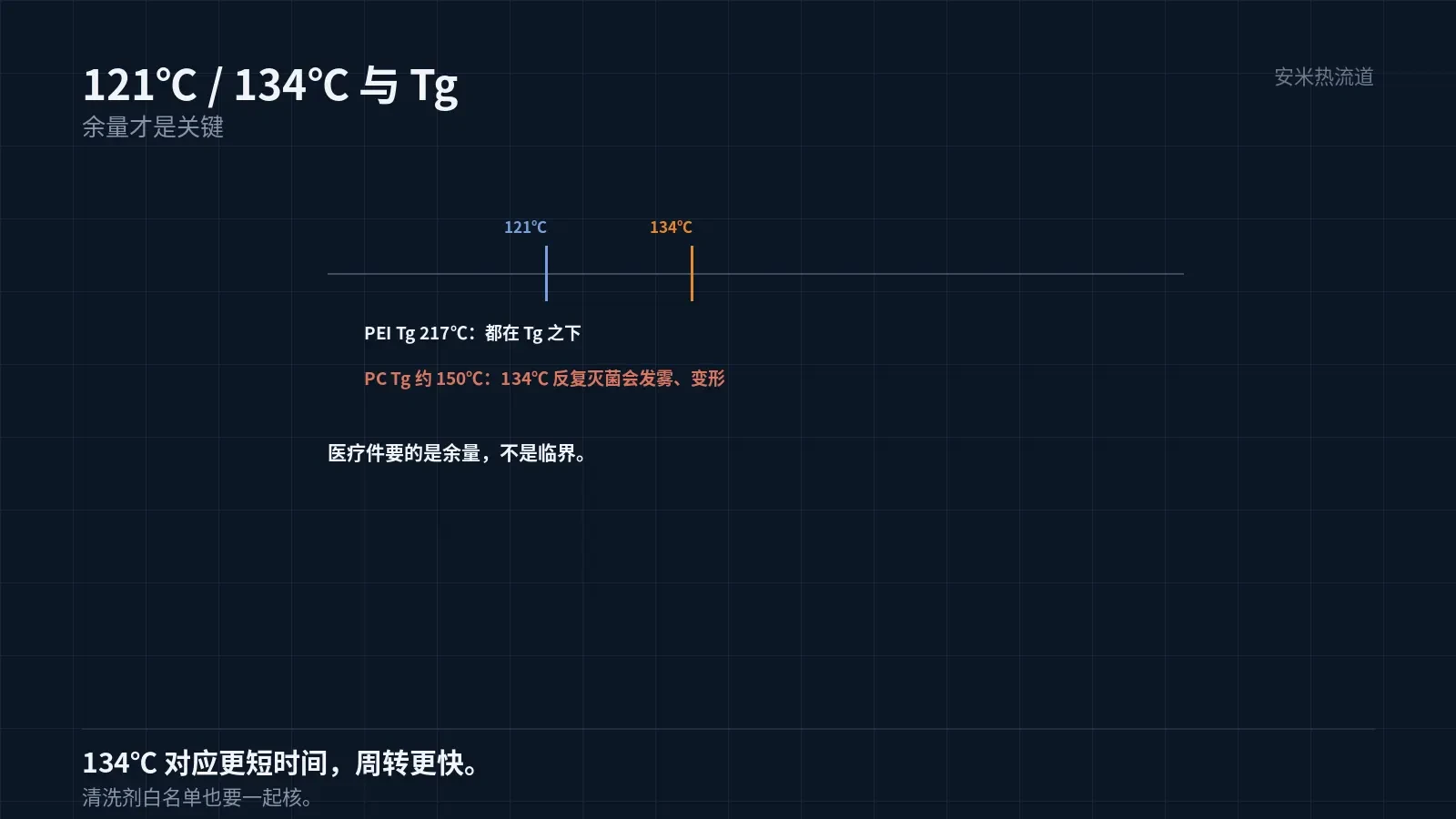
Common steam sterilization conditions are 121°C or 134°C. The 134°C cycle offers shorter durations and faster turnaround, making it the preferred choice for hospitals.
For plastic parts, saturated steam at 134°C presents challenges beyond temperature, including wet heat and repeated cycles.
PEI has a Tg of 217°C. Since 134°C is below the Tg, the material maintains its rigidity and does not deform after repeated sterilization.
PC has a Tg around 150°C. Operating at 134°C is very close to this limit, which can cause haze, deformation, and cracking after repeated sterilization.
This explains why PC isn't used: it's not due to poor heat resistance, but an insufficient safety margin. Medical-grade components require a safety margin, not operation at critical limits.
Transparency and Cleanliness
The primary enemy of transparent parts is internal stress. Stress birefringence creates rainbow patterns that mimic cracks and obstruct observation.
Stress control requires high mold temperatures and slow cooling. For PEI, use the upper end of the 135–180°C mold temperature range to allow sufficient relaxation within the mold.
The second enemy is moisture. If moisture content exceeds 0.02%, bubbles form in the melt, resulting in defective transparent parts.
Drying requires 150°C for 4–6 hours. This condition is more stringent than for other materials, so the drying equipment must reach 150°C.
The third enemy is contamination. Residue in the hopper or barrel creates black spots on transparent parts, so dedicated machines and materials are required for them.
How to compensate for rigidity
PEI is a non-reinforced grade with lower rigidity than glass-fiber reinforced materials. Since trays hold instruments, rigidity must be compensated by design.
Compensation methods include adding ribs, flanges, and fillets. Calculate rib height and spacing based on stiffness requirements—not by experience.
Wall thickness must also be reasonable. Tray through-walls are typically 2–3 mm; walls that are too thin may deform, while those that are too thick increase weight and cycle time.
Another requirement: trays must be stackable. The stacking design should ensure load-bearing occurs at the edges, not on the thin central walls.
This is especially critical during high-temperature sterilization. At 134°C, material rigidity drops, concentrating stacking pressure on the thinnest areas.
Compatibility with Cleaning and Disinfection
Trays must be cleaned in addition to being sterilized. Detergents include alkaline, acidic, and enzymatic types, typically used at 60–90°C.
Strong alkalis cause more PEI erosion than neutral detergents at high temperatures. Prolonged exposure can lead to stress cracking.
Therefore, equipment departments typically maintain a whitelist of approved detergents. Tray materials must be verified against this list, not just by sterilization temperature.
Stress cracks originate at stress concentration points, such as rib roots and screw hole edges. These areas should be filleted in the design.
This point is frequently overlooked during acceptance testing. Parts may not fracture, but cracks can harbor contaminants and pose hygiene risks.
Tray corners are also critical. Right angles concentrate stress and crack first after repeated sterilization; designs should include fillets of at least R3.
Fillet size also impacts cleanability. If too small, brushes cannot reach them, allowing debris to accumulate in areas that sterilization cannot access.
Tray drainage is critical. Flat-bottom trays drain slowly, allowing residual water to form stains during sterilization and leave marks on instruments.
Therefore, trays typically include slight inclines or guide channels. This is a structural design issue that cannot be resolved through mold design alone.
Molding Key Points
PEI belongs to the high-viscosity group and exhibits significant flow resistance. Due to the long runner length in trays, high injection speed and mold temperature are required.
Nozzle temperature: 345–405°C. Select a mid-range value. Lower temperatures increase viscosity and impede filling; higher temperatures risk material degradation.
PEI degrades over time, unlike PPS, whose melt viscosity does not increase during residence. Purge material during shutdowns; avoid prolonged holding at temperature without molding.
Gate dimensions comply with AM industry standards. PEI is compatible with SD, VG, PVG, and TP series. Use the SD series for transparent parts to prevent valve pin marks.
Back pressure: 0.3–0.7 MPa. Insufficient back pressure causes poor mixing and unmelted pellets in transparent parts.
Validation tests include repeated sterilization (multiple cycles), chemical cleaning resistance, transparency and haze, dimensional accuracy, stacking stability, and drop test.
Repeated sterilization is critical. Passing one cycle does not guarantee passing ten; haze accumulation is cumulative.
Please provide sterilization temperature, cycle count, cleaning agents, tray dimensions, and stacking method. We will verify material and structure before providing a quote.
MATCHED BY MATERIAL AND DEFECT
This article covers stringing, drooling, clogging, and high-heat resins; refer to SD for gate freeze and break-off.
Register for a selection review and quote
Submit part, mold, and material details. Our engineers will evaluate the gate solution per part and provide a quote.
Upload a 2D layout drawing using the form.
Online selection and quote
Scan to register