
Instrument Handles for High-Temp Sterilization: Why PA46?
Material Applications16 min read
On this page
Surgical instrument handles must be rigid, lightweight, withstand 134°C steam sterilization, and remain intact without loosening or cracking after dozens of sterilization cycles.
Among these four requirements, "after dozens of cycles" is the most frequently underestimated.
Handle Mechanics
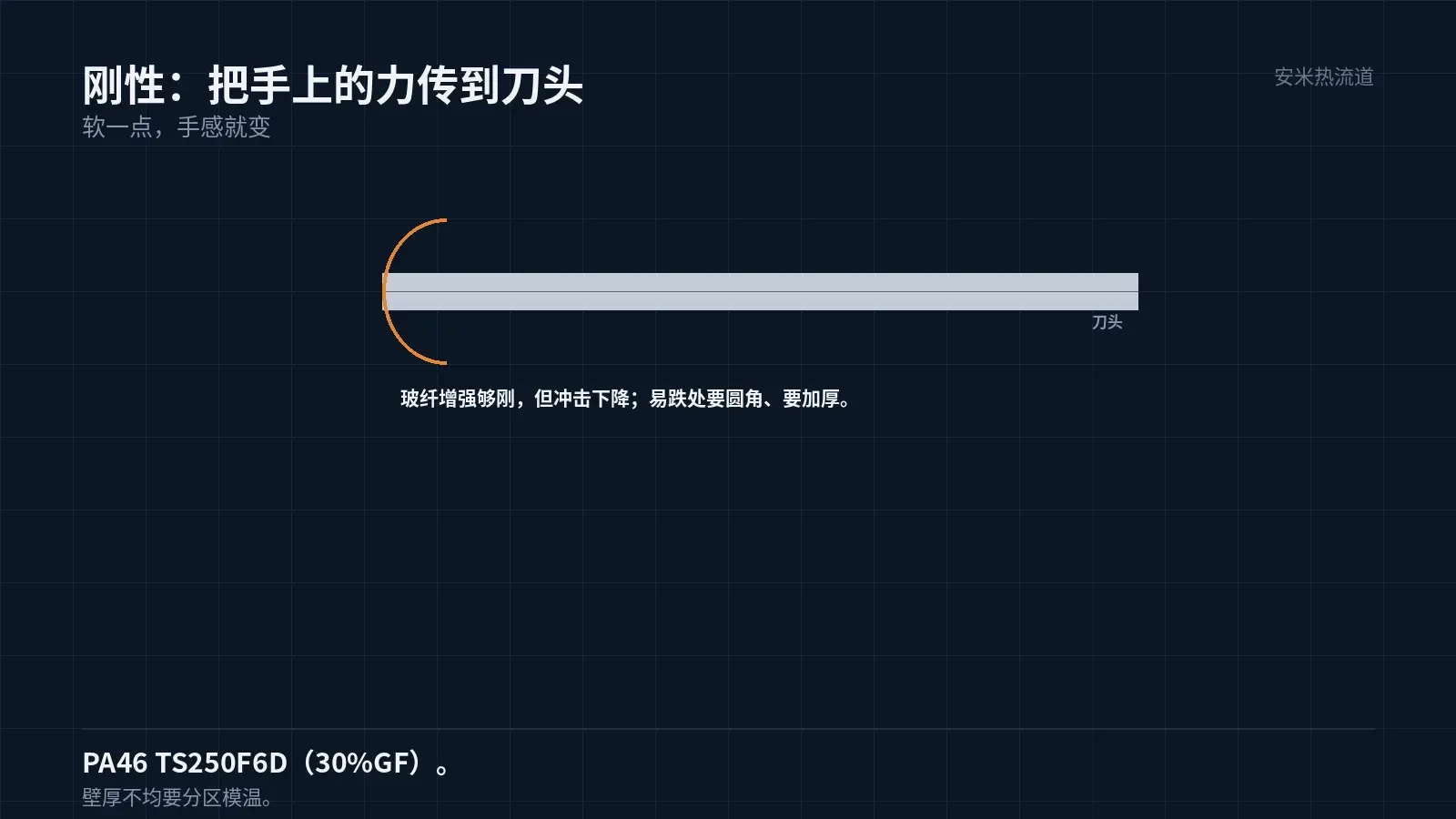
Handles transmit force and torque during surgery. Insufficient rigidity causes a "soft" feel, degrading the surgeon's tactile feedback.
PA46 reinforced with 30% glass fiber exhibits tensile strength of approximately 200 MPa and a flexural modulus of approximately 10 GPa.
This rigidity is sufficient for handles. It's inferior to stainless steel but significantly better than unreinforced engineering plastics.
The downside of rigidity is brittleness. Impact strength drops in glass-fiber-reinforced parts, making corners prone to chipping when dropped.
Therefore, handle structures should feature rounded corners and reinforced sections in drop-prone areas; relying solely on tensile strength is insufficient.
Repeated Sterilization at 134°C
Steam sterilization at 134°C for tens of minutes per cycle; instruments are reused dozens to hundreds of times.
PA46 has a melting point of 295°C and can withstand long-term heat exposure above 150°C. Steam temperatures up to 134°C are within its operating range.
However, "heat resistance" and "moisture-heat resistance" are distinct. Steam contains water, making hydrolysis the primary aging mechanism.
PA46 has a high amide bond density and is theoretically more susceptible to hydrolysis. Actual performance depends on the grade's stabilization system and sterilization duration.
Therefore, validation requires a "sterilization cycle followed by mechanical retesting": measure strength and impact after dozens of cycles.
Water Absorption and Dimensions
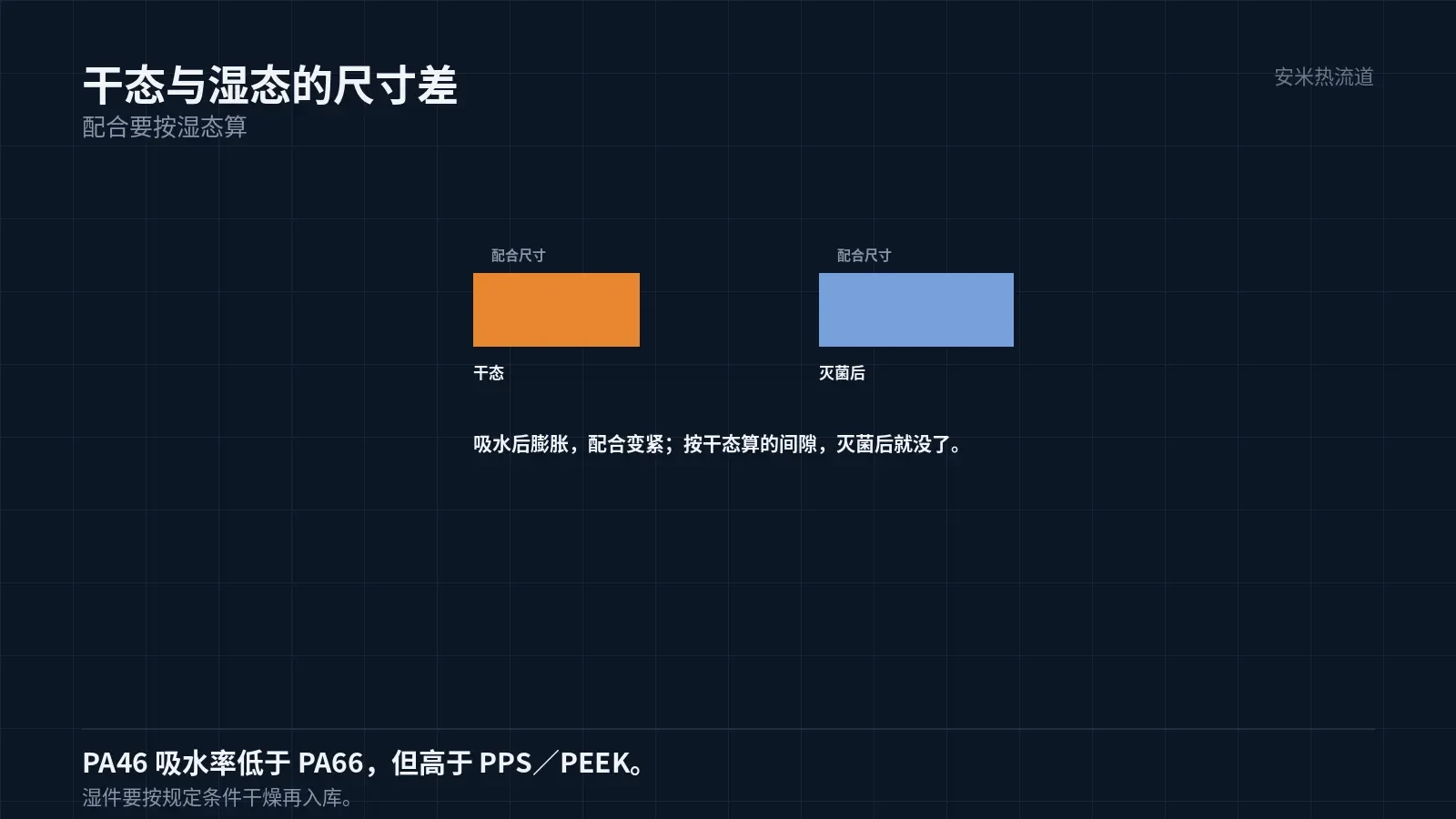
PA46 absorbs less water than PA66 but more than PPS and PEEK. Steam sterilization causes parts to absorb moisture.
After absorption, dimensions increase, stiffness decreases, and surfaces become rough. Mating areas may become too tight or too loose.
Therefore, the handle design must account for "water absorption margin." Mating fits should be calculated using wet-state dimensions, not dry-state.
Post-sterilization drying is also critical. Parts exiting the sterilizer are wet and must be dried under specified conditions before assembly or storage.
This step is often skipped in production, but storing wet parts can cause mold spots or dimensional drift within days.
Molding Window: 15°C
PA46 melt temperature must exceed 305°C, with an optimal range of 305–320°C. Below 305°C causes short shots; above 320°C leads to degradation.
The window is only 15°C narrower than other materials. Mold temperature controllers, zone control, and hot runner temperature control must all be precise.
Handle wall thickness is inconsistent: thick at the grip and thin at the connection. Sink marks and internal stress are likely to occur at the transition zones.
Control methods include gradual transitions and staged holding pressure. Staged holding pressure applies high pressure initially to pack the thick section, then reduces pressure to prevent overpacking.
Purge material during shutdown. Material residence exceeding 20 minutes causes degradation, resulting in yellowing and brittleness of parts.
Mold venting must be sufficient. The handle features deep cavities and thin walls; trapped air causes burns at the transition section, a critical load-bearing area.
Vent depth must be set based on PA46 viscosity: excessive depth causes flash, while insufficient depth leads to burns. Flash on the grip surface requires trimming, which may leave visible marks.
The OEM did not specify mold temperature. Due to uneven wall thickness in the handle, zoned mold temperature control is required: higher for thick sections and lower for thin sections to ensure uniform shrinkage.
Zoned mold temperature control uses baffles or independent cooling channels. This must be defined during the mold design phase.
Preheat inserts as well. Contact between cold metal inserts and molten plastic causes instantaneous cooling at the interface, which reduces overmolding strength.
The plastic layer surrounding inserts must be at least 1.5 mm. Thinner layers are constrained by the insert during cooling, which can cause cracking—often visible after sterilization.
Cracks usually start at sharp insert corners. Fillets and chamfers on the insert influence cracking more than plastic layer thickness.
Therefore, avoid sharp corners in insert design. Use chamfers where possible, as this is less costly than structural changes.
Insert material must match the plastic. A significant mismatch in thermal expansion coefficients causes interfacial stress during sterilization due to temperature changes.
Surface and Cleaning
Instrument surfaces must be smooth and easy to clean. Rough surfaces trap blood and tissue that sterilization cannot remove.
Glass-fiber reinforced parts may expose fibers on the surface. Exposed fibers can hinder cleaning and puncture gloves.
Control methods include high mold temperature, moderate injection speed, and polished mold surfaces. All three are required for a smooth finish.
Additionally, mold release agents are prohibited. Residual agents may leach out after sterilization, creating compliance risks.
Therefore, molds for instrument parts rely on inherent surface quality and ejection design rather than release agents.
Validation and Failure
Validation includes sterilization cycles (dozens of repetitions), mechanical tests (tensile, impact, torque), dimensional checks (dry and wet states), surface inspection, and cleanliness verification.
Three failure modes: brittle fracture (degradation or hydrolytic aging), loose fit (swelling from moisture absorption), and surface fuzzing (glass fiber exposure).
Brittle fracture is the most dangerous among these. It occurs after sterilization, leading to sudden breakage when the instrument is stressed during surgery.
Therefore, mechanical re-testing must be performed after sterilization, not before. This requirement must be included in the acceptance procedure.
Please provide the number of sterilization cycles, device type, loading mode, mating structure, and current material. We will verify against the process window and structure before providing a quote.
MATCHED BY MATERIAL AND DEFECT
This article covers stringing, drooling, clogging, and high-heat resins; refer to SD for gate freeze and break-off.
Register for a selection review and quote
Submit part, mold, and material details. Our engineers will evaluate the gate solution per part and provide a quote.
Upload a 2D layout drawing using the form.
Online selection and quote
Scan to register