
Infusion Connectors: Why PPS Over PC or ABS
Material Applications17 min read
On this page
The infusion connector is a small component that must internally carry fluid, externally connect to tubing, and withstand repeated sterilization. These simultaneous requirements limit material selection.
PPS isn't the strongest material, but it excels in sterilization resistance, dimensional stability, and halogen-free compliance.
First Barrier: Fluid Contact
The infusion connector contacts the fluid directly. The material must not leach, adsorb drugs, or react with them.
Leachable requirements are validated against the customer's compliance list, typically covering heavy metals, plasticizers, and residual monomers.
Adsorption is a separate concern. Some drugs bind to the plastic surface, lowering concentration and compromising dosage accuracy.
PPS has low surface energy and extremely low water absorption, minimizing adsorption and leaching risks. This is the primary reason for its selection.
However, "low risk" does not mean "qualified." Specific compatibility must be verified through immersion testing with actual drugs and cannot be inferred from general material properties.
Repeated Disinfection Challenges
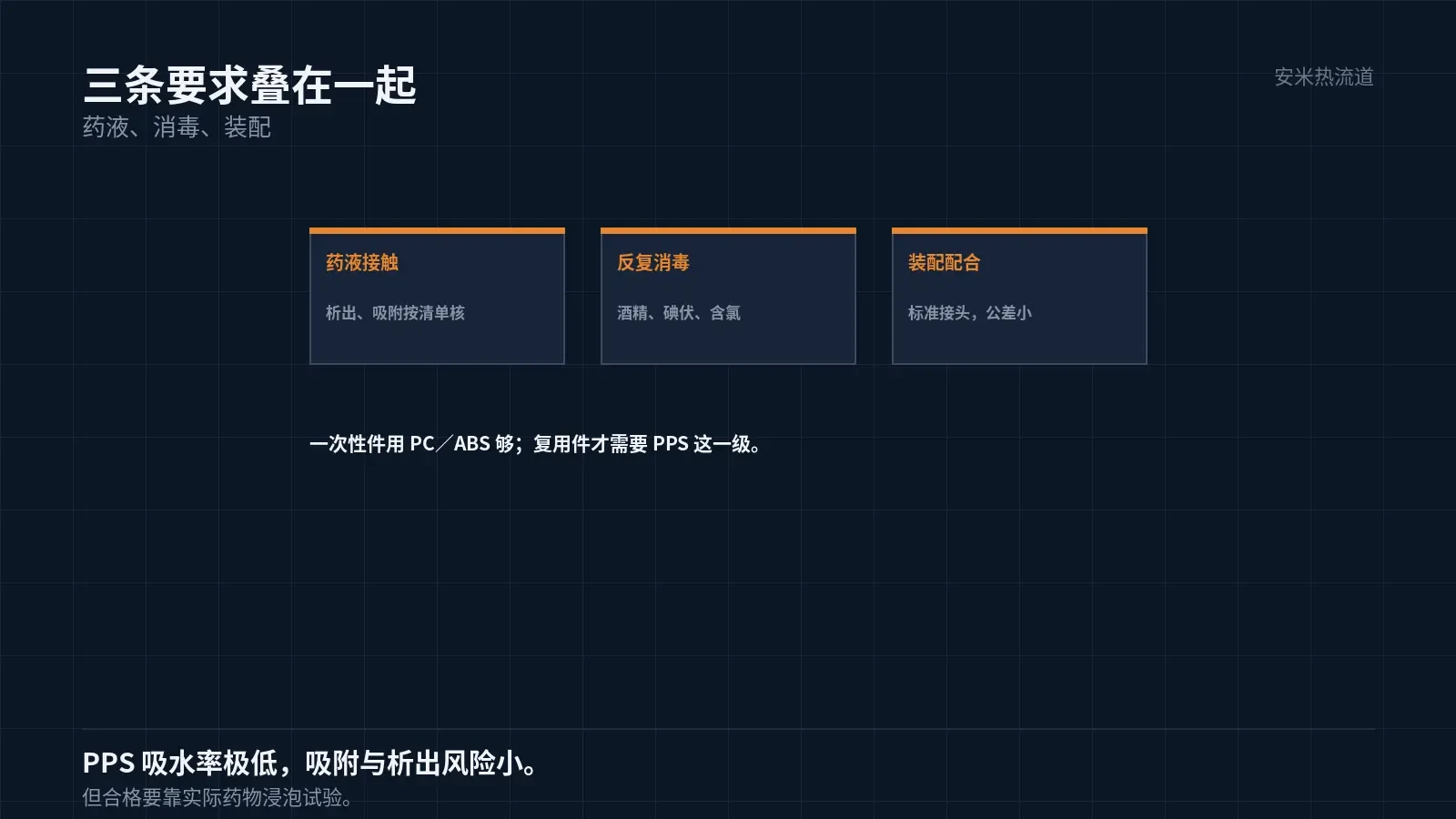
Infusion connectors are repeatedly disinfected in clinical settings using alcohol, povidone-iodine, or chlorine-based disinfectants.
String disinfection differs from immersion: higher concentration, more frequent cycles, and mechanical friction place greater direct stress on the surface.
PPS shows good chemical resistance to alcohol and povidone-iodine. However, prolonged exposure to chlorine-based disinfectants can roughen the surface.
Surface roughening leads to two problems: contamination retention and a higher friction coefficient, resulting in stiff insertion and removal.
Therefore, connector validation must include "stringing cycles + surface roughness" testing rather than relying solely on a single immersion test.
Dimensions: Connector Fit
Infusion connectors are standardized. Mating dimensions for infusion sets and indwelling needles adhere to strict standards with tight tolerances.
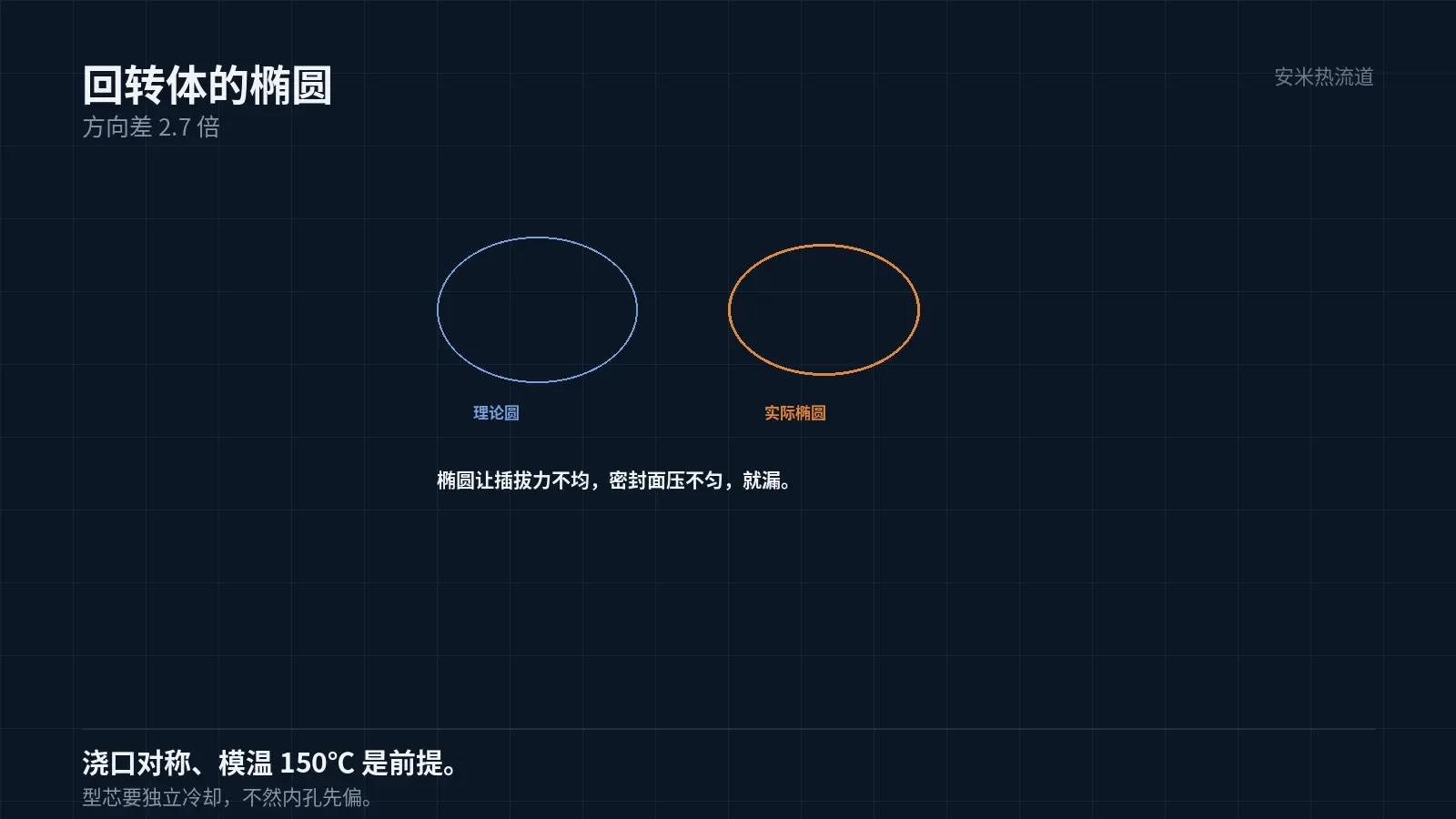
PPS reinforced with 40% glass fiber exhibits shrinkage of 0.3%/0.8%, resulting in a directional difference factor of 2.7. Since connectors are rotational bodies, this anisotropy can cause circular features to deform into ellipses.
Elliptical gates cause uneven insertion/removal forces and potential leakage. Therefore, gates must be positioned symmetrically, and mold temperature must remain uniform.
The connector's inner bore includes an additional layer. Its tolerance is harder to control than the outer diameter because core cooling conditions are less effective than those in the cavity.
Because the core cools slowly, shrinkage varies on that side. Therefore, the core needs independent cooling and cannot rely on the cavity's water channels for heat dissipation.
Complex water channels are not feasible for small cores; fountain-type or baffle cooling is typically used. The difference in temperature uniformity between these two methods must be verified through actual measurement.
A mold temperature of 150°C is required. Low mold temperatures cause incomplete crystallization, leading to continued dimensional changes after sterilization or storage.
This issue is especially pronounced in small parts, which cool rapidly and exhibit greater crystallinity variations when mold temperature is insufficient.
Why not PC or ABS?
PC offers moderate chemical resistance. Prolonged exposure to alcohol may cause stress cracking, particularly in injection-molded parts with internal stresses.
ABS offers weaker chemical resistance and is significantly affected by iodophor and chlorine-based disinfectants. Additionally, its low heat resistance makes it unsuitable for steam sterilization.
PC and ABS are both lower cost than PPS. Therefore, the reason for not using them is the sterilization method, not performance.
If the product is single-use and doesn't contact disinfectants, PC and ABS are sufficient and cost half as much.
Material selection starts by determining: Is the part reusable or single-use? How many reuses and what sterilization method? These answers dictate the material choice.
Intermediate Zone: Parts reused sparingly (e.g., same patient). Material requirements may be relaxed.
Such parts typically define validation cycles as "short-term reuse," ranging from three to five cycles. Fewer cycles significantly expand material options.
Sterilization methods must also be distinguished: stringing, soaking, and machine washing place completely different stresses on materials.
Machine washing uses high water pressure. The impact of high-pressure water on the corners of small parts accelerates surface aging—a factor often overlooked.
Connector validation must simulate machine washing, not rely solely on manual stringing data. These two conditions differ significantly.
Molding Key Points
Pre-dry PPS at 140°C for 3 hours or 120°C for 5 hours. Small parts have low material volume, making effective drying easier to achieve.
Nozzle 310–320°C, mold temperature 150°C, melt temperature ≤ 360°C. These are the specifications for DURAFIDE 1140A1..
Pin-point gates typically use φ0.8–1.2mm.. Use smaller values for small parts, but excessively small gates cause high pressure loss and short shots in thin-wall areas.
Vent depth is 0.005–0.008mm.. PPS has low viscosity; excessive vent depth causes flash, which can create leakage points if it lands on sealing surfaces.
Use the SD Series hot runner. PPS residence viscosity remains stable, supporting continuous production; however, degradation occurs if melt temperature exceeds 360°C.
Validation and Failure
Validation includes: drug compatibility (immersion), extractables, wipe cycles, seal integrity (hold pressure), insertion/extraction force, and sterilization.
Three failure modes exist: leakage (sealing surface or connector ovality), excessive extractables (material or additives), and surface aging (cumulative disinfection).
Among these, extractables are the most subtle. Initial testing may pass, but limits can be exceeded after long-term immersion, indicating cumulative failure.
Therefore, drug compatibility testing duration must be based on actual shelf life; short-term tests cannot substitute for this.
Specify the drug solution type, disinfection method, reuse count, connector standard, and sealing structure. We will verify against material and gate specifications before providing a quote.
MATCHED BY MATERIAL AND DEFECT
This article covers stringing, drooling, clogging, and high-heat resins; refer to SD for gate freeze and break-off.
Register for a selection review and quote
Submit part, mold, and material details. Our engineers will evaluate the gate solution per part and provide a quote.
Upload a 2D layout drawing using the form.
Online selection and quote
Scan to register