
Why Is PEEK Increasingly Used in Medical Applications?
Material Applications16 min read
On this page
PEEK's reputation in medical applications stems from both its performance and its comprehensive compliance system.
Performance is measurable; compliance cannot be bypassed. This article covers both aspects.
Performance: Wear Resistance and Repeated Sterilization
Medical PEEK components fall into two categories: wear-resistant parts for in vitro devices, and implants or peri-implant components.
Wear-resistant components for in vitro devices require low friction coefficients and high compressive strength. Carbon-fiber or glass-fiber reinforced grades are more suitable.
Repeated sterilization has minimal impact on PEEK. It withstands all three methods: 134°C steam, ethylene oxide (EO), and gamma irradiation.
Gamma irradiation harms most plastics by causing chain scission and embrittlement. PEEK's radiation resistance is a key advantage for medical applications.
Therefore, the claim that PEEK "withstands repeated sterilization" must specify the method: it is valid only if it passes steam, EO, and irradiation.

Compliance: Material Grades and Traceability
Medical-grade components require more than just purchasing a batch. You must select medical-grade resins accompanied by the necessary compliance documentation.
Compliance documents include biocompatibility reports, extractables testing, change control statements, and batch traceability.
Implantable devices require stricter standards. Materials must be implant-grade, and the supply chain must ensure full traceability.
This is the main reason medical-grade PEEK is costly. The expense stems not only from the material itself but also from the comprehensive documentation and quality control systems required.
Industrial-grade resins cannot replace medical-grade materials during selection. Even with identical performance, they are unusable without valid compliance documentation.
Processing: No Material Mixing
Medical part processing requires dedicated machines and materials. Residuals from other materials processed on the same machine can cause contamination and cross-contamination risks.
Equipment cleaning must be documented. Screw, barrel, and nozzle cleaning must follow procedures and remain traceable.
Regrind is not allowed. Medical parts generally prohibit regrind usage, unlike industrial parts.
Therefore, material utilization for medical parts is low because gates and runners are fully scrapped, creating a cost structure distinct from industrial parts.
This factor must be included in quotes. Quoting based on industrial part calculations will inevitably lead to losses.
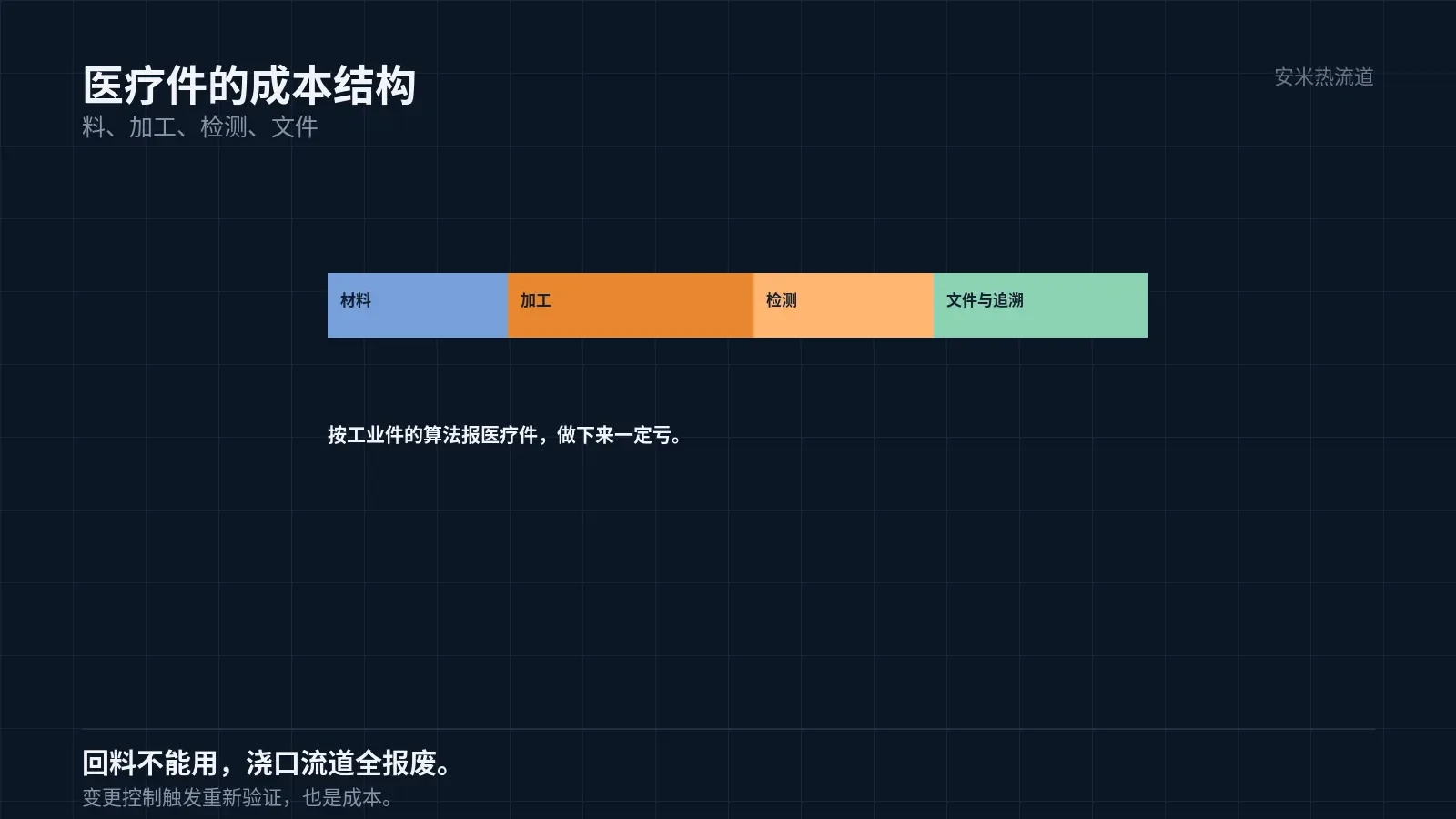
Another cost item is inspection. Medical parts require full inspection or high-ratio sampling for dimensions and cleanliness, resulting in significant per-part inspection costs.
Therefore, medical part quotations typically include four components: "material + processing + inspection + documentation," not just a processing fee.
Documentation is also a cost. Each batch requires inspection reports, retained samples, and traceability records, creating significant workload.
As a result, medical component supply typically relies on long-term partnerships. Switching suppliers requires re-validation, which often costs far more than any potential material savings.
Change control is required. Any modifications to materials, molds, or processes must be re-validated and cannot be made without approval.
This imposes stringent management requirements on suppliers. Even modifying a mold insert may trigger re-validation.
Therefore, medical part molds typically include sufficient backups upfront. Inserts and cores are kept as spares to prevent production stoppages while waiting for new molds.
Spare parts also require first-article validation. If a new insert's dimensions differ from the old one, the part changes accordingly—a detail often overlooked.
PEEK Processing Window
Grade 650G: Rear zone 375°C, middle zone 380–385°C, front zone 390°C, nozzle 395°C, mold temperature 170–200°C.
Barrel heating capacity must exceed 400°C; HT/ST grades require 430°C. Equipment capability is a strict requirement.
Dry at 120–150°C for 3–5 hours. Medical parts are moisture-sensitive; retain drying records.
For molds at 200°C, use high-temperature oil in the water channels. Water temperature is insufficient to achieve the required mold temperature, leading to incomplete crystallization.
Gate dimensions adhere to AM industry specifications. The SD/VG/PVG series are suitable for PEEK; the TP series is not recommended. The VG series is commonly used for precision parts due to its minimal gate marks.
Dimensions and Validation
Parts surrounding implants typically have dimensional tolerances of 0.02–0.05mm.. PEEK grade 450GL30 has shrinkage rates of 0.30%/0, with a directional difference of 3 times.
Gate and part geometry must control directional differences. Ring-shaped and long strip parts are easier to manage; block-shaped parts are difficult.
Validation includes: dimensions, mechanical properties, wear resistance (for friction components), sterilization (multiple methods), biocompatibility, and cleanliness.
Biocompatibility testing must comply with regulatory requirements, involving long cycles and high costs. Schedule this item in the project plan in advance.
Three failure modes must be covered in validation: dimensional out-of-tolerance, excessive wear, and performance degradation after sterilization.
Which components are compatible with PEEK?
Three criteria: repeated sterilization, wear resistance, and chemical resistance. If two are met, consider it.
If only one condition is met, prioritize PPS or PEI due to their lower costs and simpler compliance documentation.
If none of the three conditions are met, using PEEK is wasteful. Medical parts are highly cost-sensitive.
Therefore, the claim that "all medical parts use PEEK" is a misconception. Only a minority of parts use PEEK—specifically those meeting all three conditions simultaneously.
Specify sterilization method, wear resistance requirements, dimensional tolerances, implant status, and target market. We will review based on operating conditions and structure, then provide a quote upon confirmation.
MATCHED BY MATERIAL AND DEFECT
The article covers stringing, drooling, clogging or high-heat resins; check SD for gate freeze and break-off.
Register for a selection review and quotation
Send the part, mold and material details. Our engineers assess the gate solution by part, then provide a quotation.
A 2D layout drawing can be uploaded with the form.
Online selection and quote
Scan to register