
Why Replace Aluminum Alloy with PA46 for Cylinder End Caps?
Material Applications17 min read
On this page
End caps for small-bore cylinders were originally machined from aluminum alloy. Many are now injection-molded in PA46, replacing three parts with one.
Savings come from reduced machining costs, lighter weight, and consistent sealing surfaces.
Three Common Issues with Aluminum Alloys
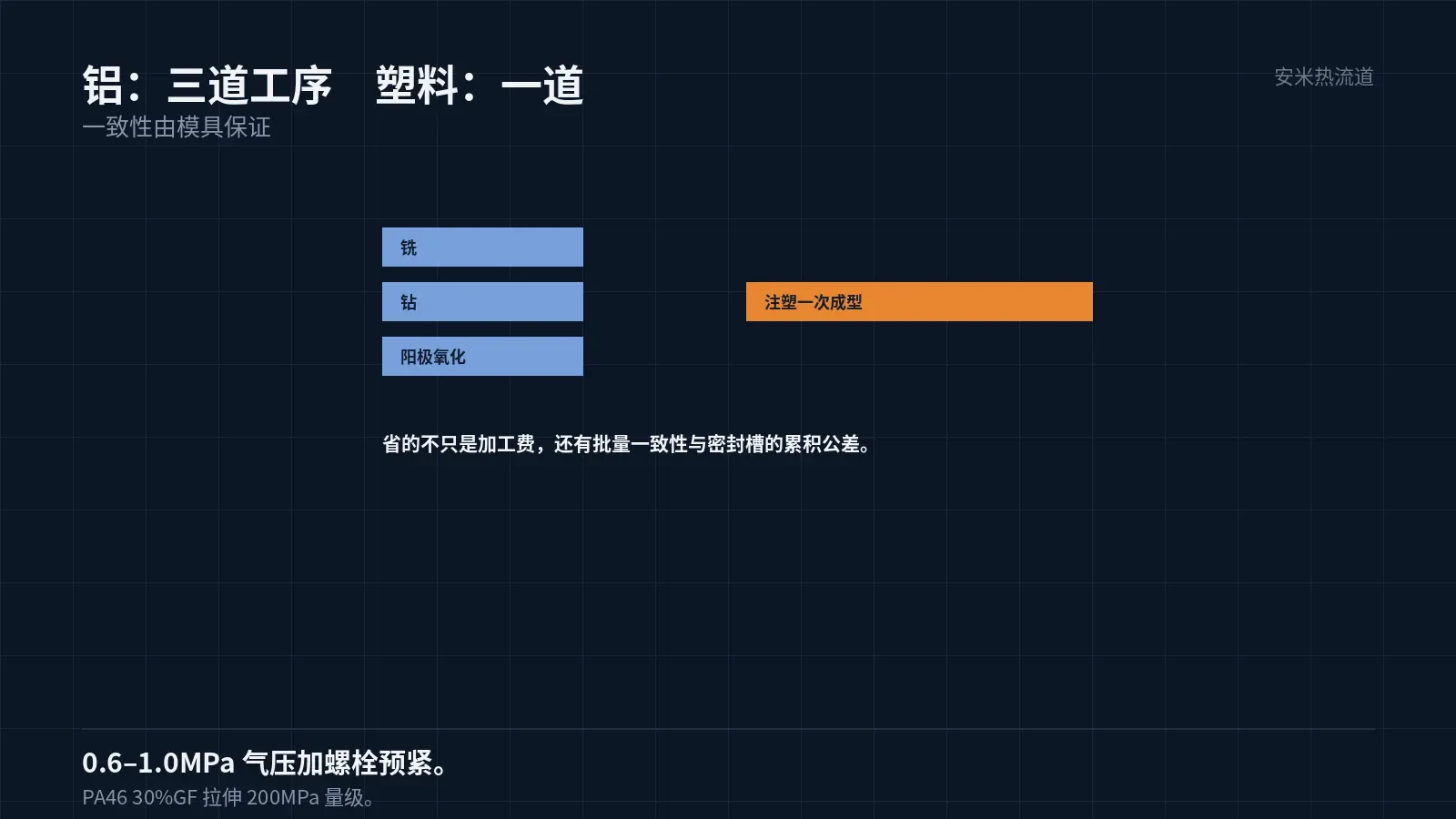
Aluminum alloy end caps require milling, drilling, and anodizing, leading to numerous process steps and long lead times. Unit costs are high for small batches.
Sealing surfaces on aluminum alloys depend on machining, so batch consistency is influenced by tooling and machine conditions, resulting in time-based variations.
Aluminum alloy requires separate machining of seal grooves, with depth and width tolerances accumulating.
Injection molding takes a different approach: the end cap, seal groove, and air inlet are formed in a single step, with consistency guaranteed by the mold.
This is the core logic behind "plastic replacing aluminum" in pneumatic components: it's not about stronger materials, but fewer process steps and better consistency.
Another hidden benefit is corrosion resistance. When scratched, anodized aluminum exposes the substrate, while plastic parts do not rust.
Workshop cutting fluids and cleaners corrode aluminum but have minimal impact on PA46, making it ideal for machining environments.
End cap threads must also be considered. Directly tapping into plastic parts causes thread stripping after repeated use; metal inserts or self-tapping screws are typically used instead.
Self-tapping screw torque depends on the material. PA46 becomes brittle at low temperatures; over-tightening in winter can cause cracking.
A seal is located between the end cap and cylinder barrel. The O-ring groove compression ratio follows standard calculations: excessive depth causes leakage, while insufficient depth prevents assembly.
Compression ratio pitfall in plastic parts: Groove dimensions shift due to moisture absorption and temperature changes, affecting the compression ratio.
Another benefit of injection molding is design flexibility. Internal ribs and airflow channels can be molded directly, while aluminum alloy requires milling.
Design freedom introduces risks: large wall thickness variations cause uneven shrinkage and warpage. For complex structures, perform mold flow analysis early.
Why PA46 Withstands Pressure
Cylinder end caps must withstand air pressure from 0.6 to 1.0 MPa and bolt preload forces during assembly.
The 30% glass-filled grade of PA46 offers tensile strength in the 200 MPa range and flexural modulus in the 10 GPa range, providing sufficient margin for this pressure.
More critically, the cylinder must withstand high temperatures. During continuous operation, housing temperatures near heat sources can exceed 100°C.
PA46 has a melting point of 295°C and can withstand long-term exposure above 150°C, providing ample margin at these temperatures. PA66 is not suitable for this application.
Therefore, PA46 is selected over PA66 for replacing aluminum with plastic in pneumatic components, primarily due to its temperature margin.
Seal Grooves: Injection Molding Challenges
The seal groove depth tolerance is typically 0.05 mm, and the width tolerance is 0.1 mm. These tolerances are achievable via injection molding but require shrinkage control.
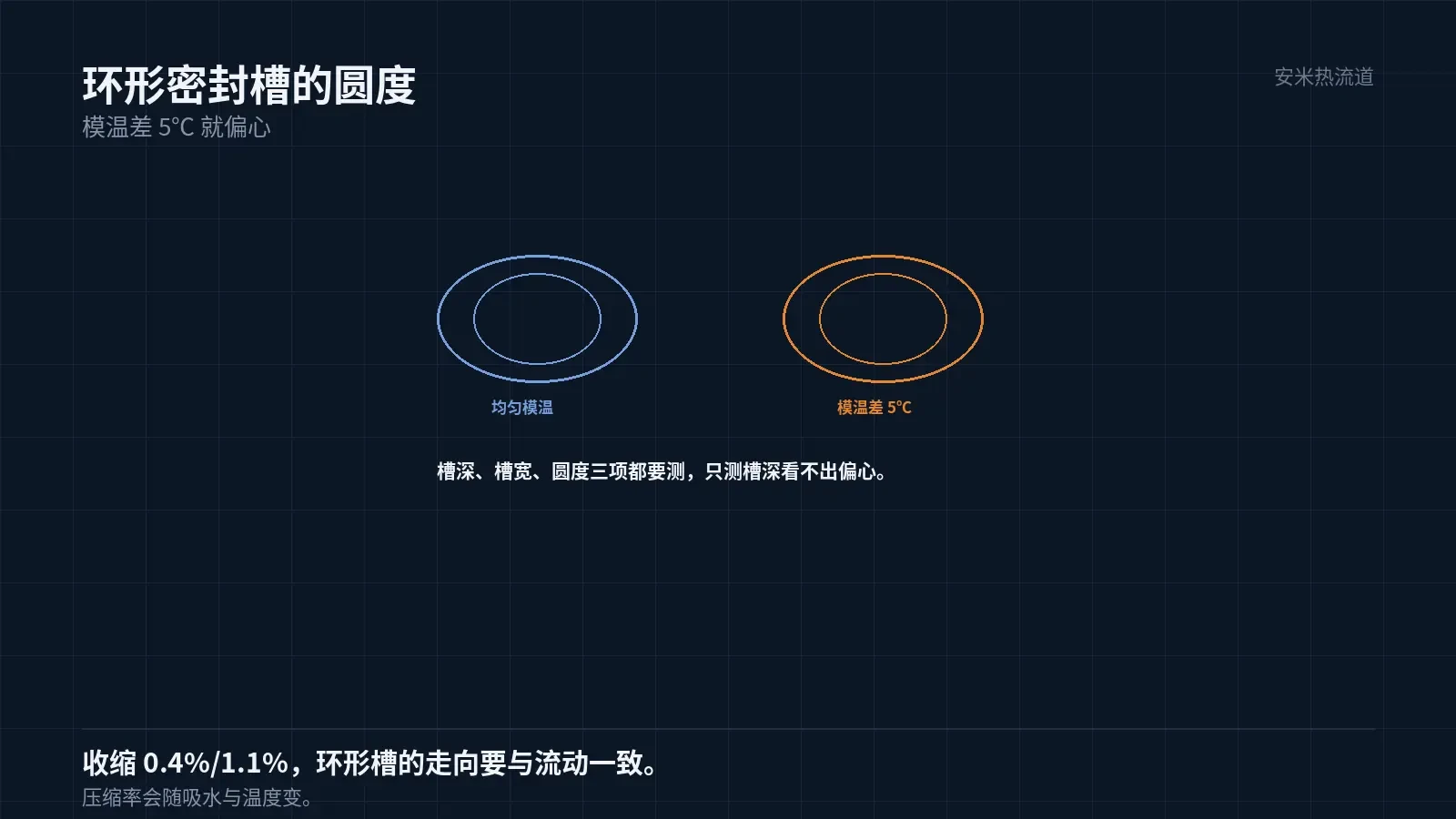
Shrinkage for 30% glass-filled PA46 is 0.4%/1.1%, with directional differences up to 3 times. Differential shrinkage across two directions leads to groove width deviation.
Thus, groove orientation must align with flow direction. For annular grooves, position gates symmetrically on the ring to ensure uniform shrinkage.
Mold temperature must also be uniform. A 5°C difference can turn an annular groove into an eccentric ring, leading to uneven seal compression and air leakage.
During trial molding, measure groove depth, width, and roundness. All three parameters must be verified, not just depth.
Molding Window: A Narrow 15°C Range
PA46 melt temperature must exceed 305°C, with an optimal range of 305–320°C. Temperatures below 305°C cause short shots; above 320°C cause degradation.
The window is only 15°C, half the width of PA66. Mold temperature controllers, barrel zone settings, and hot runner temperature control must be precise.
Purge material during shutdowns. Dwell times exceeding 20 minutes cause degradation. Degraded material cannot be reused as it contaminates the entire batch.
This challenges continuous production. Shift changes, mold changes, and temporary stoppages must follow strict procedures.
Pneumatic components have thick walls and are easy to fill, so set temperatures in the middle of the range to maintain margins on both sides.
Assembly and Failure Modes
End caps and cylinders are typically joined by bolts or snap fits. Bolt preload must be controlled; excessive force can crack the plastic parts.
A common practice is to add metal bushings to transfer preload force to the bushing instead of the plastic. The plastic layer surrounding the bushing must be at least 1.5mm thick.
Three failure modes exist: air leakage (seal groove deformation), cracking (excessive preload or internal stress), and dimensional drift (moisture absorption).
Among these, air leakage is the most common. In most cases, the issue lies not with the O-ring itself, but with seal groove roundness or depth that is out of tolerance.
Therefore, for acceptance inspection of pneumatic components, the three seal groove parameters must be listed separately and not grouped under general "dimensional compliance."
Verification
Verification includes: airtightness testing (pressure drop during hold period), pressure resistance testing (1.5x rated pressure), life testing (reciprocating cycles), and high/low temperature testing.
Life testing is critical. Whether the seal groove wears out or the end cap cracks after millions of reciprocating cycles can only be determined through actual testing.
High/low temperature considerations should account for winter and summer workshop environments, as well as cylinder self-heating.
Another factor is moisture absorption. PA46 expands dimensionally when it absorbs moisture, which reduces groove depth, increases O-ring compression, and raises friction.
Please provide the bore diameter, air pressure, reciprocating frequency, ambient temperature, and connection method. We will verify material and structure before issuing a quote.
MATCHED BY MATERIAL AND DEFECT
This article covers stringing, drooling, clogging, and high-heat resins; refer to SD for gate freeze and break-off.
Register for a selection review and quote
Submit part, mold, and material details. Our engineers will evaluate the gate solution per part and provide a quote.
Upload a 2D layout drawing using the form.
Online selection and quote
Scan to register