
Why Switch from Metal to PPS for Chemical Pump Casings?
Material Applications17 min read
On this page
For low-flow chemical pumps, housings were originally made of metal or PVDF. In recent years, corrosion-resistant pumps increasingly use glass-fiber-reinforced PPS.
The switch is chosen not just for strength, but for its combined advantages in chemical resistance, dimensional stability, and cost.
Define material by medium
The first step in selecting materials for chemical pumps is not consulting strength tables, but listing the media: acids, alkalis, solvents, and salt solutions, along with their concentrations and temperatures.
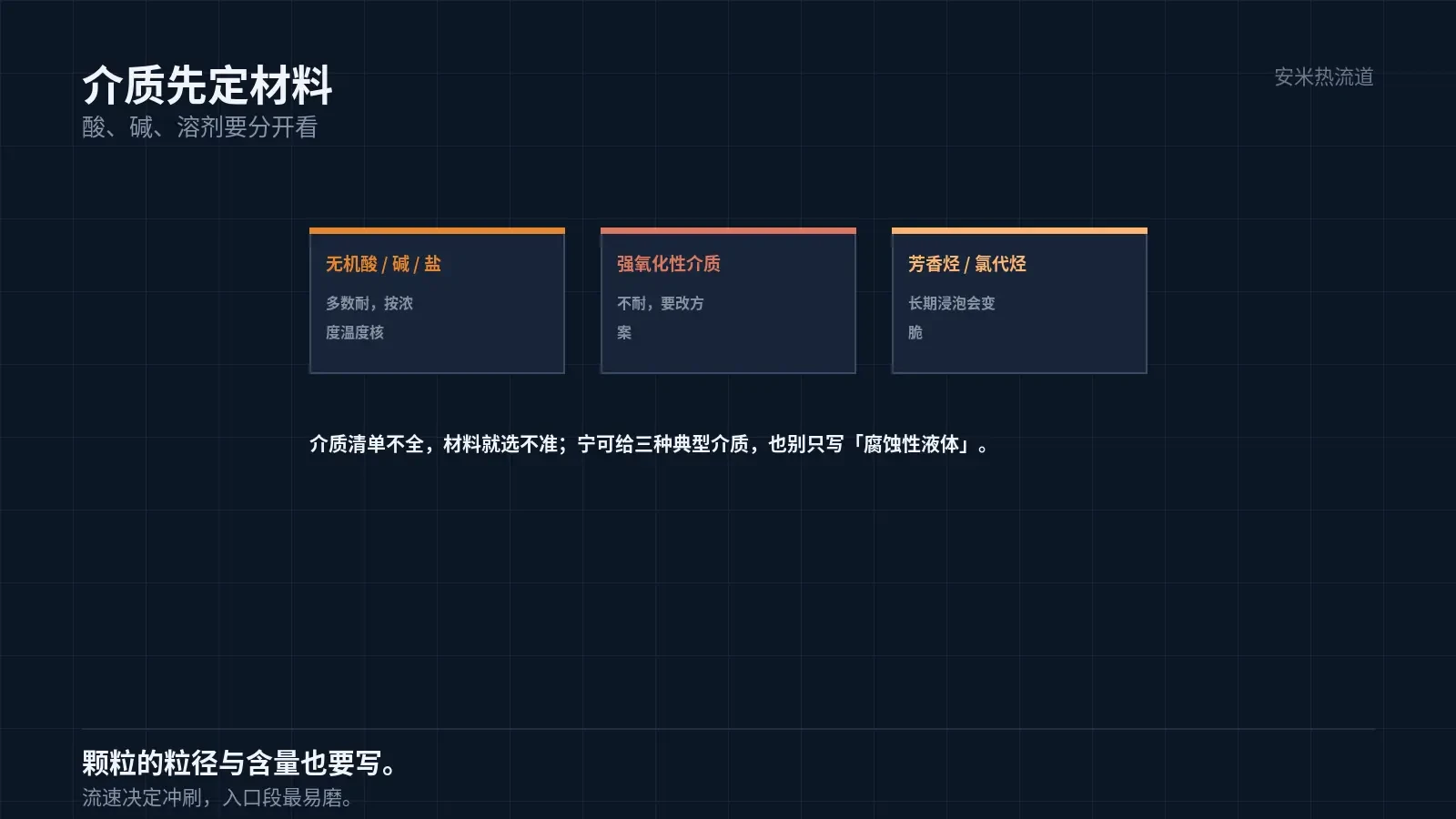
PPS resists most inorganic acids, alkalis, and salt solutions but is not resistant to certain strongly oxidizing media. Resistance depends on the grade and concentration of the medium; do not assume it is universally corrosion-resistant.
Solvents require separate evaluation. Aromatic and chlorinated hydrocarbons affect PPS more than inorganic media, causing parts to become brittle after prolonged immersion.
Therefore, for the same pump handling different media, the material solution may differ entirely. This is often oversimplified to "all PPS" during selection.
Incomplete media lists lead to inaccurate material selection. It's better to specify three typical media types initially rather than just "corrosive liquid."
Selection charts typically include concentration and flow velocity. Concentration determines the corrosion rate, while flow velocity determines erosion wear; both must be specified.
At high flow velocities, the pump housing inlet is most susceptible to damage. Thicken the material in this area or install a metal liner.
Another factor is solid particles in the medium. Particle-laden media cause abrasion, requiring thicker pump casing walls and wear-resistant materials.
Particle hardness is also critical. Sand causes more wear on plastics than metal powder. Specify particle size and concentration during selection.
Combined Effect of Temperature and Pressure
The long-term service temperature of PPS is approximately 200°C (varies by grade). Chemical pump media temperatures typically range from 80 to 120°C, offering adequate margin.
However, pressure affects the assessment. Pump casings must withstand pressure; higher pressure requires thicker walls, making shrinkage and internal stress control more challenging for thick-walled components.
When temperature and pressure act simultaneously, material creep accelerates. Wall thickness adequate at room temperature may be insufficient under long-term pressure at 100°C.
Therefore, pump casing wall thickness must be calculated based on "temperature + pressure + lifespan," not solely on room-temperature pressure test results.
This step is often overlooked. A prototype may pass pressure tests but deform after six months of field operation, leading to leaks at sealing surfaces.
Dimensions: Pump housing sealing surface
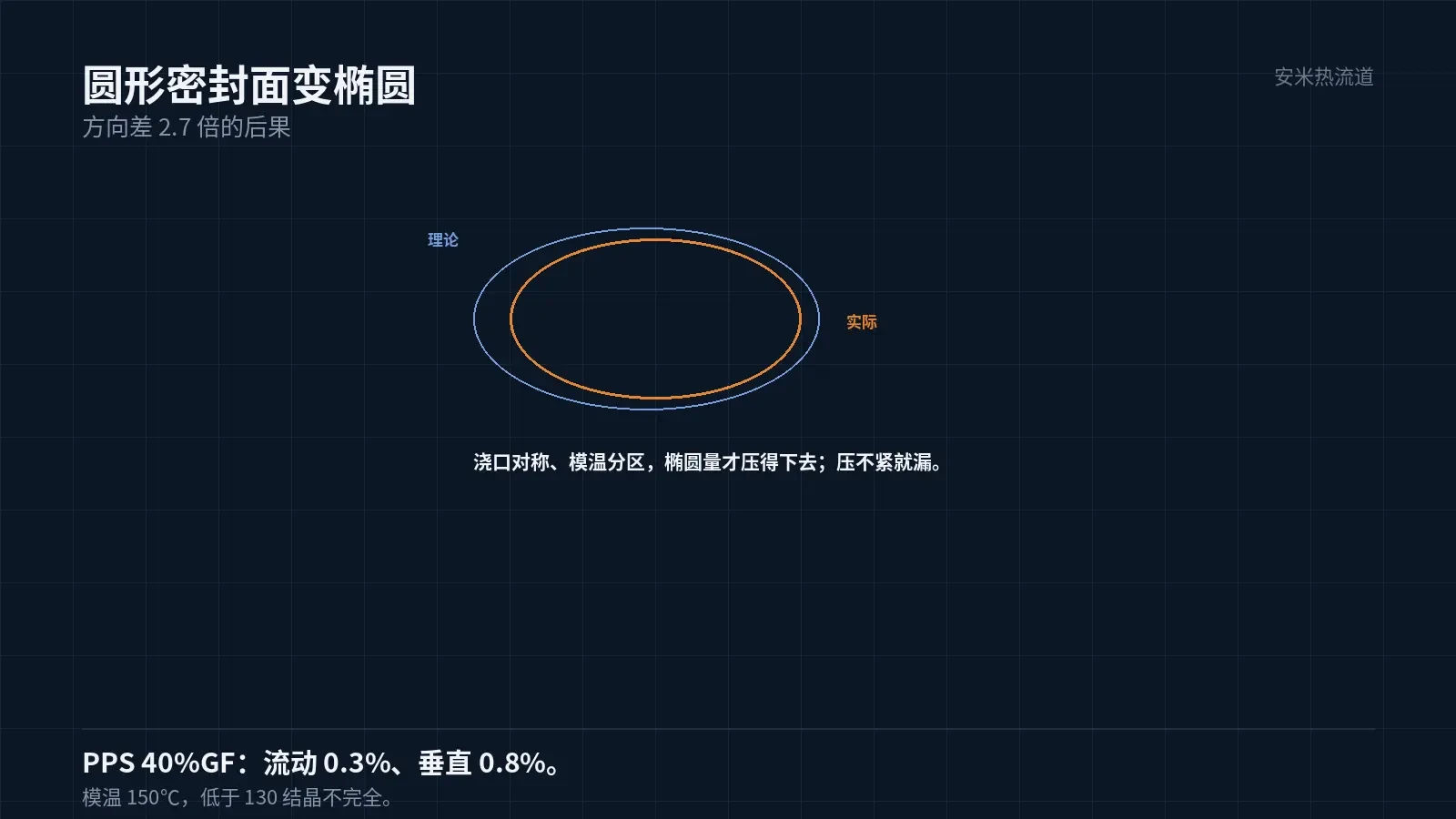
The pump housing sealing surface must be flat; insufficient flatness causes leakage. PPS with 40% glass fiber exhibits shrinkage of 0.3%/0.8%, with a directional difference factor of 2.7.
Large directional differences cause uneven shrinkage on the sealing surface, distorting circular surfaces into ellipses. Elliptical sealing surfaces cannot achieve a tight seal.
Control methods include gate placement and mold temperature. Positioning the gate symmetrically relative to the sealing surface and maintaining uniform zoned mold temperature minimizes ellipticity.
A mold temperature of 150°C is required. Low mold temperature causes incomplete crystallization, reduced part rigidity, and sealing surface bulging under pressure.
Polyplastics DURAFIDE 1140A1 specifications: nozzle 310–320°C, mold temperature 150°C, melt temperature ≤ 360°C.
Differences from Metal
Metal pump housings derive rigidity from the material itself, while plastic housings rely on wall thickness and glass fiber. For equivalent pressure resistance, plastic parts require thicker walls.
Metals have a low coefficient of linear expansion, while plastics have a high one. Plastic parts undergo more significant dimensional changes with temperature variations; compensation allowances must be provided at connections to metal piping.
Metals do not absorb water, and PPS has an extremely low moisture absorption rate, making them similar in this regard. Consequently, PPS provides dimensional stability closer to metals than PA-based materials.
Metals can be welded, while plastics require bonding or mechanical fastening. The connection method determines the pump housing design and mold complexity.
These four factors show that changing materials isn't just about switching resin grades; structural design, connections, and molds must also be adjusted accordingly.
Molding Key Points
Drying: 140°C for 3 hours or 120°C for 5 hours. Although PPS has low moisture absorption, skipping drying can still cause silver streaks, especially on cosmetic surfaces.
Vent depth: 0.005–0.008mm.. Due to PPS's low viscosity, excessive vent depth causes flash. Flash on sealing surfaces can lead to leakage.
Pinpoint gates typically use φ0.8–1.2mm.. For medium-sized parts like pump housings, use the median value; smaller diameters cause high pressure loss.
SD Series hot runners are compatible. PPS viscosity remains stable during extended residence times, offering an advantage for continuous production.
However, residence time does not mean no degradation. Keep melt temperature below 360°C; exceeding this limit causes degradation and reduces part strength.
Validation and Failure
Pump housing validation: hydrostatic test, airtightness, medium immersion resistance, dimensions (including post-immersion), and vibration.
Medium immersion resistance is the most time-consuming test. Submerge the material in the actual medium at the specified temperature for hundreds of hours, then measure its weight, dimensions, and strength.
Three failure modes exist: sealing surface leakage (warping or creep), housing cracking (internal stress + medium), and dimensional drift (post-shrinkage).
Among the three, cracking is the most dangerous. It shows no warning before failure and is only detected during pressure testing, resulting in sudden failure.
Send us the media, temperature, pressure, flow rate, and connection type. We'll verify based on material and gate design, then provide a quote upon confirmation.
MATCHED BY MATERIAL AND DEFECT
This article covers stringing, drooling, clogging, and high-heat resins; refer to SD for gate freeze and break-off.
Register for a selection review and quote
Submit part, mold, and material details. Our engineers will evaluate the gate solution per part and provide a quote.
Upload a 2D layout drawing using the form.
Online selection and quote
Scan to register