
Is PA46 Flow Sufficient for 0.2mm FPC Connectors?
Material Applications16 min read
On this page
PA46 delivers some of the best flow properties among high-temperature nylons. At melt temperatures of 305–320°C, its thin-wall filling performance rivals that of LCP, opening up opportunities for FPC connectors.
However, good flowability also means higher sensitivity to temperature and residence time. This article discusses the actual processing window for PA46 on 0 2mm thin walls and explains why this window narrows.
Adequate Flow Requires Precise Temperature Control
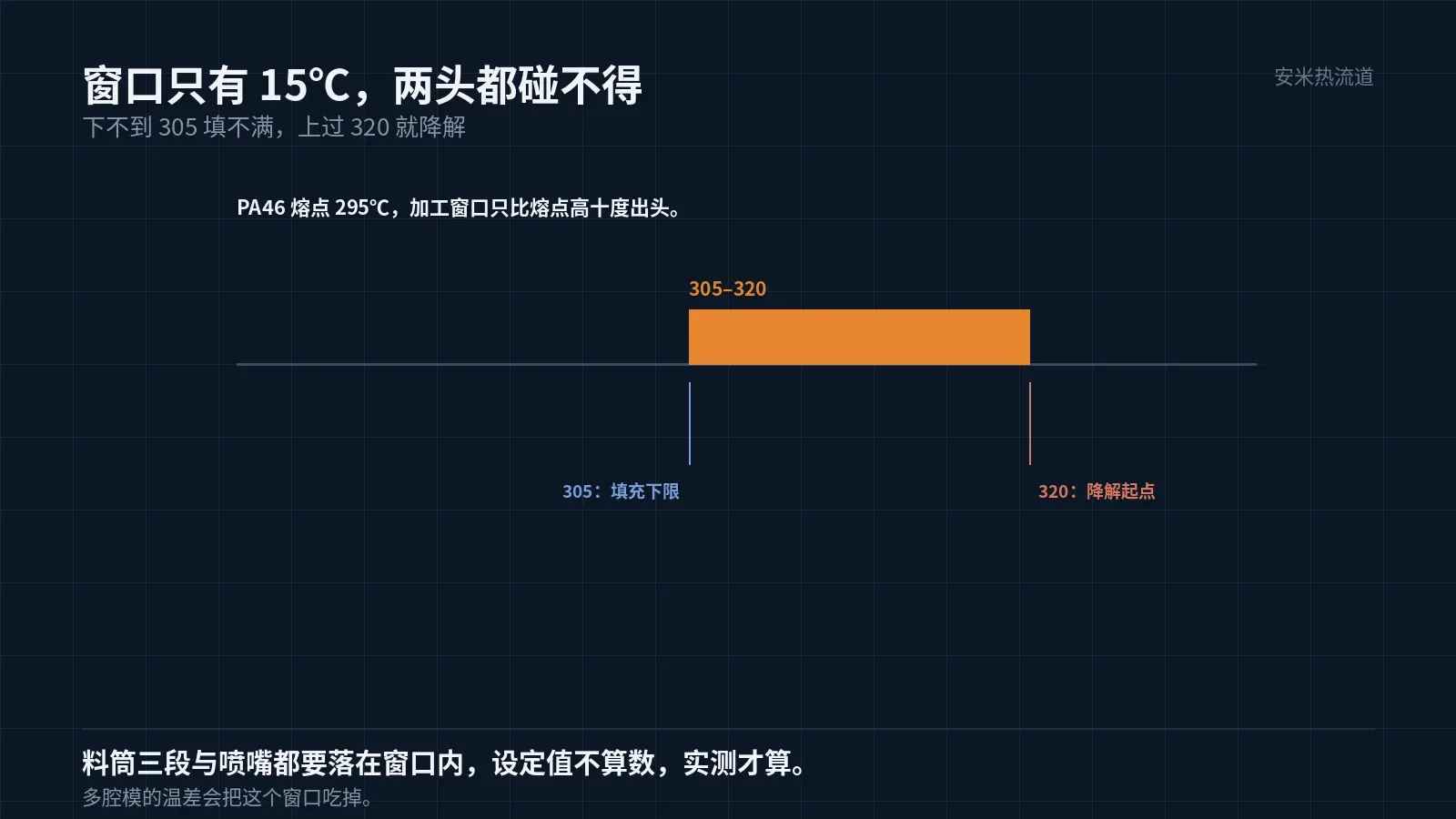
PA46 has a melting point of 295°C and requires melt temperatures above 305°C, with an optimal range of 305–320°C. Below 305°C, 2mm thin walls generally cannot be fully filled; this is a hard limit.
Within this window, PA46 can fill parts with 0.2mm wall thickness and flow length ratios around 70, giving it a competitive edge over LCP in the FPC market.
The window's upper limit is only 320°C; exceeding it causes degradation. The total window width is just 15°C, narrower than that of LCP.
A narrow processing window requires precise temperature control. Actual temperatures in each zone—barrel (three zones), nozzle tip, and hot runner—must stay within the window; setpoints alone are insufficient.
In multi-cavity molds, temperature variations across cavities narrow this window. As the number of cavities increases, compensation depends more on mold temperature and runner balance than on melt temperature.
Residence time in thin walls is more critical than in thick walls.
Thin-walled parts have low melt volume, but the runner inventory remains constant. As wall thickness decreases, the ratio of runner material to part weight increases, leading to longer residence times.
FPC connectors typically weigh 1–3 g. For runners larger than φ6 mm, the runner material volume can be several times the part weight, significantly increasing residence time.
Extended residence causes PA46 degradation. Degradation begins in runner dead zones and progresses to the part, appearing as black spots, embrittlement, and darkening.
For thin-wall hot runner systems, match the runner diameter to part weight; smaller is preferred. This contradicts the common belief that "larger runners fill better."
Smaller runners increase pressure drop, necessitating higher injection speeds that introduce shear. Balancing these factors is the core challenge for PA46 thin-wall molding.
In multi-cavity molds, varying runner lengths between cavities affect residence time. Even minor differences can cause color shifts and black spots to appear first in specific cavities, providing a key diagnostic clue.
Material changeovers and machine cleaning are also critical. PA46 degradation is cumulative; cleaning intervals and procedures must be documented in work instructions rather than relying on experience.
Warpage: 0.4%/1.1% shrinkage under long-term conditions
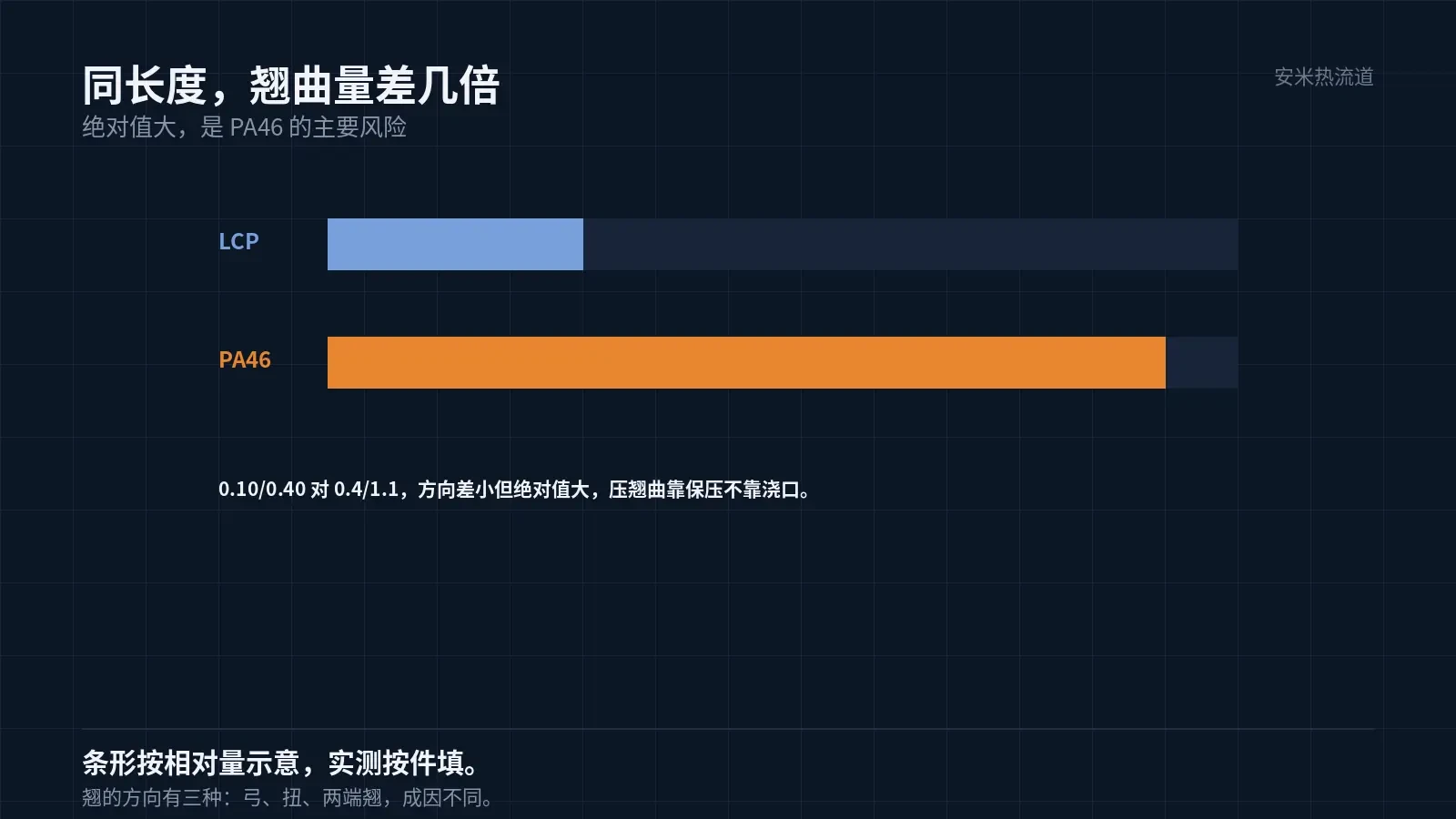
PA46 exhibits shrinkage of 0.4%/1.1%, with nearly a threefold difference between directions. FPC connectors are long components, where directional shrinkage differences are amplified by length, resulting in more pronounced warpage than board-to-board connectors.
LCP has a small absolute value (0.10/0.40), while PA46 has a large absolute value (0.4/1.1). For the same length, PA46 warps several times more than LCP.
Therefore, for PA46 in FPC applications, warpage—not short shots—is the primary risk. Before selecting this material, verify that your coplanarity tolerance can accommodate the expected warp level.
The warpage direction must also be clearly identified. Under long conditions, warpage may appear as bowing, twisting, or edge lift with a flat center. Each type has distinct causes and solutions.
Bowing results from directional differences and is corrected by balancing gate and mold temperatures; twisting stems from temperature imbalances between sides and is resolved by adjusting cooling channels; a flat center with lifted ends typically indicates insufficient holding pressure and is addressed by optimizing the holding pressure profile.
Warpage is controlled by holding pressure and mold temperature, not gate location. Ensure holding pressure is sufficient to seal the gate late; set mold temperature slightly higher to delay gate freezing. Since manufacturers do not provide recommended mold temperature values, determine them through first-article trials.
Reflow Soldering and Moisture Absorption
Melting point is 295°C, and reflow soldering peak temperature is approximately 260°C, providing a 35°C margin. This margin is adequate for reflow but tighter than the 40°C margin required for PA9T.
Adjust the reflow profile based on part thickness and fixture. Thin-walled parts heat up quickly; keep peak time short to prevent softening and deformation.
PA46 absorbs moisture readily and must be dried strictly. Undried material releases steam above 305°C, causing silver streaks on parts—most visible on thin walls.
Storage between drying and molding must also be controlled. Thin-walled parts absorb moisture quickly; leaving them exposed for a few hours causes re-humidification.
When to Choose PA46
First, when high flowability, thin walls, and toughness are required—LCP is too brittle and PPS too stiff—PA46 offers a balanced solution. Second, for operating temperatures around 150°C, where PEEK is cost-prohibitive.
Third, the customer accepts significant warpage, or the part design includes ribs to control it. If the first two conditions are met but the third is not, PA46 should not be selected.
Another practical recommendation: Allocate sufficient time for PA46 mold trials. Due to the narrow processing window and high warpage, finalizing often requires two or three rounds; project schedules cannot rely on LCP experience.
Send us the part drawing, wall thickness, part weight, coplanarity tolerance, and existing hot runner dimensions. We'll evaluate flow window and warpage before providing a quote.
Alternative approach: Run a trial with PA46 in an existing mold designed for PPS or LCP to assess warpage and fill. This trial is far less costly than creating a new mold, yet the data will guide your next steps.
MATCHED BY MATERIAL AND DEFECT
This article covers stringing, drooling, clogging, and high-heat resins; refer to SD for gate freeze and break-off.
Register for a selection review and quote
Submit part, mold, and material details. Our engineers will evaluate the gate solution per part and provide a quote.
Upload a 2D layout drawing using the form.
Online selection and quote
Scan to register