
When Is FHFC Truly Necessary?
Material Applications16 min read
On this page
After writing over 100 articles, the most common question is: "Should I use variable temperature for this mold?" The answer depends not on equipment settings, but on whether gate conditions affect part quality.
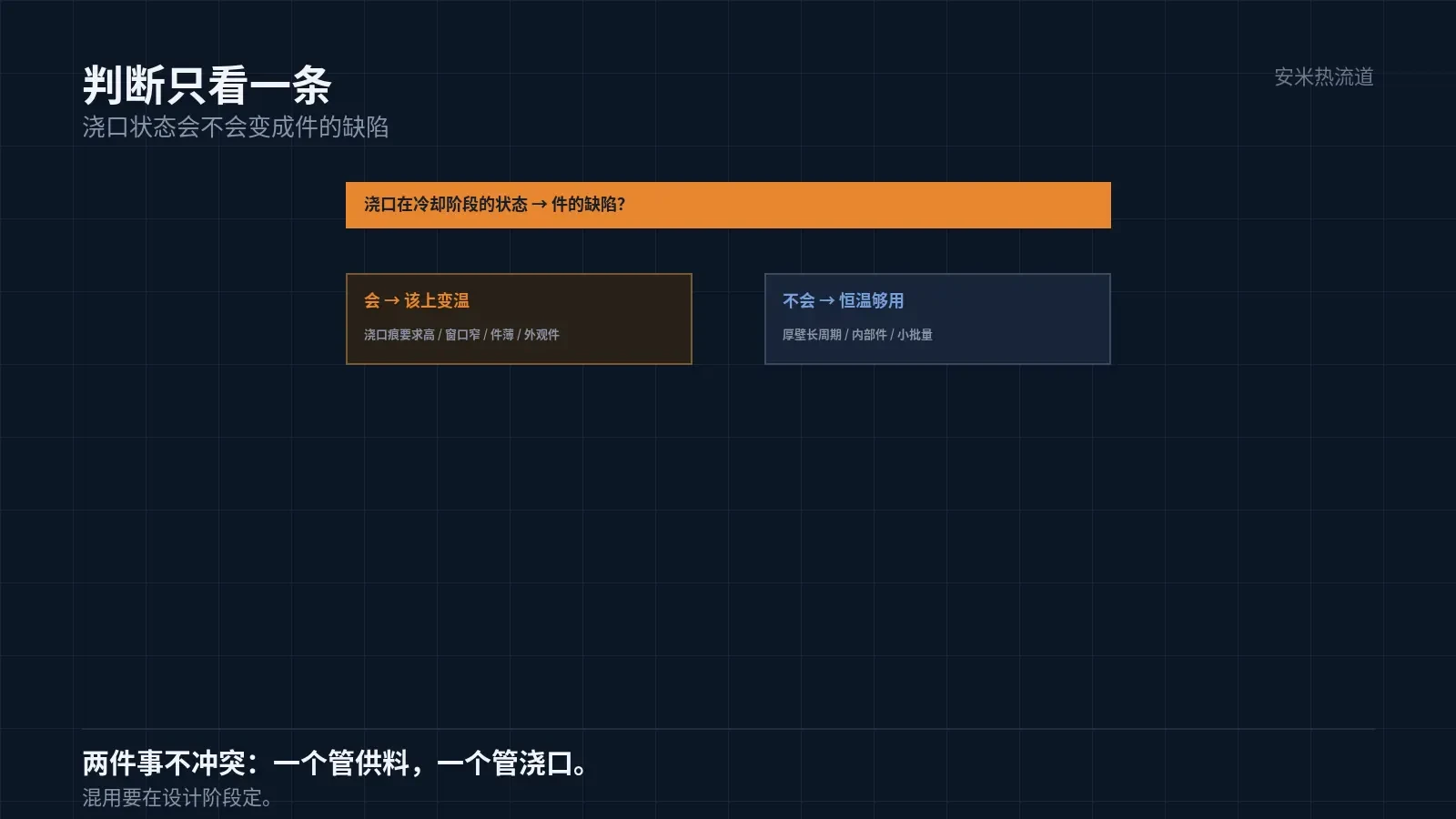
Summarizing the decision in a table is more useful than memorizing numerous parameters.
Distinguish the Two Issues First
Isothermal hot runners ensure a stable material supply with consistent temperature, viscosity, and predictable flow.
FHFC "gate control": freeze the gate after packing to prevent further participation in molding.
These two issues do not conflict. Most parts only require the first; a few strictly require the second.
Therefore, the question is not "is variable temperature good," but "does this part require gate control."
The only criterion for determining necessity is whether the gate's state during cooling causes part defects.
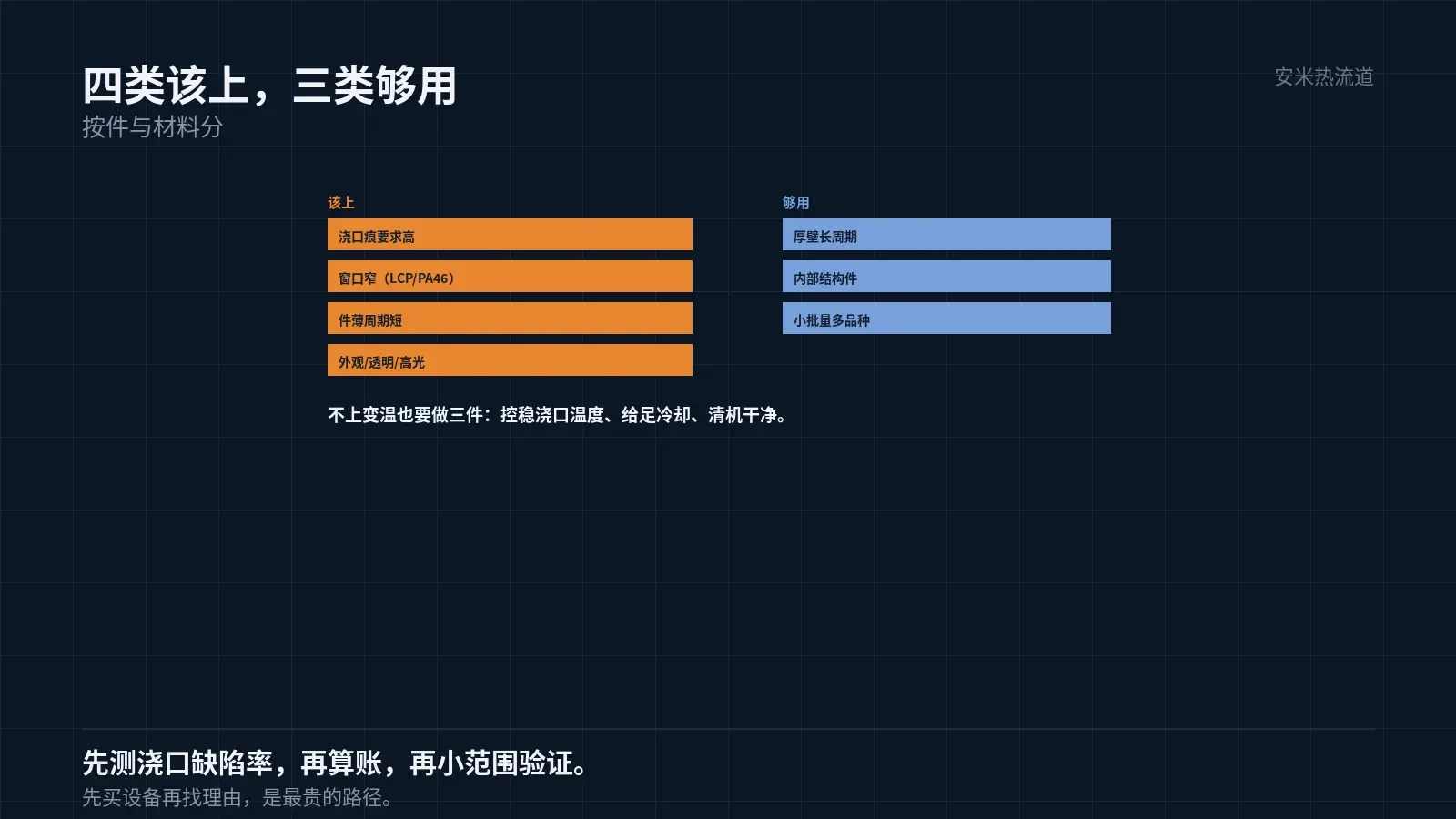
Four Categories Requiring Variable Temperature Control
Category 1: High gate mark requirements. Rejection if stringing, drool marks, sink marks, or color variation occur at the gate.
Category 2: Narrow material processing window. LCP solidifies extremely quickly; PA46 has an effective window of only about a dozen degrees. Constant temperature control is insufficient.
Category 3: Thin sections with short cycle times. Short cycles mean cooling dominates the process, increasing the likelihood of semi-solidified gates during this phase.
Category 4: Cosmetic, transparent, high-gloss parts. These are highly sensitive to flow marks; even minor gate disturbances become visible.
Common trait: Gate condition directly affects appearance or dimensions. This is the primary target for variable temperature control.
Three Scenarios Where Standard Control Is Sufficient
Category 1: Thick-walled parts with long cycle times. Extended cooling enables natural gate solidification without active freezing.
Category 2: Internal structural or non-cosmetic components. Gate marks do not affect function or assembly.
Category 3: Small batch sizes, multiple product variants, and frequent material changes. Variable temperature setup costs cannot be amortized across small production runs.
Variable temperature control for these three categories is technically feasible but not cost-effective. The equipment investment and commissioning time do not deliver corresponding quality benefits.
To determine cost-effectiveness, compare savings from reduced scrap rates against equipment and commissioning costs.
Mixed Application Scenarios
Applying variable temperature control to select cavities while excluding others on a single mold is technically feasible but must be defined during the mold design phase.
Post-design changes are not possible: nozzle structure, temperature control channels, and wiring layouts require pre-planned space.
Another issue with mixed applications is control complexity. Running two logic sets on one mold makes parameter management error-prone.
A hidden cost of mixed applications is spare parts. Nozzle tips, thermocouples, and connectors for the two systems are not interchangeable, requiring duplicate inventory.
Therefore, the barrier to mixed applications extends beyond design into ongoing maintenance. This must be clarified during the proposal stage.
In workshops with poor maintenance conditions, mixing often leads to "one set in use, one under repair," ultimately forcing standardization.
Proceed cautiously with mixed configurations. If a unified solution works, do not split into two sets.
Mixed configurations are only justified for parts with clear functional splits, such as cavities requiring cosmetic surfaces versus internal structural features.
If you proceed, what should you do first?
The first step isn't purchasing equipment—it's "gate testing." Run a batch with your existing constant-temperature solution to measure the defect rate at the gate.
The second step is "cost analysis." Compare (defect rate × unit price × annual production volume) against the cost of "equipment + mold modification + commissioning."
Step 3 is "validation." Deploy a minimum viable solution on one mold set, then scale up.
Do not reverse the order of these three steps. Purchasing equipment before establishing justification is the most common cause of project failure.
Once these three steps are complete, decisions are data-driven. Even if an error occurs, its root cause is identifiable.
If not proceeding, what should I do?
Not using variable temperature doesn't mean taking no action. Three steps are required: stabilize the gate temperature, allow sufficient cooling time, and perform thorough machine cleaning.
Stabilizing gate temperature depends on zone control and thermocouple placement; ensuring adequate cooling time relies on cycle settings; thorough cleaning requires proper procedures.
If these three steps are properly executed, the defect rate of the constant-temperature solution can be kept within an acceptable range.
If further reduction isn't possible, consider variable temperature. At this stage, the goal is specific—not a trial-and-error approach.
Therefore, "not implementing" is also a substantive decision, not merely a default option.
Among the three, "stabilizing gate temperature" is the most effective. Many cases that claim to require variable temperature actually stem from incorrect thermocouple placement.
The thermocouple controls based on its placement. If attached to the heater, it regulates the heater—not the gate. This is common when retrofitting old molds.
Thus, the first step in "not using variable temperature" is often "correcting the temperature measurement location." Once corrected, the defect rate typically decreases.
Conclusion
After 128 articles, the approach remains consistent: identify the issue, make a judgment, then choose the solution.
Localization maps symptoms to locations (nozzle tip, runner, heating, control, mold); diagnosis links locations to causes (thermal, flow, static, dynamic); solution selection is the final step.
Skipping the first two steps and selecting a solution directly is the most expensive path. Wrong equipment can be replaced, but incorrect mold modifications require remaking; lost time cannot be recovered.
Send us part requirements, material grades, current solution, and defect rate data. We'll verify against this table and provide a quote upon confirmation.
MATCHED BY MATERIAL AND DEFECT
This article covers stringing, drooling, clogging, and high-heat resins; refer to SD for gate freeze and break-off.
Register for a selection review and quote
Submit part, mold, and material details. Our engineers will evaluate the gate solution per part and provide a quote.
Upload a 2D layout drawing using the form.
Online selection and quote
Scan to register