
Seven Questions to Ask Before Finalizing a Hot Runner Solution
Material Applications17 min read
On this page
Selection goes beyond "providing a quote"—it transforms a product into an executable solution. Seven key questions must be addressed; missing even one leaves part of the solution to guesswork.
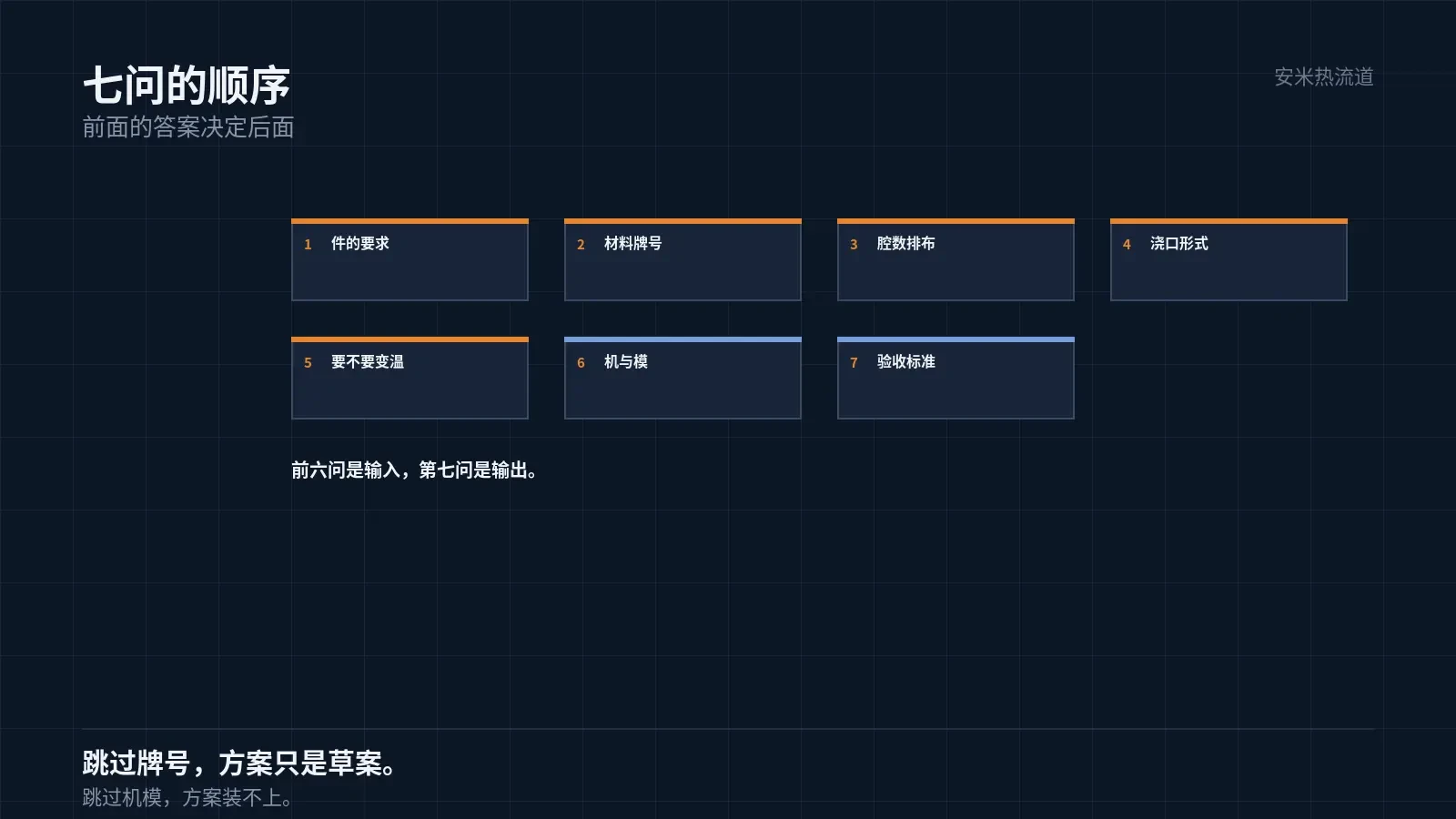
Ask these seven questions in sequence, as earlier responses determine later options.
Question 1: What is the part?
The part is the solution's starting point. Key questions include wall thickness, flow length, projected area, cosmetic requirements, and critical dimensional tolerances.
Wall thickness determines cooling time, flow length dictates pressure requirements, projected area sets clamping force, and cosmetic needs define gate location.
Critical dimensional tolerances determine whether a constant-temperature hot runner is suitable, or if finer zoning and more stable temperature control are required.
This question is often oversimplified to "send the 3D model." However, 3D models do not specify cosmetic requirements or tolerance grades.
Therefore, the output for Question 1 is a "part requirement sheet," not a model file.
The requirement sheet must also specify "which dimensions are most critical." Typically, only two or three dimensions on a part drive assembly; the rest are reference dimensions.
Identifying critical dimensions establishes the basis for trade-offs in the solution. For example, if concentricity is the critical dimension, gate alignment takes precedence over gate marks.
This point is most valuable during design reviews: when debating gate location, first determine which dimension is critical.
Second Question: What is the material grade?
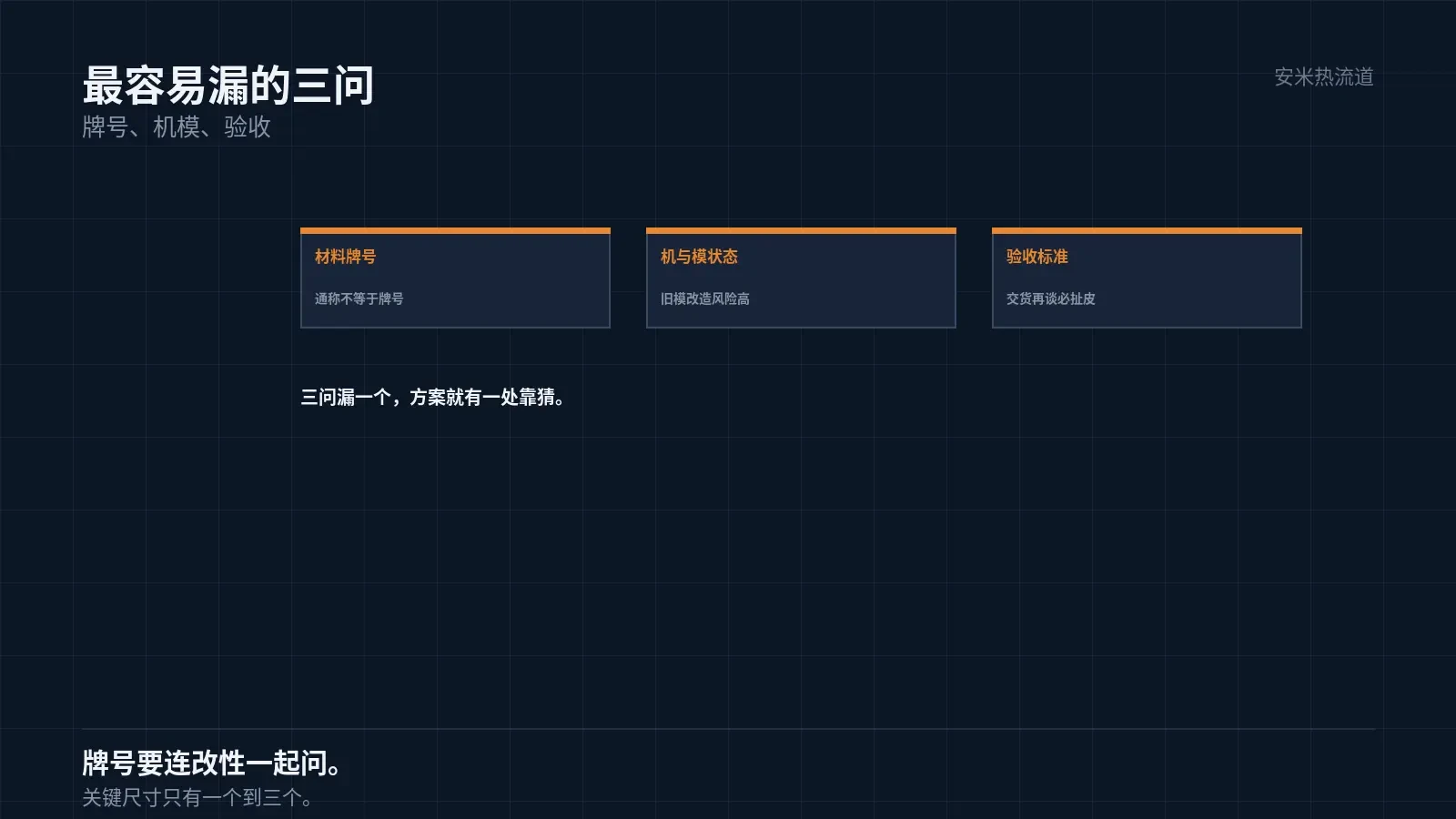
Material specifications must include the grade, not generic terms like "PA66" or "PPS."
Under the same generic name, different grades vary in glass fiber content, viscosity, and melting point, leading to different process windows.
For LCP, specify the melting point tier; for PA46, confirm whether it is a standard grade; for PPS, confirm if it is the grade that exhibits no viscosity increase upon residence.
If the grade cannot be determined, parameters must be set using manual ranges, and the proposal must state "verify against actual grade."
This point defines the threshold for proposal reliability. With a specified grade, the proposal is actionable; without it, the proposal remains a draft.
Also check if the grade has been modified. Adding flame retardants or thermally conductive fillers to the same grade alters viscosity and the processing window.
Flame-retardant modifications typically reduce melt flowability, necessitating a larger gate. Thermally conductive modifications accelerate cooling, enabling shorter cycle times.
These differences are not reflected in generic names but only in specific grades and modification descriptions. Therefore, when asking about the grade, always ask about the modifications as well.
Third Question: Cavity Count and Layout
The number of cavities determines the runner configuration, while the layout dictates runner length and symmetry.
Symmetrical layouts enable natural balance, while asymmetrical layouts require zone compensation. Costs vary between the two approaches.
As cavity count increases, zoning granularity must increase. Coarse zoning is acceptable for fewer than four cavities, but fine zoning is required for eight or more.
Also verify there is sufficient space for the hot runner system. If cavity spacing is tight and parts are thin, nozzle tips may not fit, requiring a design change.
The minimum center-to-center distance between adjacent nozzle tips is 15 mm. If cavity spacing is less than this, the proposed solution is invalid.
Question 4: What gate type is required?
The gate type determines whether variable temperature control is supported and if the gate mark is acceptable.
For cosmetic parts with small gate marks, valve gates (VG/PVG) are preferred; for internal parts, open SD nozzles offer better cost efficiency.
Material constraints apply: PA4T/PA6T/PA9T/PA10T/PA46/PPS are recommended only for SD; TP, VG, and PVG are not recommended.
LCP and PEEK support SD/VG/PVG but not TP; PEI supports all four types.
This rule is irreversible: it's not about providing what the customer wants, but what the material allows.
Question 5: Is variable temperature control required?
The only criterion is whether the gate condition affects part quality.
Variable temperature control delivers significant value when strict gate mark requirements, narrow processing windows, thin walls, or short cycle times are present.
Conversely, for thick parts with long cycle times and general cosmetic requirements, constant temperature control is sufficient, so variable temperature control is unnecessary.
Variable temperature control costs include not only equipment but also mold thermal design, temperature response, and debugging time.
Therefore, the output for Question 5 should be "whether to adopt," not "which model to choose." If the decision on "whether" is pending, recommending any specific model is incorrect.
Question 6: What is the current status of the machine and mold?
Confirm three key machine parameters: shot volume, injection pressure, and clamping force. Screw specifications and maximum injection speed are also required.
Confirm mold status: new or existing, cooling water channels, mold base modifiability, and mounting hole dimension accuracy.
Retrofitting an existing mold carries higher risk than using a new one. Plate deformation in older molds can cause improper fit during installation.
This step is often skipped, leading to the error "correct solution but cannot install." Installation failures are typically caused by the mold, not the hot runner.
Therefore, the output for Question 6 is "a checklist of current machine and mold conditions," not "a statement that it fits."
Question 7: How is acceptance defined?
Acceptance criteria must be defined during the proposal stage, not deferred until delivery.
Define allowable temperature uniformity deviation, weight distribution deviation, continuous run duration, and material leakage criteria.
Also specify who performs the measurement and the equipment used. Without this, acceptance disputes may arise.
With standards established, design targets are clear: determine the required runner diameter and zone granularity to meet these standards.
After answering all seven questions, the solution becomes executable. The first six are inputs; the seventh is the output.
Provide part requirements, material grade, cavity count and layout, gate specifications, and current mold/machine status. We will verify against the seven criteria before providing a quote.
MATCHED BY MATERIAL AND DEFECT
This article covers stringing, drooling, clogging, and high-heat resins; refer to SD for gate freeze and break-off.
Register for a selection review and quote
Submit part, mold, and material details. Our engineers will evaluate the gate solution per part and provide a quote.
Upload a 2D layout drawing using the form.
Online selection and quote
Scan to register