
When Is PEEK Mandatory for High-Voltage Connectors on 800V Platforms?
Material Applications17 min read
On this page
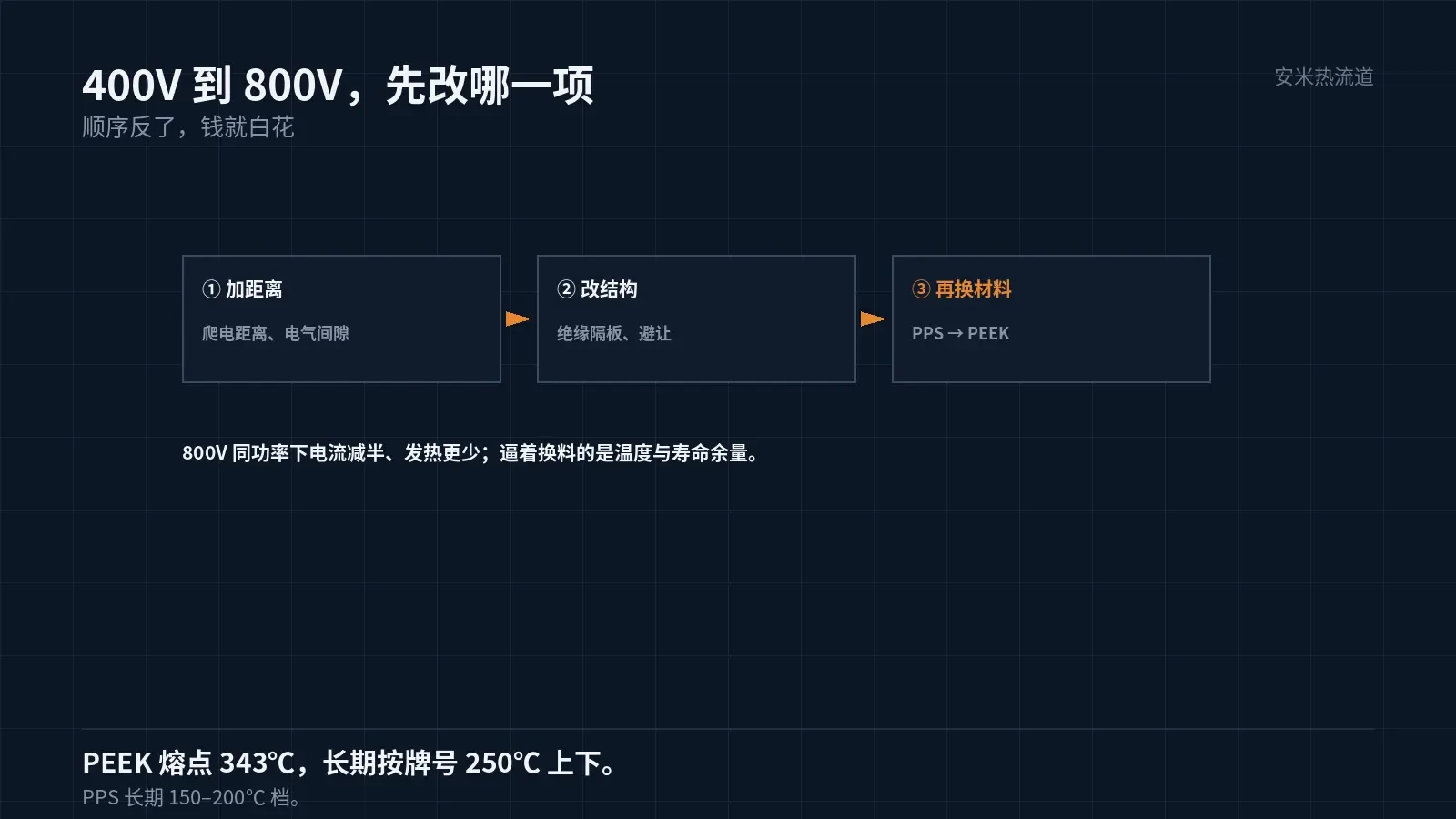
When voltage increases from 40V to 80V, the common first reaction is "upgrade the material." In reality, higher voltage primarily affects creepage distance and insulation design; a material change may not be necessary.
Temperature and long-term reliability are the key drivers for switching to PEEK. This article examines these two factors separately.
For Higher Voltage: Modify Design Before Procuring Materials
At 800V versus 400V, the current is halved for the same power, reducing heat generation. Thus, higher voltage alone does not justify a material upgrade.
Higher voltage affects insulation: creepage distance, electrical clearance, and material aging resistance. These can be mitigated by increasing distances, adding insulation barriers, or modifying the structure.
Material selection is only necessary when structural constraints prevent increasing spacing or when temperature also rises. Do not reverse this sequence.
The reverse approach—changing the material first, then checking the design—is costly and may not resolve the issue. Even with new materials, creepage distance may still be insufficient.
First, review the customer's insulation requirements, structural space constraints, and operating temperature together.
Temperature is the reason for PEEK.
High-voltage connectors are installed near battery packs, motors, and inside electronic control units. Temperatures in these areas can reach 150°C, with localized spots even higher.
The long-term service temperature of PPS is in the 150–200°C range, near its upper limit; PA46 and PA9T are lower. If parts operate continuously above 180°C, PEEK is the only viable option.
PEEK melts at 343°C and operates continuously up to approximately 250°C, depending on the grade. This margin isn't about "better performance"—it's about maintaining a safety buffer.
For automotive components, this margin indicates reliability: at the same 150°C operating temperature, PEEK provides a larger safety margin, slower aging, and a longer lifespan.
This factor must be calculated based on the part's lifespan requirements. The material selection margin varies significantly between a 15-year/200,000 km requirement and a 5-year requirement.
Another factor is the chemical environment. Battery pack coolants, sealants, and cleaning agents may contact plastic parts. PEEK offers the best chemical resistance in this category, while PPS is sensitive to certain media.
Media lists must be verified item by item; simply stating "good chemical resistance" is insufficient. A material may be stable against one medium but susceptible to stress cracking in another.
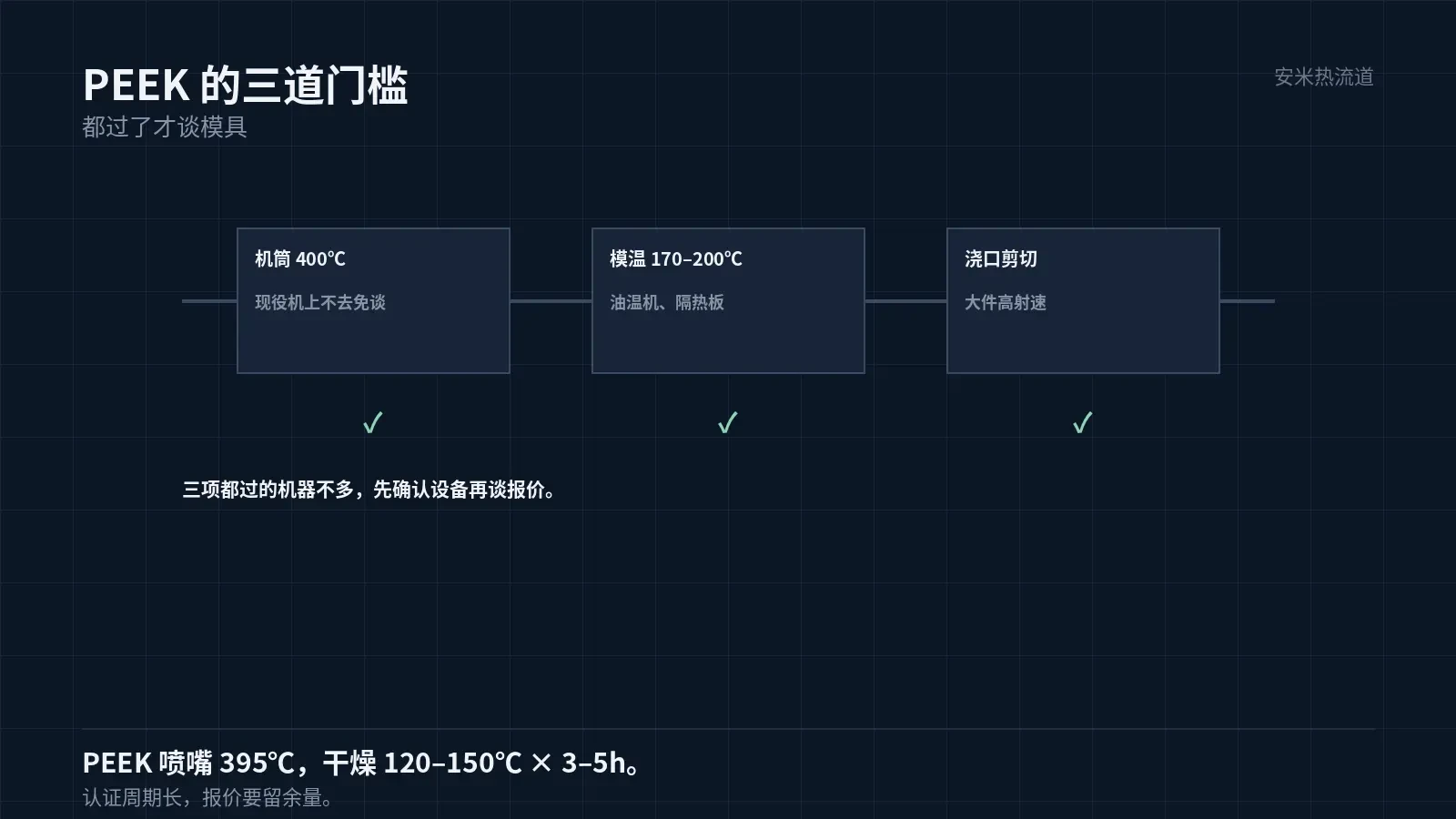
PEEK processing faces three challenges.
First hurdle: Barrel. Nozzle at 395°C, barrel zones at 375/380–385/390°C, requiring heating capability up to 400°C. If existing machines cannot reach this temperature, the solution is invalid.
Second hurdle: Mold temperature 170–200°C requires an oil temperature controller and insulation plates. Standard water controllers cannot achieve this; forcing them leads to unstable temperatures.
Third hurdle: Shear. Large parts, thick walls, and high injection speeds cause high shear at the gate. Since PEEK has high melt viscosity, shear-related issues are more severe than with LCP.
Only consider mold design after passing all three hurdles. Even then, cycle time and yield remain concerns: PEEK's long cycles and narrow processing window lead to high per-part costs.
These costs must be included in the quote and cannot be added after trial molding. High-pressure component certification takes a long time, making it difficult to revise incorrect quotes.
PEEK inserts and overmolding cost more.
High-pressure components often include metal inserts. With PEEK mold temperatures of 170–200°C, preheating the inserts is essential to prevent Fast Cooling at the interface.
PEEK has a low coefficient of thermal expansion, providing better compatibility with metal than PPS and reducing interface stress. This is ideal for overmolded parts.
However, PEEK's high processing temperature exposes inserts to greater thermal shock within the mold. Higher preheating temperatures and stricter mold insulation designs are required.
These factors must be reflected in the mold quote. For identical structures, a PEEK mold costs more than a PPS mold—not just due to temperature.
When to Avoid PEEK
First: If the operating temperature is below 150°C, PPS is sufficient. Second: If structural space allows for increased creepage distance, material compensation is not required.
Third: For high-volume, price-sensitive production, PEEK costs cannot be amortized in this category. Fourth: If the certification cycle is short, there is no time for redesign.
If any of these four conditions apply, revert to PPS or PA9T and finalize the design instead of relying on material as a fallback.
Another practical check: compare with industry peers. If most components on the same platform still use PPS, the design is viable; if all have switched to PEEK, structural space is genuinely insufficient.
Validation: Equipment First, Then Material
Step 1: Confirm three equipment parameters: barrel at 400°C, mold temperature at 200°C, and hot runner at 395°C. Step 2: Run a small-batch trial to identify the filling window.
Step 3: Perform long-term aging and thermal cycling tests simultaneously. Step 4: Conduct electrical testing after aging to determine the actual safety margin.
Additionally: In insulation design, maintain a two-level safety margin. As voltage levels increase and structural space remains fixed, ensure adequate material thickness and clearance distances are established upfront.
Final point: Material upgrades address "margins," not "design." If clearance is insufficient, no material change will help.
When providing quotes, include options for both "design modifications" and "material substitutions." Clients often prefer design changes. This is part of our professional advisory service.
Lead times vary by path: design changes require mold rework, while material swaps need re-certification. Choose the faster option based on your project milestones.
In quotes for high-voltage components, display costs and lead times for both options side by side so clients can compare and choose.
Provide the voltage platform, insulation requirements, operating temperature range, lifespan expectations, and existing equipment parameters. We will first evaluate whether a material change is necessary, then validate the solution.
MATCHED BY MATERIAL AND DEFECT
This article covers stringing, drooling, clogging, and high-heat resins; refer to SD for gate freeze and break-off.
Register for a selection review and quote
Submit part, mold, and material details. Our engineers will evaluate the gate solution per part and provide a quote.
Upload a 2D layout drawing using the form.
Online selection and quote
Scan to register