
PA46 for HV Connectors: Why Long-Term Thermal Aging Fails Despite Short-Term Passes?
Material Applications16 min read
On this page
PA46 offers excellent flow and toughness. For large parts such as high-voltage connectors, it fills more easily than PPS and provides a better insertion/extraction feel. First articles and short-term tests typically pass.
The problem stems from long-term thermal aging: after hundreds of hours at 150°C, mechanical properties and dimensions degrade. This article explains the source of this degradation.
Polyamide Thermal Aging: Molecular Chain Scission
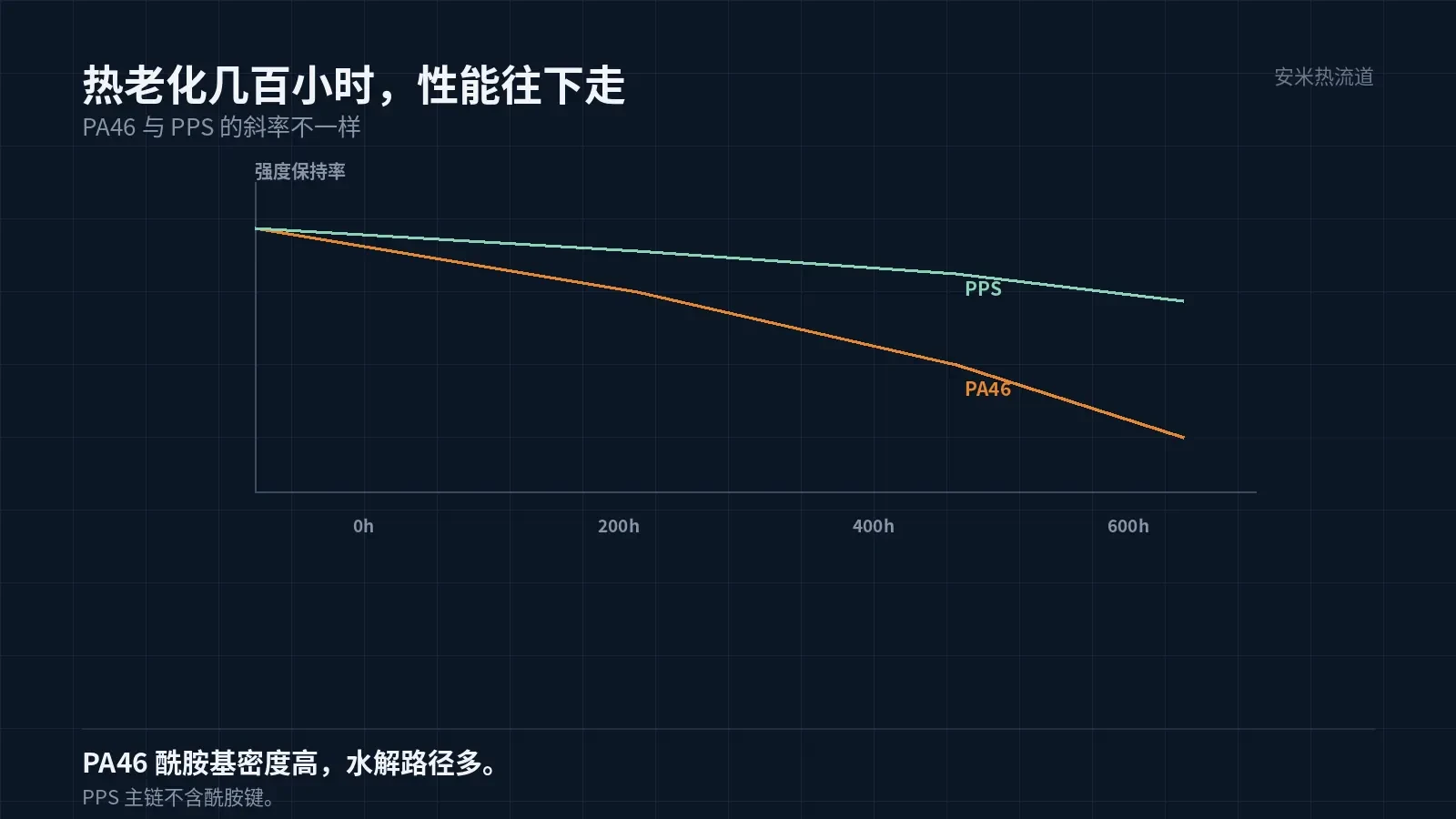
Under high temperatures and in the presence of oxygen, polyamide amide bonds undergo hydrolysis, causing molecular chains to break. This results in reduced strength, decreased elongation, and color darkening.
PA46 contains a high density of amide groups, resulting in more amide bonds per unit volume than PA9T. At the same temperature, it ages faster.
This is determined by PA46's structural characteristics: its high melting point and stiffness come at the cost of thermal aging sensitivity. This trade-off must be considered during material selection.
Therefore, when using PA46 for high-voltage components, ensure sufficient margin for long-term heat resistance. For parts operating continuously at 150°C, PA46 may not be optimal.
In contrast, PPS demonstrates more stable thermal aging performance because its main chain consists of thioether bonds and benzene rings, with no amide bonds. This gives PPS an advantage in high-temperature applications.
Stabilizers and grades are variables
Thermal stabilization systems vary by grade within the same material class. Some grades include thermal stabilizers for enhanced long-term temperature resistance, while others lack them and are suitable only for short-term high-temperature exposure.
Grade selection requires reviewing OEM thermal aging data, not just material names. Long-term temperature resistance varies significantly between PA46 grades.
This is a common quoting error: specifying standard grades when customers require long-term 150°C performance leads to failure and costly rework.
For high-pressure component selection, obtain OEM thermal aging curves first. Do not recommend grades without such curves for long-term high-temperature applications.
Thick walls make aging more complex
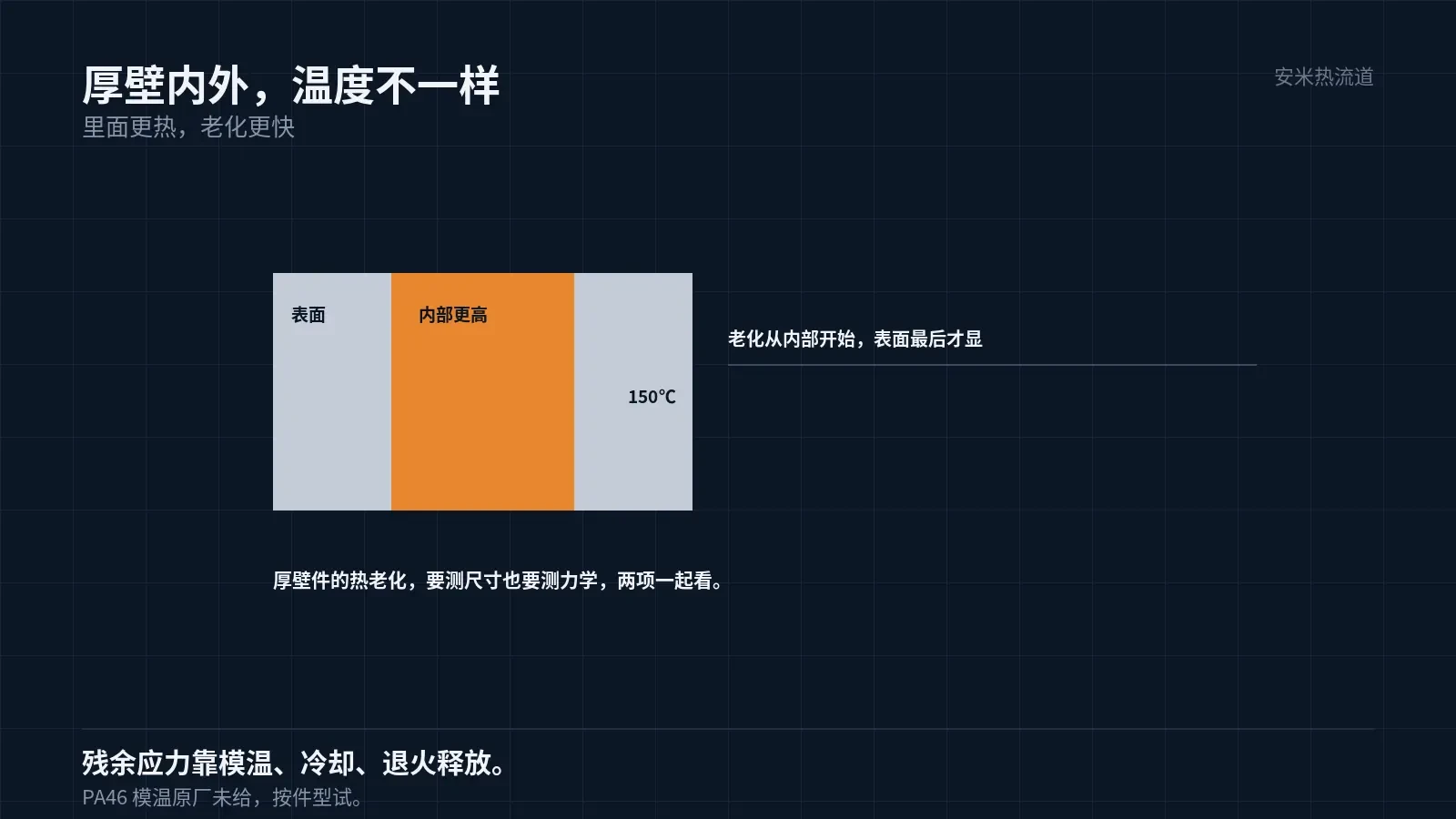
High-pressure components have wall thicknesses of 2–3 mm. Slow heat dissipation in thick sections causes internal temperatures to exceed surface levels, accelerating aging.
Thick walls exhibit higher residual stresses. Stress relaxation during aging, combined with material degradation, leads to progressive warpage.
Thermal aging tests for thick-walled parts must evaluate both dimensional stability and mechanical properties. Assessing only one yields incomplete conclusions.
Reducing residual stress depends on mold temperature, cooling time, and annealing. OEMs do not specify a recommended mold temperature for PA46; it must be determined through trial based on part geometry.
Annealing is effective for PA46 but adds process steps. Whether to perform it depends on the customer's thermal aging requirements.
Melt temperature and residence time accelerate aging.
PA46 melt temperature must exceed 305°C, with an optimal range of 305–320°C. This tolerance window is only 15°C wide; exceeding it causes degradation.
Degraded material has already experienced molecular chain scission, advancing the onset of thermal aging in the final part. This difference is not apparent initially but emerges after hundreds of hours.
Therefore, maintain the melt temperature at the lower end of the range and minimize residence time. For large parts, high runner volume leads to long residence times; this factor requires specific calculation.
Determine purge cycles based on residence time curves. While some factories purge per shift, actual purging may be required every two hours. Calculate total costs by factoring in both purging and rework expenses.
Do not skip drying for PA46 due to its high moisture absorption. Undried material releases steam above 305°C, causing silver streaks on parts and reducing mechanical properties.
Dryer capacity must match production throughput. Large parts require substantial material volume; if the dryer is undersized, material accumulates at the machine and remains undried. This is frequently overlooked during line planning.
Another consideration: residence time in the barrel correlates with part weight. Larger parts have higher shot volumes and faster melt renewal, leading to shorter residence times; smaller parts are where residence time issues are most concentrated. This contradicts intuition.
Regarding thermal aging: Long-term PPS data is generally more stable than PA46. This is not because it is "more heat-resistant," but because its main chain lacks amide bonds, reducing hydrolysis pathways.
Therefore, for parts operating continuously at 150°C, the roles of PA9T and PPS are clear: use PA9T for toughness, PPS for temperature resistance, and upgrade to PEEK if both properties are required.
Verification: Accelerated Aging Must Comply with Standards
First set: Thermal aging at customer-specified temperatures and durations, with intermediate tensile and dimensional testing. Second set: Damp heat testing (temperature and humidity) to evaluate hydrolysis extent.
Third set: Post-aging electrical testing for insulation and withstand voltage. High-voltage component failures are often compound, with mechanical and electrical properties degrading simultaneously.
If the material grade doesn't meet requirements, consider structural modifications: increase wall thickness or add ribs at stress points to offset material degradation. For thick-walled parts, this is often more cost-effective than switching materials.
Structural changes incur costs: increased thickness adds weight, affecting vehicle lightweighting goals. This must be reviewed jointly with the customer and cannot be changed unilaterally.
Final practical tip: Run a trial using an existing PPS mold and conduct thermal aging tests. Use the results to decide whether to proceed with PEEK—this approach saves significant costs compared to direct tooling.
Provide the operating temperature, required duration, thermal aging curve for the material grade, and wall thickness. We will first evaluate whether the grade is adequate, then review the process plan.
MATCHED BY MATERIAL AND DEFECT
This article covers stringing, drooling, clogging, and high-heat resins; refer to SD for gate freeze and break-off.
Register for a selection review and quote
Submit part, mold, and material details. Our engineers will evaluate the gate solution per part and provide a quote.
Upload a 2D layout drawing using the form.
Online selection and quote
Scan to register