
When to Use Fast Heat Fast Cool Mold Technology vs. Constant Temperature
Material Applications16 min read
On this page
Variable temperature control isn't always better just because it's more advanced. It adds cost, debugging time, and maintenance complexity. If misapplied, it becomes a burden.
The sole judgment criterion: whether the gate condition affects part quality.
Three categories of components requiring variable temperature control
Category 1: Cosmetic Parts. For high-gloss, transparent, or unpainted parts, gate marks are more visible. Stringing, drooling, and gate marks are all cosmetic defects.
Second category: thin-wall parts. With wall thickness below 1 mm, the injection window is narrow. Gate temperature must be precisely controlled (heated or cooled as needed); otherwise, short shots or flash may occur.
Category 3: High-temperature material components. LCP, PA46, PPS, and PEEK have narrow processing windows; relying on constant temperature solution margins leads to poor stability.
Beyond these three categories, there's a special case: parts requiring "no gate marks," such as optical and medical components.
These four categories share a key trait: gate state directly determines part quality. This is the basis for judgment.
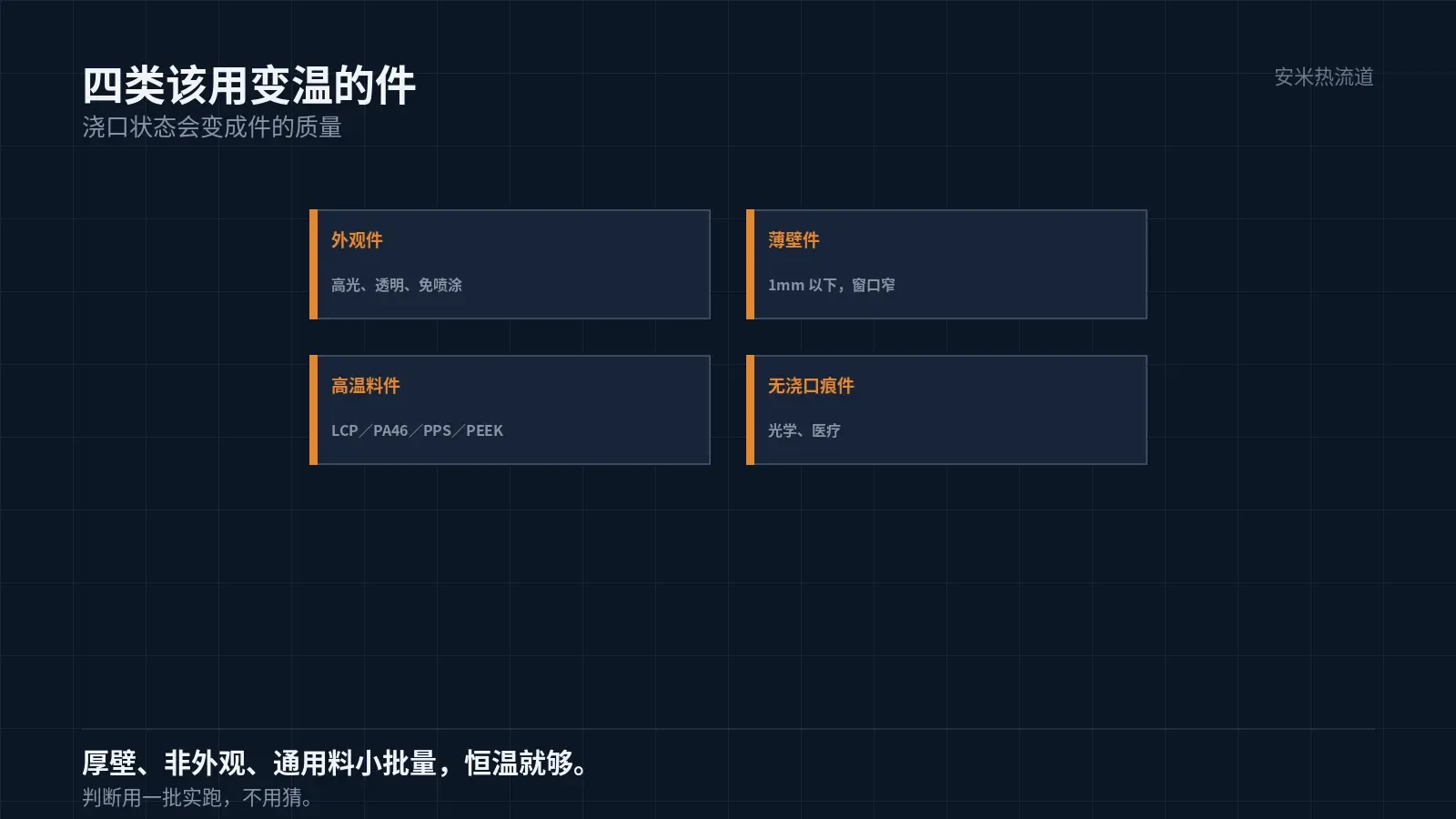
Components for precise temperature control
Start with thick-walled structural components. Walls thicker than 3 mm fill easily and are less sensitive to gate marks.
Second, non-cosmetic parts: internal brackets, spacers, and supports where appearance does not affect function.
Third, small-batch parts use general-purpose materials. PP, ABS, and PE offer wide processing windows, providing ample margin for constant-temperature solutions.
Variable temperature control offers limited benefits for these three categories while significantly increasing costs. First, determine if it is truly necessary.
Assessment method: Run a batch using the current constant-temperature solution and check for stable defects at the gate. If none are found, no changes are required.
This principle also applies in reverse: if long-term gate defect-free operation is confirmed, consider switching variable temperature control to constant temperature for currently affected parts to reduce costs.
Downgrading requires verifying that no defects emerge after the switch. Validate using small batches; do not switch directly.
Variable temperature control requires ongoing re-evaluation based on changes in part geometry, material, and batch size.
Batch size also affects the decision. For small batches, setup costs are not amortized; variable temperature benefits only become apparent at higher volumes.
Another scenario is "intermittent defects." With a rate of 2 in 100 shots, it becomes difficult to decide whether to implement a change.
Assessing intermittency requires analyzing the defect distribution: are defects concentrated in specific shot cycles, cavities, or time periods? Concentration indicates a systemic cause.
Cost Calculation
Variable temperature costs include three components: hot runner hardware, the control system, and commissioning/maintenance.
There is also a "trial-and-error cost." Variable-temperature solutions require tuning based on part geometry; initial batch yields are typically low, so this must be factored into the project budget.
Trial duration depends on mold-hot runner compatibility. Good compatibility stabilizes in one or two iterations; poor compatibility requires repeated gate insert modifications.
When selecting suppliers, commissioning support matters more than saving a few thousand yuan on price. The value of variable temperature systems lies in their performance after commissioning.
Hot runner costs are driven by structural design and machining precision: compactness, tight gate proximity, and low thermal inertia all demand high machining accuracy.
Control system costs are driven by sensor points and algorithms: multi-channel independent temperature control, fast response, and overshoot prevention cannot be achieved with standard temperature controllers.
Commissioning and maintenance costs are driven by "personnel": variable temperature parameters are not universal values but must be tuned to the material and part geometry, followed by ongoing maintenance.
The combined cost of the three components is typically much higher than constant-temperature solutions. Use them only where absolutely necessary.
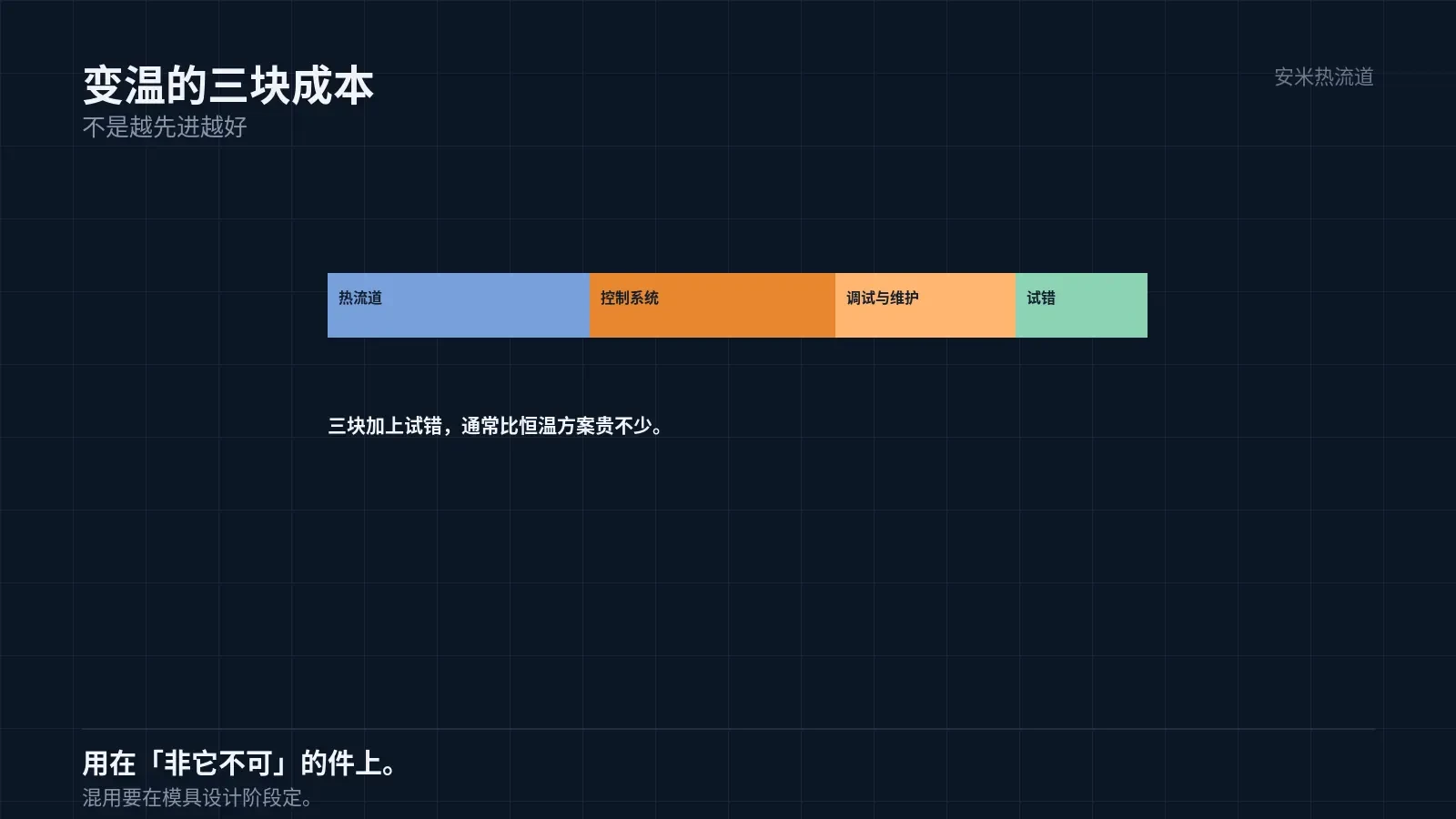
Mixed Application Scenarios
In a single mold, not all gates need variable temperature control. Some part gates are in areas that don't affect appearance.
In such cases, mixed usage is possible: use variable temperature for critical gates and constant temperature for others. Zoning the control can reduce costs.
Mixed-use molds pose a design challenge: fitting the structures, water circuits, and controls of two systems into a single mold base often leaves insufficient space.
Therefore, mixed usage must be determined during mold design. Changes after completion require remaking the mold base.
Another challenge with mixed usage is control: running two temperature profiles on a single controller without timing interference.
Interference appears as fluctuations in one channel when the other experiences temperature changes. Ensure sufficient margin for power capacity and sensor placement.
Common pitfall in real projects: starting with constant temperature, then realizing variable temperature is needed, forcing a complete mold redesign.
Product Correspondence
AM Industry exclusively offers FHFC systems, including four product lines: SD Series, TP Series, VG Series, and PVG. We do not manufacture constant-temperature hot runner systems.
SD is an open straight-through nozzle tip; TP is a pinpoint type; VG and PVG are valve-gate types. These four models correspond to different gate designs and part geometries.
Model selection depends on gate type, part appearance requirements, and cavity spacing. Verify against the mold design.
Gate compatibility varies by material: PA4T, PA6T, PA9T, PA10T, and PA46 require SD only; LCP and PEEK support SD, VG, and PVG but not TP; PEI supports all four models.
Provide part requirements, material, cavity count, and gate type. We'll verify structure and gate compatibility before issuing a quote.
MATCHED BY MATERIAL AND DEFECT
This article covers stringing, drooling, clogging, and high-heat resins; refer to SD for gate freeze and break-off.
Register for a selection review and quote
Submit part, mold, and material details. Our engineers will evaluate the gate solution per part and provide a quote.
Upload a 2D layout drawing using the form.
Online selection and quote
Scan to register