
Constant Temperature vs. Fast Heat Fast Cool Hot Runners: Key Differences
Material Applications15 min read
On this page
The two names sound like different products, but the difference is one action: whether the gate temperature changes during the molding cycle.
This single factor determines all subsequent structures, controls, and applicable materials.
Common Features
Both hot runner systems perform the same function: delivering molten plastic from the injection molding machine nozzle to the mold gate without solidification.
Therefore, both include nozzles, runners, heating elements, and temperature control. The structural concepts and materials for this component are identical.
The difference lies not in 'delivery,' but in 'what happens after delivery.' This is the starting point for understanding the distinction.
During delivery, both require stable temperature, unobstructed flow paths, and no stagnant zones. Poor execution in this area renders variable temperature control ineffective.
When evaluating a hot runner system, assess delivery first, then the gate. Most on-site issues stem from the first step, not the second.
Delivery capability is measured by three metrics: pressure loss, temperature uniformity, and thorough color-change cleaning. All three must be evaluated; checking temperature alone is insufficient.
Pressure loss is measured as the difference between inlet and nozzle tip pressures. Excessive pressure loss prevents thin-wall parts from filling completely, requiring higher machine pressure.

Constant Temperature Control Logic
A constant-temperature hot runner maintains a stable nozzle tip temperature from the first to the last shot, keeping the gate in a "melt-flowable" state.
This logic is simple, stable, and low-cost. It works well for most general-purpose plastics (PP, ABS, PC/ABS).
The trade-off is that the gate stays hot. The melt at the gate remains flowable; it solidifies wherever processing stops.
The freezing process is uncontrolled. Stop time, mold temperature, and melt temperature together determine the gate freeze shape.
Therefore, the main issue with constant-temperature hot runners is not that they are unusable, but rather that they have a narrow process window and rely heavily on luck.
A narrow process window allows precise tuning but requires readjustment after changing shots, material batches, or weather conditions.
This "runnable but hard to maintain" state creates hidden costs in mass production. These are not reflected in quotes, but in yield rates and setup labor hours.
FHFC Logic
FHFC means: the gate is heated during filling to allow melt flow; at the end of packing and start of cooling, the gate temperature drops rapidly to freeze it off.
Once frozen, packing pressure cannot reach the mold cavity, reducing gate stress and preventing breakage or stringing during ejection.
After mold opening and part ejection, the gate is rapidly reheated for the next shot. Each cycle subjects the gate to a "hot-cold-hot" thermal transition.
The key isn't just the ability to change temperature, but how quickly it changes. If too slow, the temperature effectively remains constant.
Therefore, "rapid" in FHFC refers to response speed, not temperature magnitude.
Response speed is measured by the time it takes to reach the target temperature from the setpoint. This duration must be significantly shorter than the corresponding phase length.
Equating large temperature differences with FHFC is incorrect. A large difference with a slow response only shifts the constant-temperature window; defects remain unchanged.
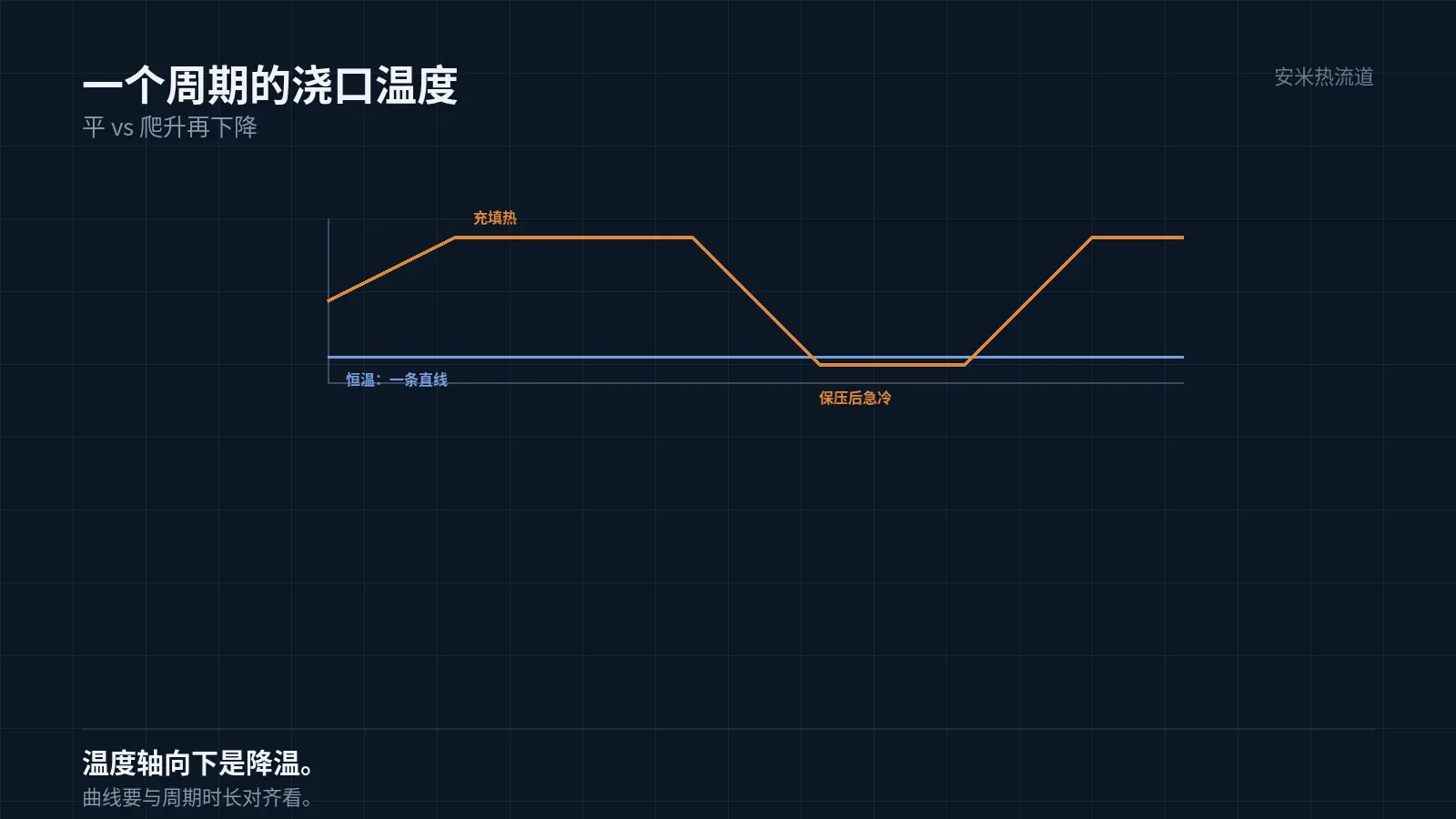
Key Difference: Gate Freezing
The key difference between the two solutions lies in when and how the gate freezes.
In the constant-temperature solution, gate freezing is passive, relying on heat dissipation through mold temperature and time. The location and morphology of the frozen gate cannot be fully controlled.
In the FHFC solution, gate freezing is enabled: cooling forcibly freezes the gate when holding pressure ends.
Active freezing provides three key benefits: low residual stress at the gate, clean demolding, and controllable cycle time.
This also explains why defects like stringing and drooling are significantly reduced with the FHFC solution: they occur most easily when the gate is semi-frozen.
Structural Differences
For constant-temperature hot nozzles, the heating zone can be longer and more uniform since rapid temperature changes are not required.
For FHFC hot nozzles, heating and cooling must occur near the gate to ensure low thermal inertia. A longer heating zone leads to slower temperature changes.
Accordingly, FHFC hot nozzles feature a more compact design with the focus near the nozzle tip. Temperature changes occur near the gate, closest to the nozzle tip.
Nozzle tip outer diameter Ø14 mm sets the minimum cavity pitch; the minimum center-to-center distance between adjacent hot nozzles is 15 mm.
Compact structure trade-offs: high machining precision, limited maintenance access, and strict mold fit tolerances.
Applications and Selection
For general plastics with low cosmetic standards and small batch sizes, constant-temperature hot runners are sufficient and cost-effective.
For thin-wall parts, cosmetic components, high-gloss finishes, transparent parts, high-temperature materials (LCP, PA46, PPS, PEEK), and applications requiring no stringing or drooling, variable temperature control offers a more stable solution.
The criterion is not material cost, but whether gate condition affects part appearance and dimensions. If so, consider variable temperature control.
Selection also depends on the mold: cavity count, center-to-center spacing, and gate type (pin-point, direct, side). These factors determine compatible nozzle types.
Provide material, wall thickness, cosmetic requirements, number of cavities, and center-to-center distance. We will verify structure and gate design before quoting.
MATCHED BY MATERIAL AND DEFECT
This article covers stringing, drooling, clogging, and high-heat resins; refer to SD for gate freeze and break-off.
Register for a selection review and quote
Submit part, mold, and material details. Our engineers will evaluate the gate solution per part and provide a quote.
Upload a 2D layout drawing using the form.
Online selection and quote
Scan to register