
Why Constant Temperature Hot Runners Prone to Stringing and Drooling
Material Applications17 min read
On this page
Stringing and drooling are the two most commonly reported defects in hot runner systems. Both result from a single root cause: excessive gate temperature.
The high temperature is caused by structural limitations, not incorrect settings.
First, examine the phenomena
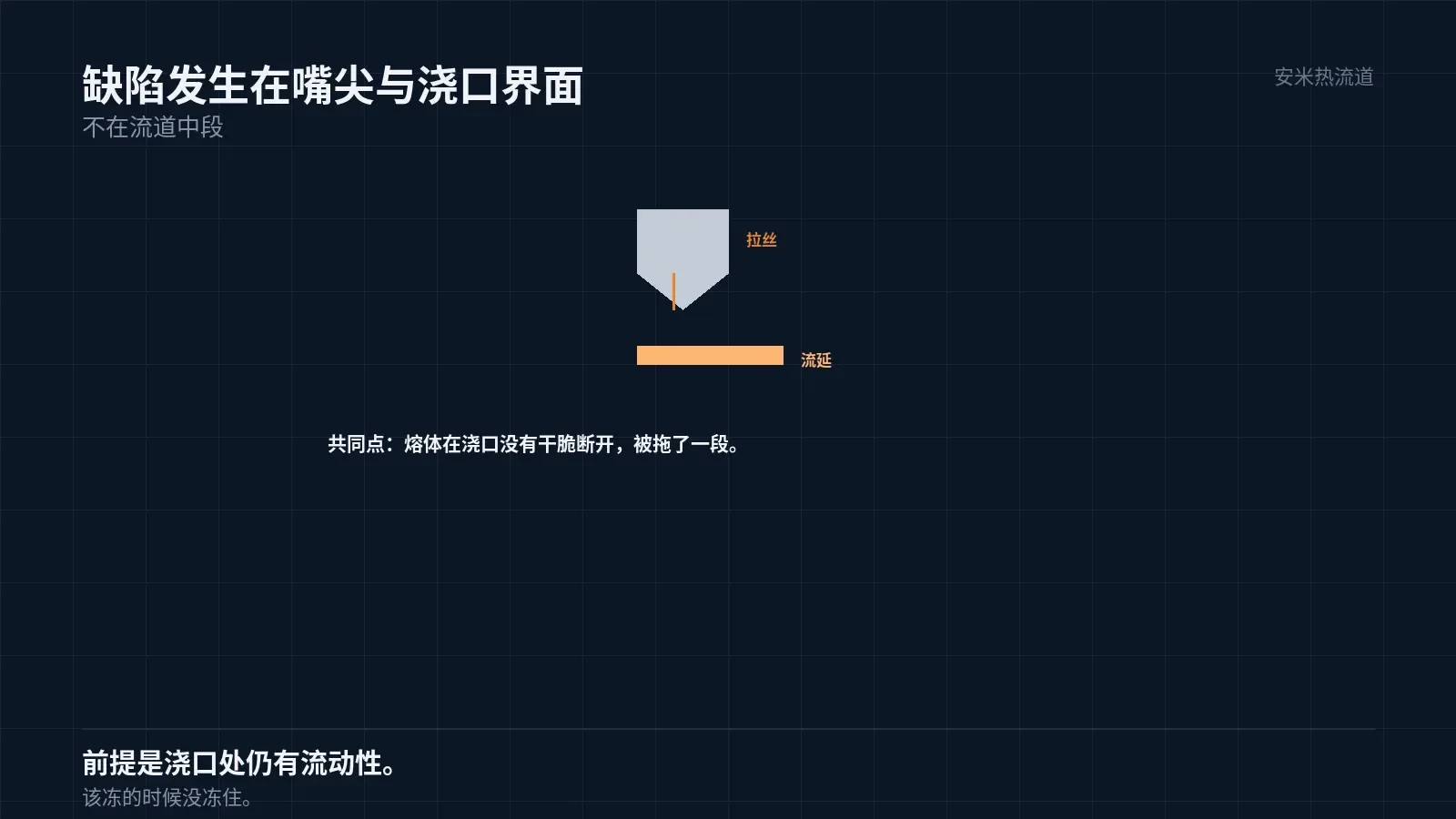
Stringing occurs when a thin filament is pulled from the gate during ejection, sticking to the part or hanging on the nozzle tip. The filament hardens as it cools, causing a cosmetic defect.
Drooling occurs when a thin film flows out of the gate and smears onto the part surface or near the gate. The film is typically tens of microns thick with irregular edges.
Both share a common characteristic: the melt at the gate does not break cleanly but is instead dragged along for a certain distance.
Dragging requires the melt at the gate to remain fluid. If it is fluid, it can be pulled.
Therefore, both defects share the same root cause: the gate fails to freeze when required.
Why can't the constant temperature be lowered?
The design goal of a constant-temperature hot runner is to prevent melt solidification along the flow path. Therefore, heating is continuous, and the gate area remains within the heated zone.
Once holding pressure ends and cooling starts, the injection molding machine stops feeding material while nozzle heating continues. This keeps the melt at the gate fluid by maintaining its temperature.
If the mold opens at this stage, melt at the gate may be pulled out, causing stringing; if squeezed out, it causes dripping.
Therefore, the root cause is not "setting the temperature too high," but the structural issue that "the gate remains heated during the cooling phase."
On-site testing repeatedly confirms that for the same mold, shortening the nozzle heating zone and lowering the contact surface temperature between the nozzle tip and gate bushing significantly reduces stringing.
However, shortening the heating zone introduces new issues: potential clogging at the end of the runner. Local modifications to a constant-temperature structure often involve trade-offs.
The true solution is to control "gate temperature" and "runner temperature" separately. This keeps the runner molten while the gate freezes on schedule.
Lowering the set temperature offers relief but introduces new issues: short shots, cold slugs, and runner clogging. This is an inherent trade-off.
Three commonly misjudged variables
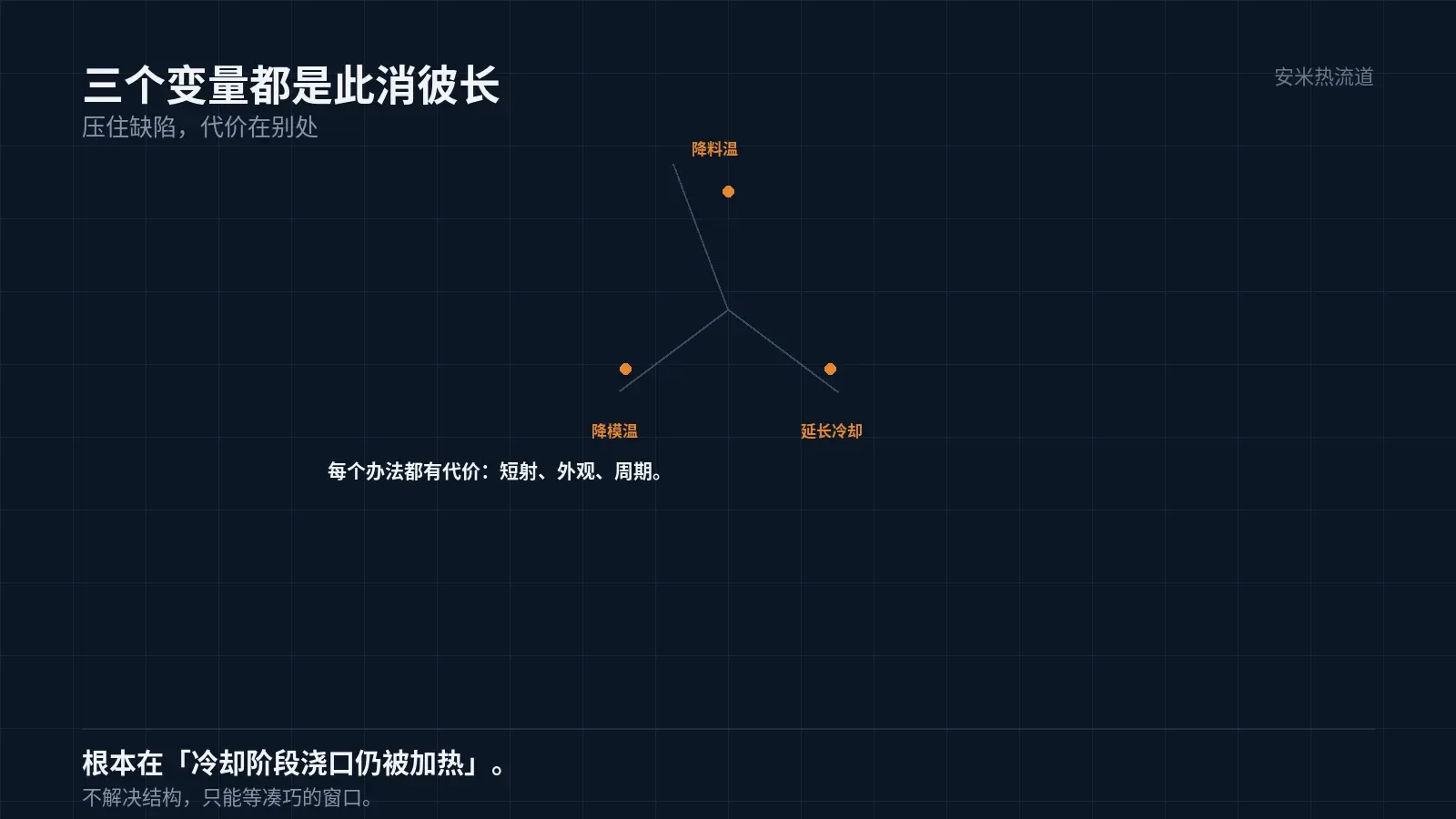
First, consider mold temperature. Lowering the mold temperature accelerates gate cooling and reduces stringing. While some operators lower mold temperature to suppress stringing, this can compromise part appearance and increase shrinkage.
The second factor is cooling time. Short cooling times cause the mold to open before the gate fully freezes, worsening stringing. Extending cooling suppresses this issue but increases cycle time.
Third is melt temperature. High melt temperatures increase gate fluidity and stretch tendency. Lowering the melt temperature suppresses this but risks short shots on thin-wall parts.
All three variables can temporarily suppress the defect, but none address the root cause: the gate remains heated during the cooling phase.
This explains why repeated machine adjustments and parameter changes still lead to intermittent stringing: the process waits for a window where parameters happen to align.
This coincidental window has another characteristic: it only holds on certain machines. Switching machines or hot runners eliminates the window.
Temperature control accuracy, thermocouple placement, and PID parameters vary across machines. A narrower window increases sensitivity to these differences.
Therefore, "tuned on this machine" does not mean "stable solution." Mass production requires stability across different machines.
Material worsens this issue.
Low-viscosity materials (LCP) and high-melting-point materials (PA46, PPS, PEEK) further narrow this window.
LCP solidifies almost instantly but has very low viscosity; once it flows, it stretches into long filaments. PA46 offers a processing window of only 15°C, leaving little room to reduce the melt temperature.
Therefore, parameter adjustment alone often cannot resolve high-temperature stringing issues; the gate's thermal state must be addressed.
This is a common on-site issue: with the same mold and machine, PP parts show no stringing, but switching to LCP causes it. The difference isn't the machine—it's the material's sensitivity to gate conditions.
The sensitivity difference arises from the slope of viscosity versus temperature. LCP viscosity changes dramatically near its melting point; a few degrees' difference determines whether it flows.
PA46 has a narrow processing window of only 15°C (305–320°C), leaving limited room for adjustment; attempting to reduce stringing by lowering the melt temperature often results in short shots.
PPS behaves oppositely: viscosity remains stable even after prolonged residence time, making it less sensitive to temperature. Stringing is more closely tied to gate design.
Therefore, to determine if a material is prone to stringing, focus on how steep its viscosity-temperature curve is.
How to resolve
Structural solution: actively cool the gate during the cooling phase. This is what FHFC addresses.
Design solution: Match gate type to part geometry. Pin-point gates break off more easily than direct gates; sprue bushing taper angle and gate diameter influence material break-off.
Solution: Adjust cooling time and zone mold temperature together. These factors are interdependent; changing one alone often shifts the defect rather than resolving it.
Mold venting and cooling water channels are also critical. Insufficient cooling near the gate slows solidification, worsening stringing.
Therefore, resolving stringing usually requires a combination of actions, not just adjusting a single parameter.
Review and Verification
Verifying that a fix truly resolves stringing cannot rely solely on running hundreds of shots without issues after adjustment.
Key conditions to verify: initial shots after restart from a stoppage, initial shots following color or material changes, and shots taken during mold temperature fluctuations. These scenarios are most likely to reproduce the issue.
Verification method: Run each of the three scenarios and inspect for clean gates, with no strings or films on parts.
Please provide the material, gate type, current solution, and conditions where stringing occurs. We will review the gate thermal state before providing a quote.
MATCHED BY MATERIAL AND DEFECT
This article covers stringing, drooling, clogging, and high-heat resins; refer to SD for gate freeze and break-off.
Register for a selection review and quote
Submit part, mold, and material details. Our engineers will evaluate the gate solution per part and provide a quote.
Upload a 2D layout drawing using the form.
Online selection and quote
Scan to register