
PPS for Board-to-Board: Stable Dimensions but Poor Insertion Resistance?
Material Applications17 min read
On this page
PPS is well-suited for board-to-board connectors, offering high-temperature resistance, low moisture absorption, dimensional stability, and stable molding at 150°C. Parts made with PPS typically exhibit better dimensional accuracy than those made with LCP or PA9T.
However, assembly line feedback reveals another issue: stiff insertion and extraction force, loose terminals after repeated cycles, and snap-fit cracking in severe cases. Dimensions are correct, but mechanical properties are not. This article addresses this discrepancy.
High stiffness ensures precise dimensions.
PPS reinforced with 40% glass fiber offers high stiffness and low creep. Part dimensions remain nearly stable after cooling and during reflow soldering. This is both its advantage and the source of its challenges.
Board-to-board insertion relies on an elastic fit between the terminal and the plastic hole wall. The plastic must allow slight deflection to prevent the terminal from being force-fitted rigidly. PPS is too stiff to deflect, causing stress to concentrate at the terminal and hole wall.
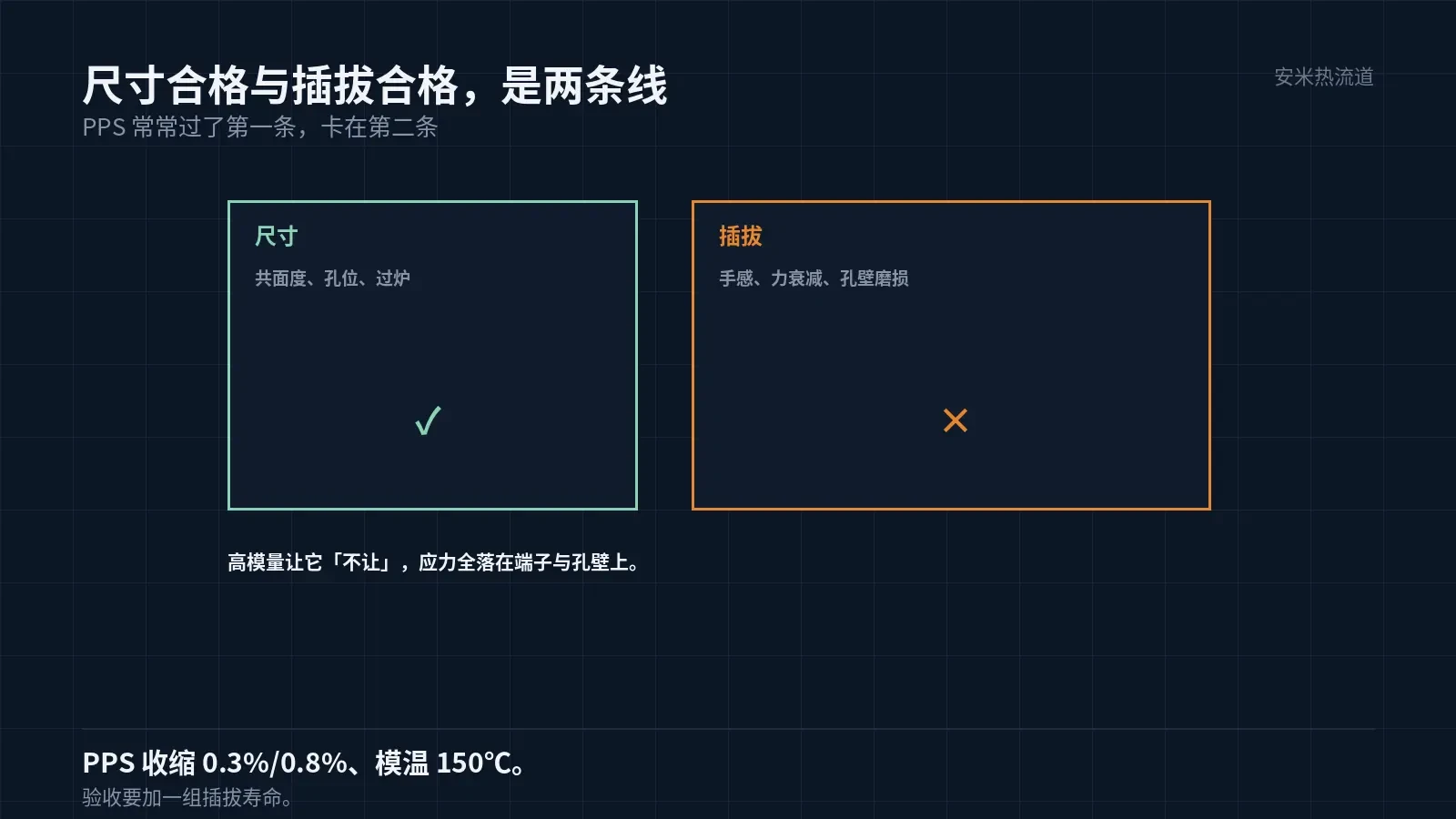
This leads to two problems: increased insertion and extraction force, creating a stiff feel; plus hole wall wear and terminal loosening after repeated insertions. Neither issue appears in dimensional reports.
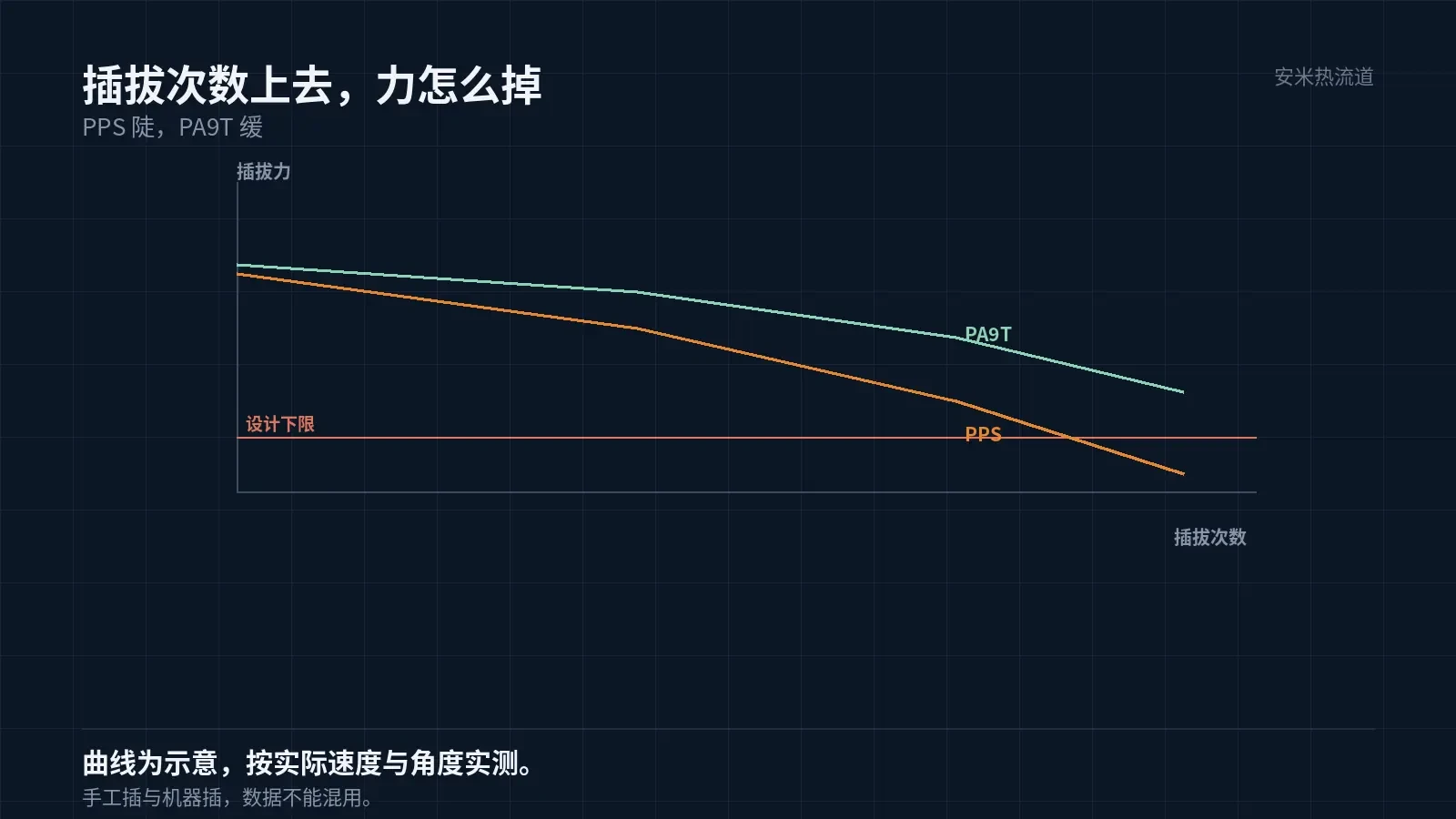
Therefore, acceptance testing for PPS board-to-board connectors must go beyond dimensional checks to include insertion/extraction life testing. The true lifespan is determined by the number of cycles until force drops below the lower limit.
A mold temperature of 150°C ensures stability.
The typical mold temperature for PPS is 150°C, with a minimum of 130°C. This ensures complete crystallization, which is essential for dimensional stability and heat resistance. If the mold temperature drops to 120°C, parts may appear acceptable initially but will deviate after two weeks.
For thin-walled, multi-cavity board-to-board components, mold temperature uniformity is more critical than the absolute value. A 5°C temperature difference between cavities in a multi-cavity mold leads to a one-grade dimensional variation.
Zoned mold temperature control is standard for multi-cavity board-to-board molds, with separate control for the runner zone, cavity zone, and end zone. Temperatures for these three zones are determined by mold flow analysis and first-article data; a single temperature setting for the entire mold is not acceptable.
Higher mold temperatures increase cycle time. For high-volume board-to-board production, offset this cost by using "multi-cavity molds + quick mold changes" instead of lowering the mold temperature to save time.
Additionally, higher mold temperatures require more careful demolding. When ejecting PPS parts from a 150°C mold wall, sufficient ejection force is needed, and ejector pin positions must avoid terminal holes to prevent misalignment.
Brittleness is the second trade-off.
PPS exhibits low notched impact strength, a limitation that worsens with glass fiber reinforcement. Brittle fracture commonly occurs at clips, locating posts, and thin-wall flanges on board-to-board connectors.
Interference fits must be tightened during assembly. PPS parts forced into place may not crack immediately but can fail after dozens of insertions or removals. These failures are undetectable during incoming inspection and only appear at the customer site.
Three structural guidelines: wall thickness ≥ 0.5mm,, corner radii ≥ R2, and avoid perpendicular orientation between fiber direction and stress direction. The third requirement must be verified using mold flow analysis.
If toughness is critical, PPS is not the optimal choice. PA9T provides superior toughness but at the expense of moisture absorption and warpage; LCP offers higher stiffness with lower directional shrinkage. This trade-off is resolved during material selection.
Gate: Use SD Series Only; Gate Mark Must Be Within Tolerance
According to company records, only the SD Series is recommended for PPS; TP, VG, and PVG series are not recommended. For board-to-board multi-cavity small parts, the SD Series provides a minimal gate mark and clean break-off, ideal for dense layouts.
Pin-point gates typically use φ0.8–1.2mm.. Smaller diameters are selected for multi-cavity molds, but excessively small gates cause high shear and glass fiber breakage, resulting in brittleness near the gate.
Vent depth should be 0.005–0.008mm.. Although board-to-board cavities are shallow with short flow paths requiring less venting, this depth cannot be omitted. PPS flows rapidly, causing instantaneous high pressure at the end of fill; poor venting results in burn marks.
Gate mark protrusions affect mounting coplanarity. Board-to-board coplanarity tolerance is typically 0.05mm;; the protrusion height must be accounted for within this tolerance and cannot be corrected after mold opening.
Hot Runner: Balanced Flow for Multi-Cavity Molds
Manufacturer data shows that PPS viscosity remains stable even during extended residence, making hot runners a viable option. This is ideal for multi-cavity board-to-board applications, as extensive purging is not required when restarting after downtime.
Multi-cavity balance depends on runner design, not temperature control compensation. Ensure runner lengths for each cavity are as consistent as possible and branch points are symmetrical; otherwise, fill time differences between cavities will accumulate.
Temperature control requires zoning: nozzle at 310–320°C, melt temperature not exceeding 360°C. The OEM's claim that viscosity does not increase does not mean repeated thermal degradation at a single point is acceptable.
Balancing becomes more challenging as cavity count increases. Natural balancing is sufficient for up to 8 cavities; consider a graded manifold design for over 16 cavities; mold flow analysis is typically required for over 32 cavities.
Manifold temperature control also requires zoning. In multi-cavity molds, uniform nozzle temperatures cause cavities near the center to run hotter than those at the edges, leading to inconsistent fill times.
Validation: Add Insertion/Extraction Life Test
Standard validation covers three categories: dimensions, coplanarity, and reflow. For PPS plate-to-plate connections, add a fourth category: insertion/extraction life. Perform tests at 1.5 times the customer's actual cycle count and measure force degradation.
Insertion and extraction tests must use actual speed and angle parameters. Peak forces vary significantly between manual and automated insertion; life data cannot be combined.
Please provide part drawings, cavity count, insertion/extraction cycle requirements, and reflow profile. We will verify the design based on insertion/extraction life and gate scheme before providing a quote.
MATCHED BY MATERIAL AND DEFECT
This article covers stringing, drooling, clogging, and high-heat resins; refer to SD for gate freeze and break-off.
Register for a selection review and quote
Submit part, mold, and material details. Our engineers will evaluate the gate solution per part and provide a quote.
Upload a 2D layout drawing using the form.
Online selection and quote
Scan to register