
What Does the Extra Cost of PEEK Buy in Board-to-Board Connectors?
Material Applications15 min read
On this page
Board-to-board connectors are a high-volume, small-part, low-unit-price category. PEEK resin costs more than ten times that of PPS, making it appear uneconomical for this application. However, some projects do use it and never switch back.
This article clarifies exactly which capabilities the extra cost delivers and which are wasted.
First Capability Purchased: Temperature Margin
PEEK has a melting point of 343°C and a long-term service temperature of approximately 250°C, depending on the grade. Board-to-board connectors do not require such high heat resistance; reflow soldering peaks at around 260°C, and PPS's 300°C melting point is sufficient.
Therefore, heat resistance is an unnecessary cost for standard board-to-board connectors. This margin only matters if the part is near a heat source or must withstand multiple repair cycles (repeated oven passes).
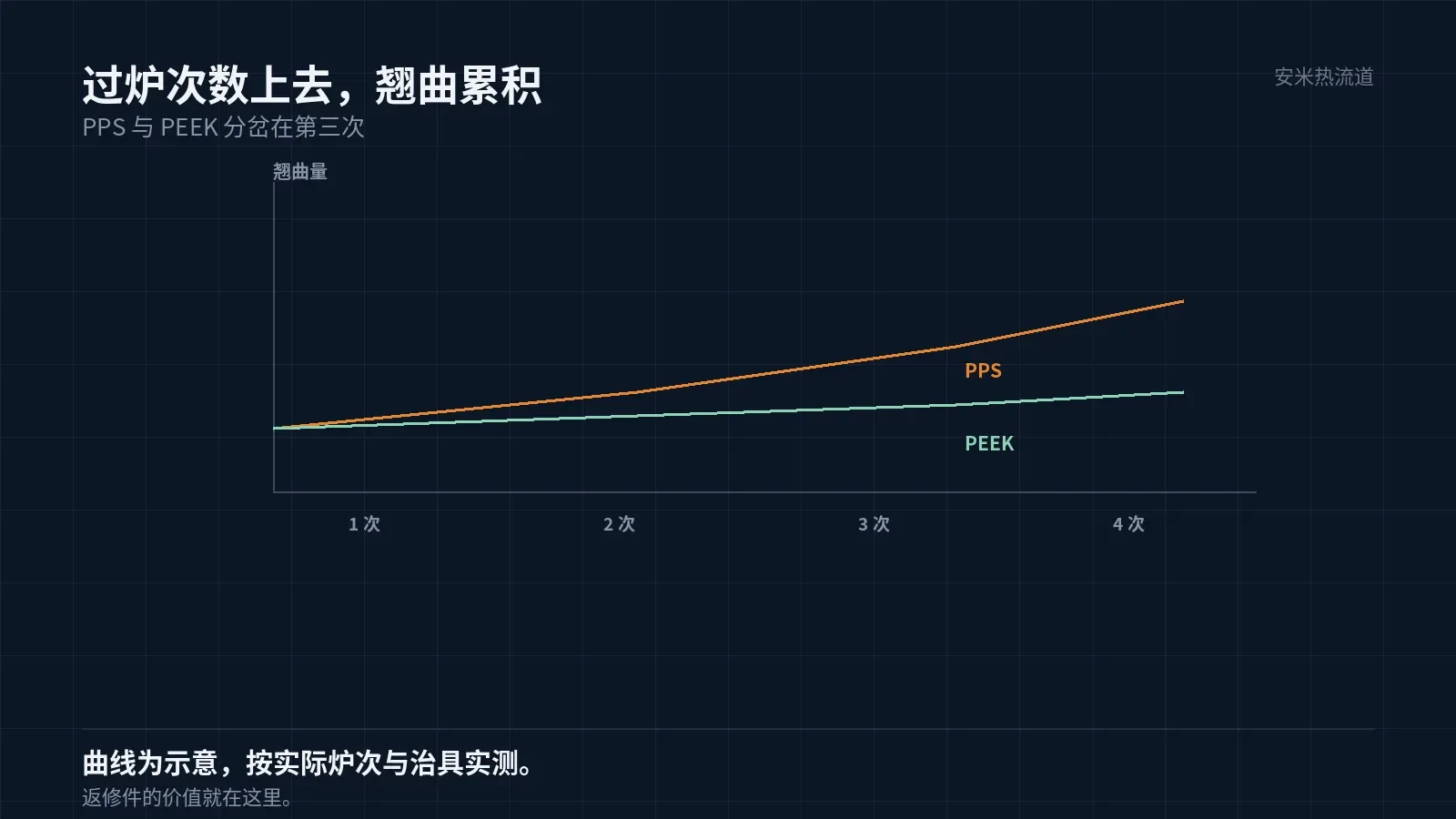
Repair is a real-world scenario: BGA rework and secondary reflow require parts to pass through the oven three to four times. PPS shows cumulative warpage after multiple oven passes, while PEEK offers greater margin with less accumulation.
This factor drives many high-end board-to-board PEEK connector selections: it's not about the first oven pass, but the third and fourth.
Second Purchased Capability: Long-Term Dimensional Stability
PEEK exhibits extremely low water absorption, maintaining nearly unchanged dimensional stability even in long-term humid environments. Board-to-board applications demand high hole-position accuracy; this property eliminates the need for full compensation designs.
However, PPS also has extremely low water absorption, so the two are similar in this regard. The key differentiator is "long-term creep resistance at high temperatures": PEEK exhibits significantly better creep resistance above 200°C.
Therefore, this advantage is not universal. For parts operating at room temperature, PPS is sufficient; PEEK is only valuable when used above 150°C under sustained load.
Sustained loads are uncommon in board-to-board applications, which typically involve terminal pre-tension and mating/unmating. These loads are minimal, and PPS can generally withstand them.
Third Benefit: Wear Resistance and Mating/Unmating Cycle Life
PEEK forms a transfer film under low-oil or dry conditions, resulting in a low coefficient of friction. Board-to-board mating and unmating involve dry friction, making this property directly relevant to mating/unmating durability.
PPS is hard and brittle, causing hole wall wear after repeated mating/unmating cycles. PEEK offers superior toughness, leading to more gradual wear—its key practical advantage in board-to-board applications.
However, this depends on the terminal material and plating. Gold-plated and tin-plated terminals exhibit different friction characteristics against plastic components. PEEK with tin-plated terminals may not outperform PPS with gold-plated terminals.
Before switching to PEEK, evaluate the terminal system first. Plastic components and terminals form a matched wear pair; changing only one side yields limited results.

The downside: Material cost and molding cycle time
PEEK entails high material costs and processing temperatures: nozzle at 395°C, barrel at 375/380–385/390°C, mold temperature at 170–200°C, drying at 120–150°C for 3–5 hours; barrel heating capacity must reach 400°C.
A mold temperature of 170–200°C increases cycle time compared to PPS. Board-to-board connectors are high-volume products; a 10% rise in cycle time reduces production capacity by 10%. This cost factor must be included in quotations.
Equipment is also a limiting factor. Machines that cannot heat the barrel to 400°C cannot process PEEK. Before discussing tooling for PEEK solutions, verify equipment capability first.
Combining these three factors, the unit price for PEEK board-to-board connectors is typically two to three times higher than that of PPS. This premium is justified only in applications requiring multiple reflow cycles or high insertion/extraction durability.
Another hidden cost is yield. Due to PEEK's narrow processing window and high mold temperatures, thin-walled parts typically have a yield rate one tier lower than PPS. This loss must be amortized over order volume, making it particularly uneconomical for small-batch projects.
Gates: Three viable options
Company records indicate that SD, VG, and PVG gates are available for both PEEK and LCP materials, while TP is not supported. For multi-cavity board-to-board molds: - SD gates leave smaller marks, making them ideal for dense layouts. - VG and PVG gates provide superior flow capacity, suitable for molds with many cavities and long flow paths.
PEEK melt viscosity is high; do not size gates and runners based on PPS experience. Undersized dimensions cause excessive pressure drop and shear, which can break glass fibers and lead to brittleness near the gate.
The hot runner must be designed for 395°C with sufficient heating power margin. PEEK melt exhibits a higher pressure drop in the flow channel than PPS; therefore, mold flow analysis for cavity balance in multi-cavity molds must be re-run.
Decision Table: Three Questions
First question: How many reflow passes does this component require? One pass: PPS is sufficient. Three or more passes: PEEK offers a margin advantage.
Second question: What are the mating cycle requirements? PPS is acceptable for a few thousand cycles; PEEK offers more gradual wear over ten thousand cycles.
Question 3: Can the equipment reach 400°C? If not, the solution is invalid.
Proceed only if two of the three questions indicate PEEK. If only one points to PEEK, calculate costs first before deciding.
Submit the part drawing, number of reflow passes, mating cycle requirements, and existing equipment parameters. We will first assess feasibility, then validate the gate design, and provide a quote upon confirmation.
MATCHED BY MATERIAL AND DEFECT
This article covers stringing, drooling, clogging, and high-heat resins; refer to SD for gate freeze and break-off.
Register for a selection review and quote
Submit part, mold, and material details. Our engineers will evaluate the gate solution per part and provide a quote.
Upload a 2D layout drawing using the form.
Online selection and quote
Scan to register