
Replacing LCP with PA9T in Board-to-Board: Three Critical Conditions
Material Applications15 min read
On this page
PA9T is more cost-effective than LCP, offers superior toughness, and its low water absorption of 0.19% is also advantageous. As a result, many board-to-board projects aim to replace LCP with PA9T. While this sounds reasonable, issues frequently emerge by the third production batch in practice.
This article outlines three prerequisites for substitution. All three must be met for it to work; if any one fails, failure is inevitable.
Prerequisite 1: Pitch must not be too small
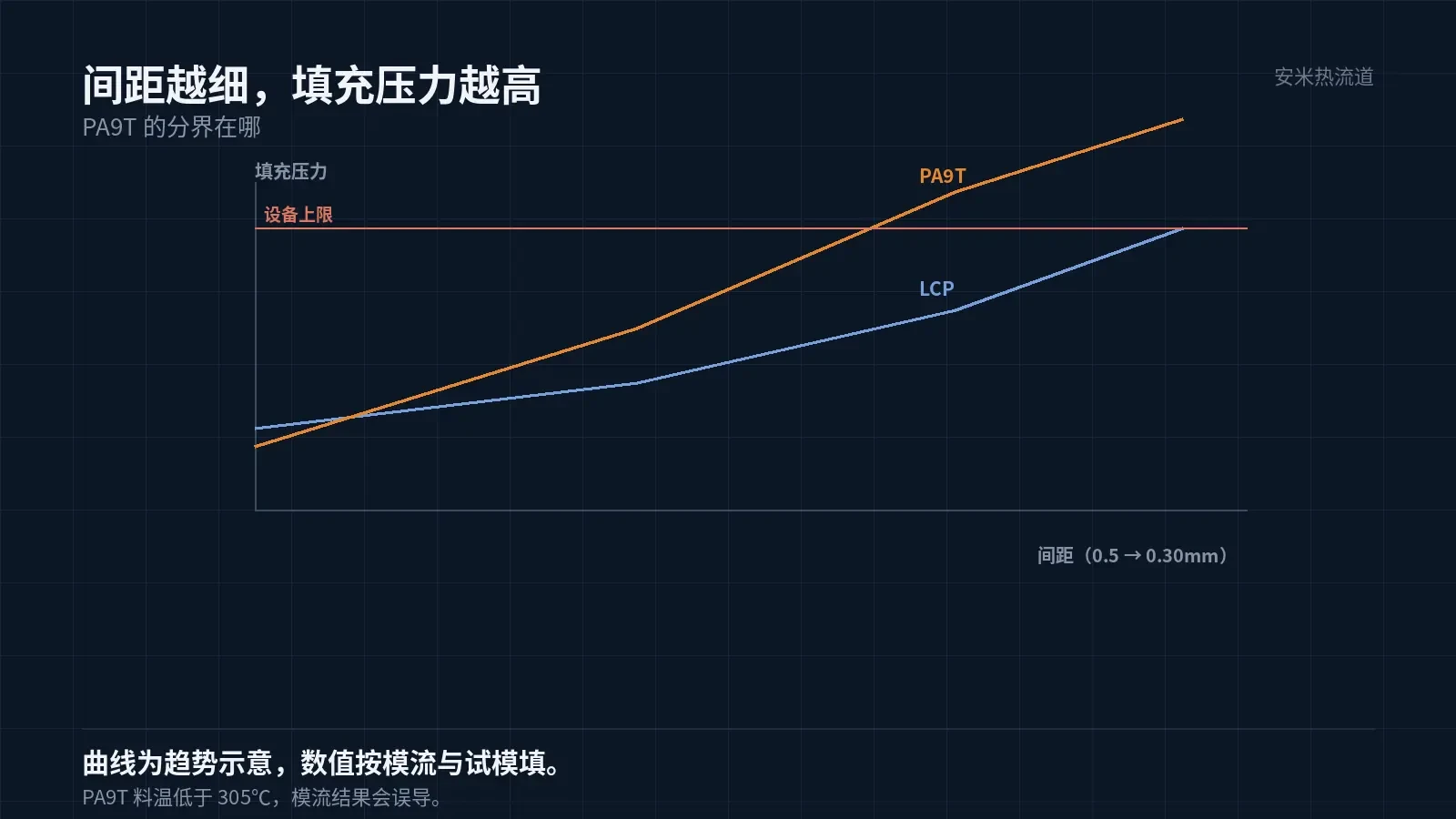
LCP offers top-tier flowability for thin-wall, long-flow applications, while PA9T lags behind. For parts with 0mm pitch and 60 pins, PA9T can still fill; below 0.35mmmm pitch or with more than 100 pins, filling pressure will exceed equipment limits.
Excessive fill pressure causes high shear near the gate. At 305–320°C, PA9T melt viscosity is already high; increased shear breaks glass fibers, actually reducing strength near the gate.
Therefore, the first assessment is straightforward: run mold flow analysis to check filling pressure and shear rate. Proceed to the next step only if both values are within equipment and material limits.
Mold flow analysis must use actual melt temperature curves, not default values. For PA9T, the melt temperature must exceed 305°C, with an optimal range of 305–320°C. Below this range, flowability is insufficient, leading to misleading simulation results.
Prerequisite 2: Warpage must be within acceptable limits
PA9T exhibits shrinkage of 0.3%/0.9% with threefold anisotropy. LCP has fourfold anisotropy but lower absolute values (0.10%/0.40%), while PA9T features threefold anisotropy with higher absolute values. Greater absolute shrinkage leads to increased warpage.
Board-to-board coplanarity tolerance is typically within 0.05 mm. For long PA9T components, warpage after cooling can easily consume most of this margin.
Feasibility depends on part length and gate design. For parts under 20 mm, PA9T is viable; for parts over 30 mm, even with balanced gating, achieving a 0.05 mm tolerance is difficult.
There are no shortcuts: prototyping and measurement are required. Mold flow analysis provides trends, not absolute values.
If tolerance cannot be met, you have two options: modify the part design (add ribs or adjust wall thickness) or change the material (switch back to LCP or use PPS). Make these decisions before tooling.
Modifying the part design is often more cost-effective than changing materials. Adding two shallow ribs along the long edges to mitigate directional shrinkage differences can typically bring tolerances back within spec, at the cost of one additional mold machining step.
Prerequisite 3: Address reflow soldering and moisture absorption together.
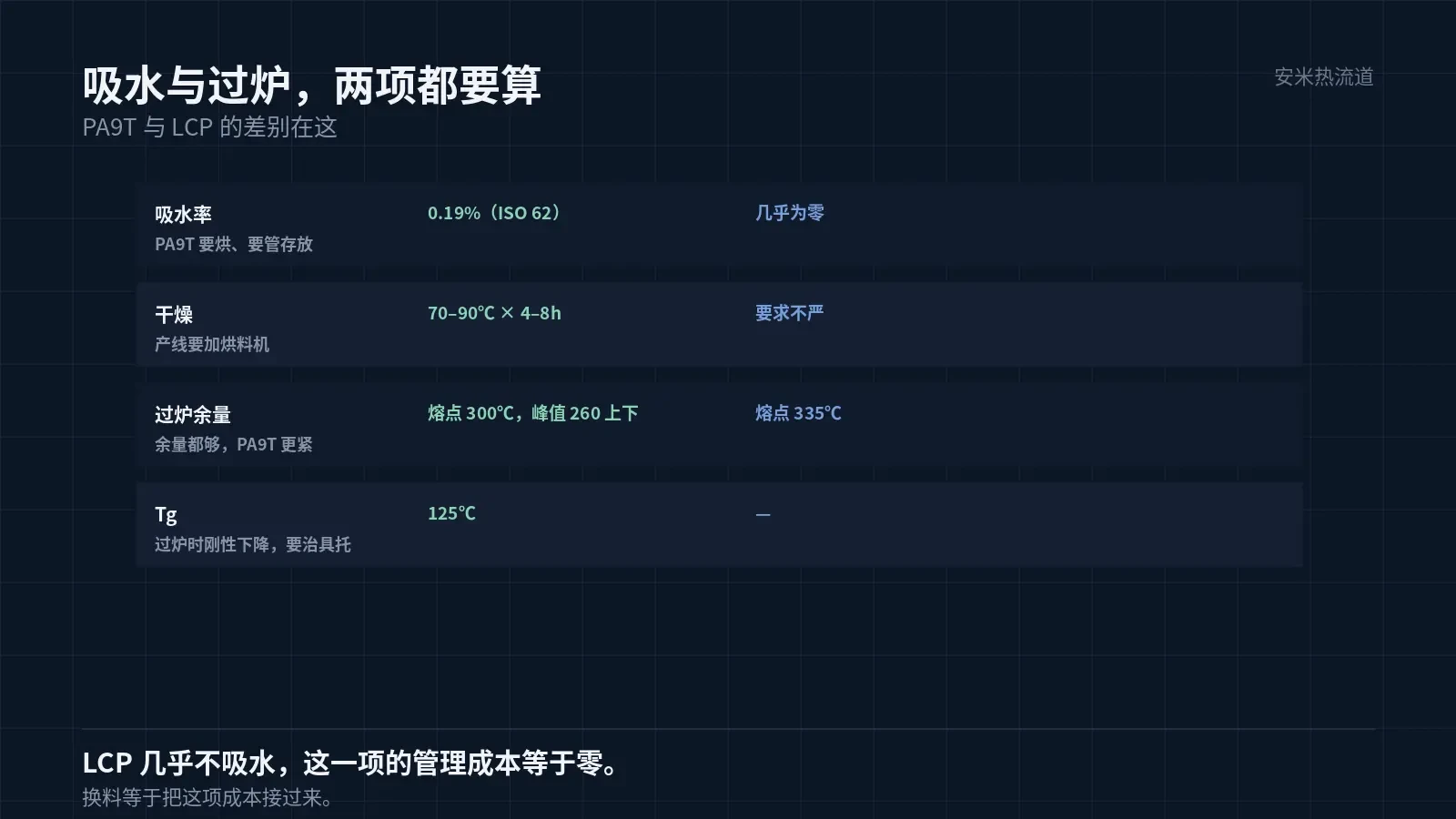
PA9T has a melting point of 300°C and a reflow peak temperature of approximately 260°C, offering a 40°C margin for soldering. With a Tg of 125°C, the entire component exceeds Tg during reflow, reducing rigidity and causing terminal displacement at high temperatures.
Moisture absorption is more of an issue with this material than with LCP. Although PA9T has a low water absorption rate of 0.19%, thin-walled board-to-board components absorb moisture quickly. Drying requires 70–90°C for 4–8 hours to maintain moisture content below 0.20%.
Storage conditions between baking and placement must be controlled. In high-humidity environments, parts stored on racks for two days can absorb enough moisture to cause reflow issues, with blistering and delamination appearing first in thin-wall areas.
LCP absorbs virtually no moisture, so this factor is negligible. Switching to PA9T shifts this management burden. Production lines must maintain baking and storage records; otherwise, root causes cannot be identified if issues occur.
Required Mold Modifications After Replacement
Melt temperature differences: PA9T barrel temperatures are 280–320/285–330/290–340°C, with nozzle temperatures at 300–350°C; LCP uses hot runners at 335–345°C. Reset the hot runner temperature zones and recalculate heating power.
Mold temperature: LCP requires 80–120°C. For PA9T, the manufacturer does not specify a recommended mold temperature; determine it based on part geometry and first-article data. Do not simply copy the 100°C setting used for LCP.
Gate Type: Only SD Series is recommended for PA9T, per company specifications. VG and PVG solutions used for LCP cannot be reused. Balance in multi-cavity molds must be re-evaluated.
Drying equipment is also required. While LCP may not need drying, PA9T must be dried. Production lines require dryers and moisture content testing. This item is most frequently overlooked during material substitution assessments.
Three Signs of Substitution Failure
First signal: During trial molding, holding pressure keeps rising while short shots remain in the same locations. This indicates flow capacity has reached its limit; gate spacing is too narrow for PA9T.
Second signal: Coplanarity exceeds tolerance after reflow and cannot be corrected by adjusting mold temperature or holding pressure. This indicates that the directional shrinkage is too large; the material is unsuitable for this part length.
Third Signal: Terminal hole position deviation occurred in the third batch, while the first two batches were normal. This typically indicates inadequate moisture control; the mold itself is not at fault.
If any of these three signals occur, revert to material selection instead of continuing to adjust process parameters.
Submit the component drawing, pin pitch, coplanarity tolerance, and reflow profile. We will first evaluate substitution feasibility, then verify gate and mold temperature solutions, and provide a quote upon confirmation.
MATCHED BY MATERIAL AND DEFECT
This article covers stringing, drooling, clogging, and high-heat resins; refer to SD for gate freeze and break-off.
Register for a selection review and quote
Submit part, mold, and material details. Our engineers will evaluate the gate solution per part and provide a quote.
Upload a 2D layout drawing using the form.
Online selection and quote
Scan to register