
PA46 for Board-to-Board: Why Must Melt Temp Exceed Melting Point by >10°C?
Material Applications16 min read
On this page
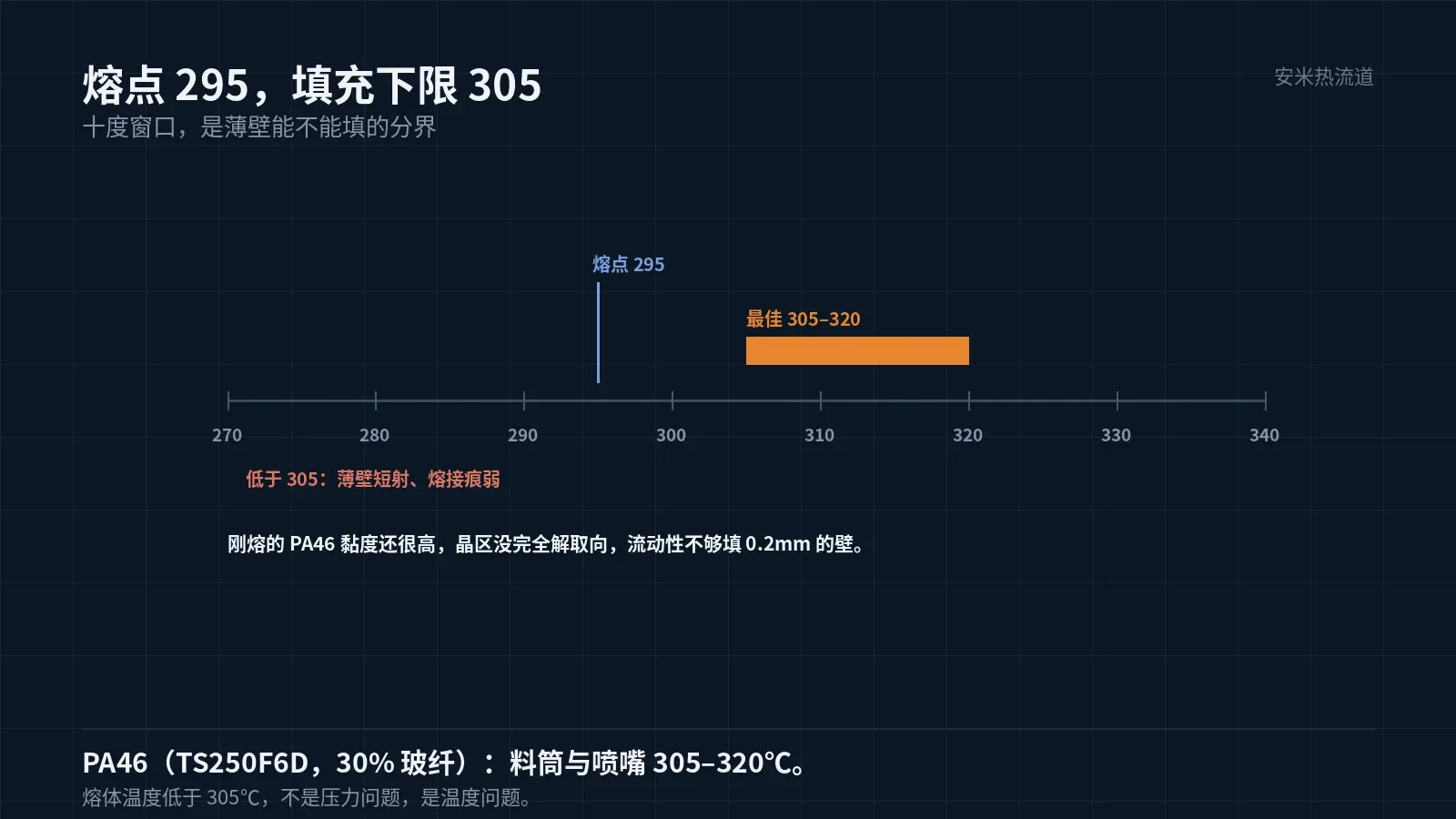
PA46 has a melting point of 295°C, but its melt temperature must exceed 305°C, with an optimal range of 305–320°C. This superheating requirement is critical for thin-wall parts such as board-to-board connectors.
Many operators set the material temperature to 300°C, assuming it is sufficient because it exceeds the melting point. However, this leads to incomplete filling of thin walls or weld lines that break easily when flexed. This article addresses this 10°C gap.
Melting Point Is Not the Flow Onset
The 295°C melting point marks the transition from solid to liquid. Just above this temperature, the melt contains many incompletely disoriented crystalline regions, leading to high viscosity and poor flowability.
Due to PA46's tightly packed molecular chains and high crystallinity, this "just-melted" state is more pronounced than in general polyamides. To lower viscosity enough for filling thin walls, the temperature must be raised by over 10°C.
The manufacturer requires the melt temperature to exceed 305°C, with an optimal range of 305–320°C for both the barrel and nozzle. This is a mandatory lower limit, not just a recommendation.
Below 305°C, thick-walled sections may still fill completely, but thin walls (1–2.4 mm) of board-to-board connectors will suffer from short shots, weak weld lines, and rough surfaces simultaneously.
Performance in Thin-Wall Applications
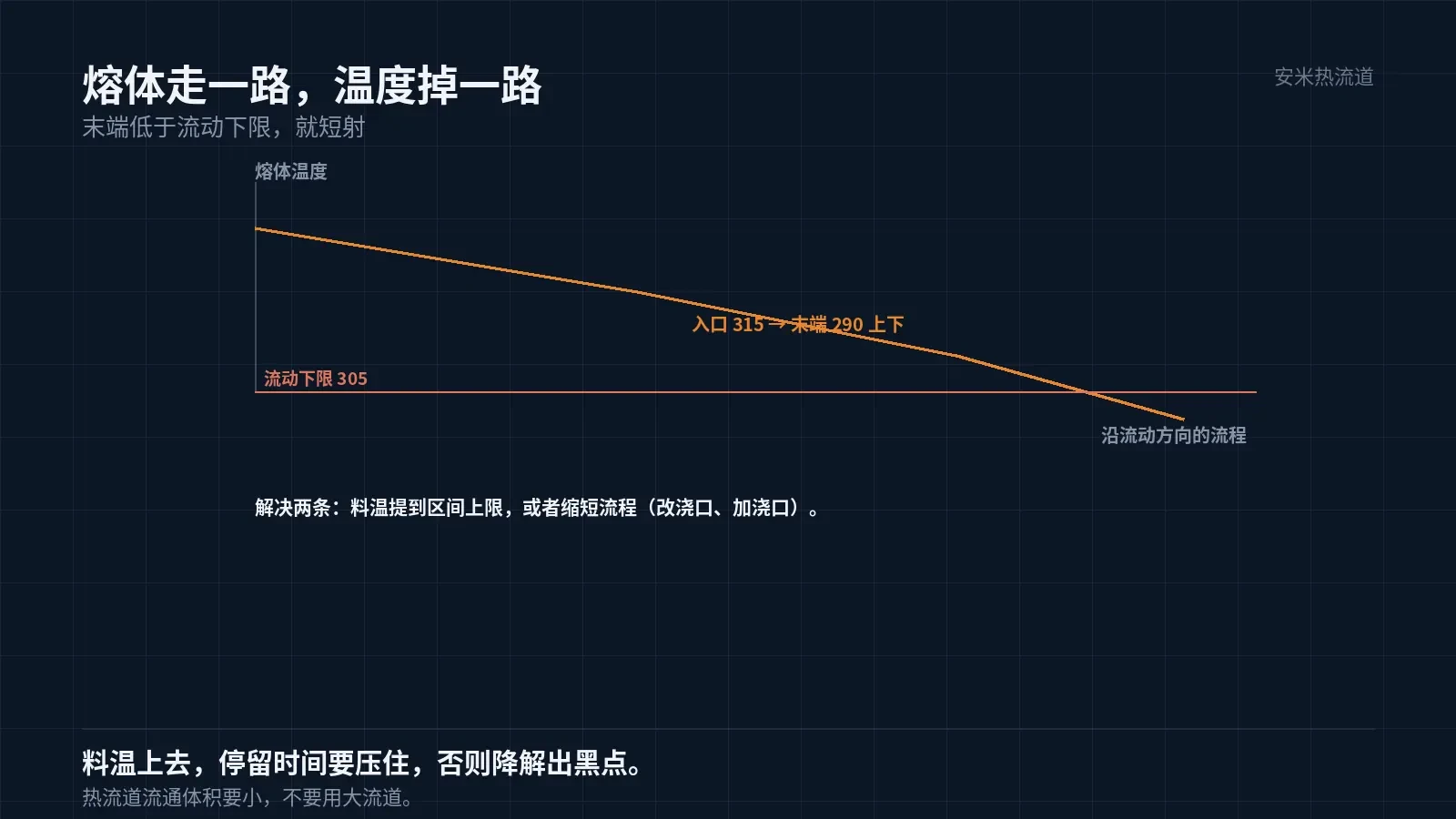
Board-to-board wall thickness is typically 0.2–0.3 mm with a high flow length ratio. In such channels, melt pressure loss and temperature drop are rapid; the melt front cools continuously during filling.
Melt enters the cavity at 305°C but may cool to approximately 290°C by the end, dropping below the flow threshold. This results in short shots at the end due to insufficient temperature rather than pressure.
Two solutions: raise melt temperature to 315–320°C (upper limit) or shorten the flow path (adjust gate location or increase gate count). Both can be used together.
Raising the melt temperature has drawbacks: PA46 degrades if held at high temperatures too long, leading to reduced flowability and black spots on parts. Therefore, residence time must be controlled when increasing the melt temperature.
Residence time is controlled by two factors: minimizing hot runner channel volume (avoid large runners) and defining startup/shutdown procedures. Purging is required after prolonged stops.
Hot Runner: No recommended temperatures provided by the manufacturer
The manufacturer does not specify recommended mold or hot runner temperatures for PA46. Therefore, process plans cannot reference "per manufacturer recommendation" and must instead state "determined by first-article inspection and mold-flow analysis."
In practice, set the hot runner temperature 5–10°C above the barrel temperature, starting in the 310–330°C range. Begin mold temperature trials at 90–110°C and adjust based on part warpage and appearance.
These values are starting points, not final conclusions. Each mold requires re-evaluation based on its specific part geometry and cavity count.
Hot Runner Type: Per company records, only the SD Series is recommended for PA46. The TP Series, VG Series, and PVG are not recommended. The SD Series provides sufficient flow capacity and minimal marks for thin-wall parts.
Warpage: The 0.4%/1.1% Shrinkage Problem
PA46 exhibits 0.4%/1.1% shrinkage, with nearly a threefold difference between directions. For board-to-board long conditions, this anisotropy directly causes warpage.
Compared to LCP, PA46 exhibits higher absolute shrinkage (0.4 vs. 0.10) but lower directional anisotropy (2.75x vs. 4x). Higher absolute values indicate greater warpage, while reduced directional differences simplify gate balancing.
Therefore, for PA46 board-to-board applications, the focus is not on "balancing directional differences" but on "controlling absolute shrinkage." This is achieved through holding pressure and mold temperature, not gate location.
Holding pressure must be sufficient and applied late. Gates freeze quickly in thin-wall parts, creating a short packing window; use mold temperature to slow solidification near the gate. This is the practical application of zoned mold temperature control for PA46.
Moisture Absorption and Reflow
PA46 exhibits relatively high moisture absorption among high-temperature resins and requires strict drying. Dry the material to low moisture levels per grade-specific data sheets; do not apply PA9T's 70–90°C parameters.
Thin-wall board-to-board components absorb moisture quickly, so storage time after drying must be strictly controlled. In high-humidity environments, parts on racks can reabsorb moisture within hours.
Reflow: Melting point 295°C, peak temperature approx. 260°C, leaving a 35°C margin—tighter than the 40°C margin for PA9T. Adjust reflow profiles based on part thickness and fixtures; do not reuse them directly.
The combination of reflow warpage and moisture absorption is the most common failure mode for PA46 board-to-board connectors: slight warpage during reflow, followed by additional warpage after moisture exposure, leads to cumulative out-of-tolerance conditions.
Validation: Determine the temperature range
Group 1: Temperature steps at melt temperatures of 300/305/310/315/320°C. Measure short-shot length and weld line strength. This data defines the processing window.
Second group: Hold pressure steps at the same melt temperature. Adjust holding pressure and time to measure shrinkage and warpage. Third group: Combined reflow and moisture absorption test. Measure dimensions in three states: after drying, after reflow, and after 48h moisture exposure.
After completing these three groups, the process window for this mold is established. For parts with narrow windows, adjust the part design or gate location during the design phase; do not rely solely on machine adjustments.
Send us the part drawing, wall thickness, flow length, and reflow profile. We will validate the gate and hot runner solution against the temperature window and provide a quote upon confirmation.
MATCHED BY MATERIAL AND DEFECT
This article covers stringing, drooling, clogging, and high-heat resins; refer to SD for gate freeze and break-off.
Register for a selection review and quote
Submit part, mold, and material details. Our engineers will evaluate the gate solution per part and provide a quote.
Upload a 2D layout drawing using the form.
Online selection and quote
Scan to register