
Why Use PEEK for Wear Parts in Transmissions?
Material Applications15 min read
On this page
PEEK costs three to five times more than PA46. Customers still choose it for thrust washers in gearboxes and seal rings in pumps.
The extra cost delivers three benefits: wear resistance, oil temperature resistance, and dimensional stability.
Operating Conditions: Oil, Heat, Wear
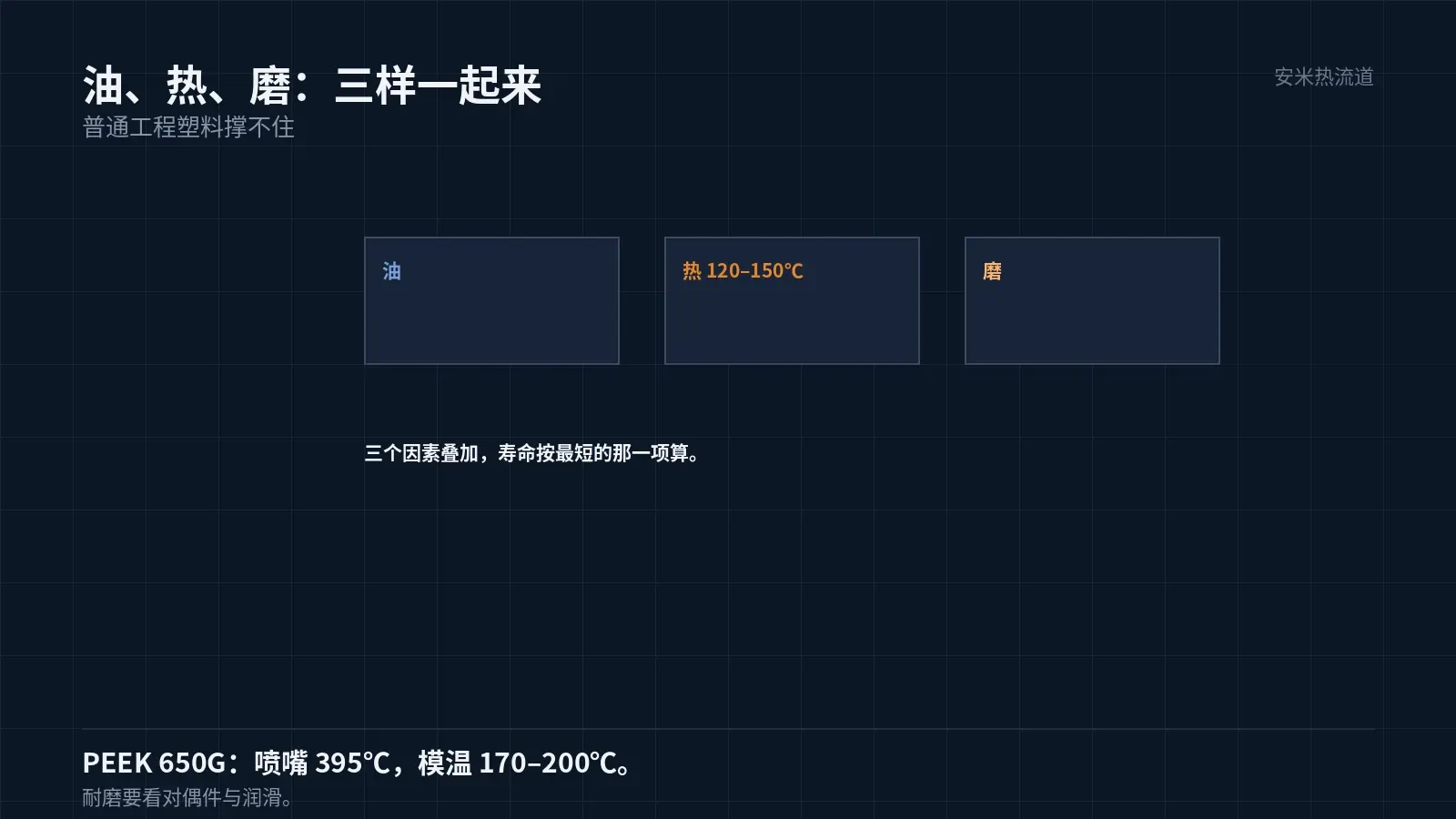
Gearbox components operate submerged in oil at 120–150°C under continuous friction and pressure.
Pump components endure harsher conditions: media may include oil, water, or mixtures, under high pressure and speed with rapid wear.
Combined, these three factors prevent standard engineering plastics from meeting service life requirements. PEEK's wear and chemical resistance provide distinct advantages in this scenario.
Victrex 650G is a 30% glass-filled grade. Barrel temperatures: rear 375°C, middle 380–385°C, front 390°C; nozzle 395°C.
Mold temperature: 170–200°C. This is twice the temperature for conventional materials, requiring a dedicated mold temperature control system.
Wear Resistance: Mechanisms
PEEK's wear resistance comes from two factors: the matrix's low friction coefficient and improved compressive strength due to glass fibers.
However, glass fiber can also abrade mating parts. In steel-on-steel friction, PEEK with glass fiber increases wear on mating components.
Therefore, mating design must account for: PEEK material pairing, surface roughness, and lubrication.
With oil lubrication, PEEK exhibits low wear; under dry friction, wear is high, requiring added lubricant or mating component changes.
This factor is frequently overlooked during material selection. Relying only on PEEK wear data without considering mating components leads to wear after installation.
Mating design must also account for surface roughness. Excessive roughness on mating parts accelerates PEEK wear rates.
Empirical data shows that keeping mating part Ra below 0.4 significantly reduces wear, which is critical for pump components.
Lubrication assessment is critical. With oil lubrication, PEEK wear rates are an order of magnitude lower than in dry friction; ensure the design allows oil to reach all friction surfaces.
For areas where oil cannot penetrate, use lubricant-filled grades or modify the design to accommodate dry friction.
Another factor is dry friction at startup. When the pump starts, oil has not yet reached the friction surfaces, leaving them dry.
Frequent pump startups cause significant dry friction wear. Account for this during material selection.
Two options: pre-lubricate before startup, or choose grades with good dry friction performance. The first modifies the system; the second changes the material.
Both incur costs. Choose based on pump startup frequency: use pre-lubrication for low-frequency starts and high-performance materials for high-frequency starts.
Temperature Resistance: Long-term Exposure to 150°C Oil
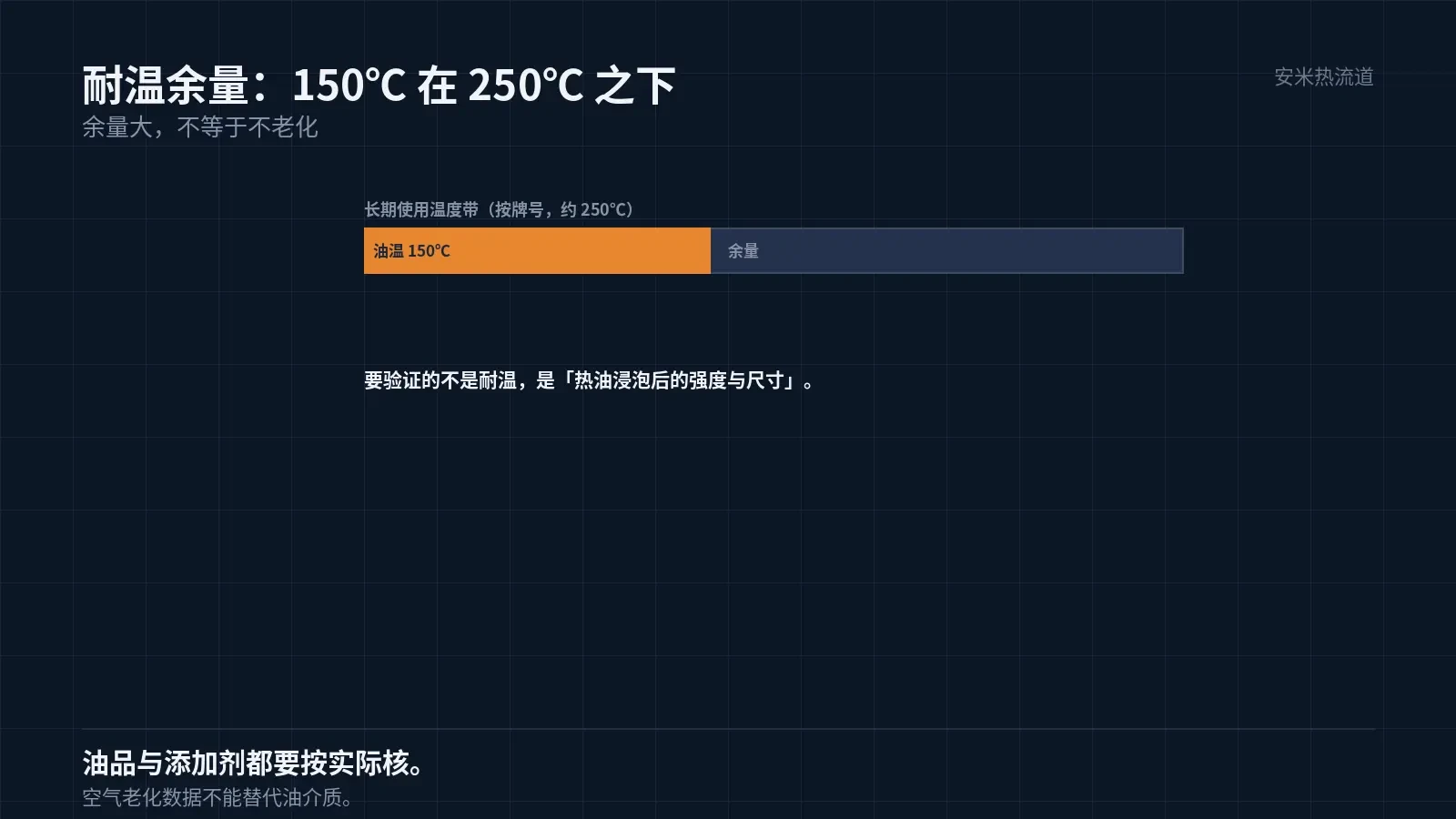
The continuous service temperature of PEEK varies by grade, reaching approximately 250°C—providing ample margin for oil temperatures up to 150°C.
However, oil aging differs from air aging. Oil induces permeation and oxidation, causing property changes after prolonged immersion.
Therefore, validation requires "hot oil immersion" testing: immerse samples in the actual oil type at the actual temperature for the actual duration, then measure strength and dimensions.
This cannot be replaced with outdoor air aging data. Different media involve different mechanisms.
Additionally, consider oil additives. Some additives can damage plastics, so verify compatibility with the specific oil formulation.
Dimensions: Pump component clearances
The clearance between pump components is very tight, typically 0.02–0.05mm.. Even slight dimensional deviations can reduce pump efficiency.
PEEK shrinkage: 45G is 0.most/1.3%, 45GL30 is 0.30%/0.most. The directional difference for glass-filled grades is 3 times greater.
A 3x directional difference requires part geometry to be aligned with the flow direction. For ring parts and long sections, gate design can control the impact of directional differences.
Mold temperature is 170–200°C; uniformity directly affects dimensional consistency. Cooling channels must be zoned with independent temperature control for each zone.
Additionally, post-shrinkage occurs. Due to high crystallinity, PEEK exhibits slight shrinkage after demolding; dimensions should be measured only after stabilization.
Molding: The cost of high temperatures
PEEK requires high processing temperatures; the barrel heating capacity must reach 400°C (430°C for HT/ST grades). Standard machines cannot process this material.
Dry at 120–150°C for 3–5 hours. Insufficient drying introduces moisture into the melt, causing silver streaks on part surfaces and reducing strength.
PEEK exhibits high melt viscosity at elevated temperatures, resulting in significant filling resistance. Thin-walled parts require high injection pressure and high injection speed.
High injection speeds generate shear heat, raising melt temperature further. Calculate carefully to prevent localized overheating and material degradation.
Therefore, PEEK molding requires a combination of high temperature, high pressure, and high speed. Equipment and molds must be configured accordingly.
When should I use it?
Worth using if two of these three conditions apply: multiple reflow passes or thermal cycles, exposure to media (oil, water, chemicals), and long-term operation above 150°C.
If only one condition is met, try PA46 or PPS first—they cost significantly less.
If none of the three conditions are met, using PEEK is wasteful. The price difference is clear, and customers will calculate costs.
Clarify this with the customer before providing a quote. If explained, the customer can decide; otherwise, you may be at a disadvantage during price comparisons later.
Send us the media, temperature, lifespan, fit clearance, and current material. We'll verify based on operating conditions and structure, then provide a quote upon confirmation.
MATCHED BY MATERIAL AND DEFECT
This article covers stringing, drooling, clogging, and high-heat resins; refer to SD for gate freeze and break-off.
Register for a selection review and quote
Submit part, mold, and material details. Our engineers will evaluate the gate solution per part and provide a quote.
Upload a 2D layout drawing using the form.
Online selection and quote
Scan to register