
Why Use PA9T Instead of PA66 for Sensor Housings in the Engine Bay?
Material Applications15 min read
On this page
For the same sensor, PA66 is used in the cabin, while PA9T is used in the engine bay. Despite the higher cost, customers still choose the premium option.
The difference lies in hydrolysis and heat aging resistance. This article explains the rationale behind this choice.
Engine Compartment Environment
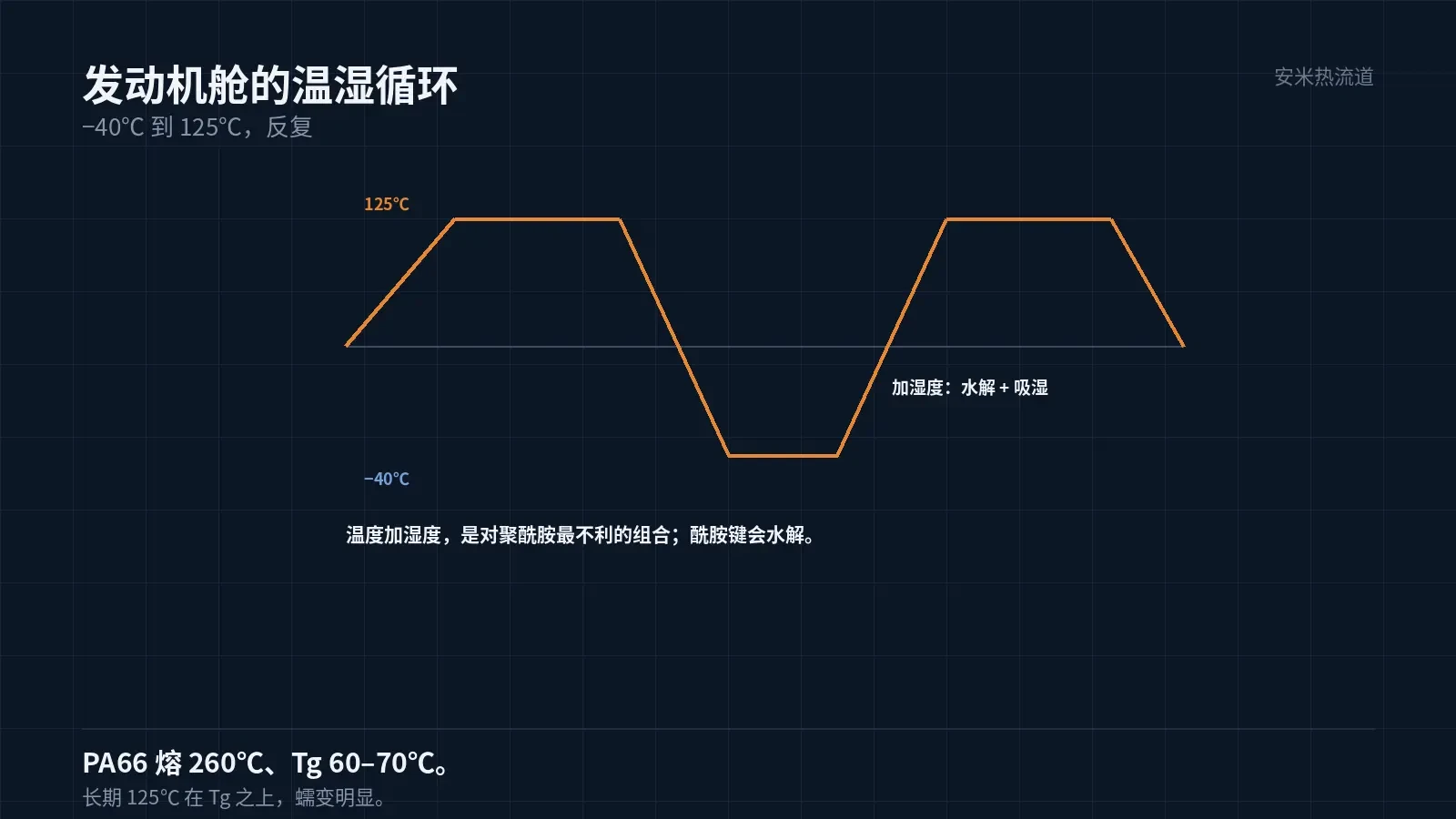
Engine bay temperatures fluctuate. Residual heat after shutdown, radiant heat during driving, and cold winter starts create repeated thermal cycles.
The temperature range is approximately −40°C to 125°C, with higher local temperatures near the exhaust manifold. Over long-term use, PA66 degrades within this range.
Humidity is also a factor. The engine bay is not dry; rain, car washes, and condensation expose housings to water.
Combined heat and humidity are the most damaging conditions for polyamides. Amide bonds hydrolyze when exposed to hot water, causing strength to degrade over time.
Therefore, for nylon components in the engine bay, the primary selection criterion is not strength, but hydrolysis resistance.
PA66 Limitations
PA66 has a melting point of approximately 260°C and a Tg of 60–70°C. At the engine bay temperature of 125°C, the material operates above its Tg over the long term.
Above Tg, molecular chain mobility increases, dimensional stability decreases, and creep becomes significant. Bolt preload decays over time.
Moisture absorption is also a concern. PA66 absorbs more water than PA9T; when it does, it swells, loses strength, and its insulation properties degrade.
Three issues compound: thermal aging, creep, and moisture absorption. PA66 can be used in the engine bay, but its service life is limited.
This does not mean PA66 cannot be used; it simply means it is not the optimal solution for applications involving long-term exposure to 125°C and humidity.
Another easily overlooked factor: in glass-filled PA66 grades, the glass fibers themselves are not resistant to hot water. Prolonged exposure to heat and humidity causes debonding at the fiber-resin interface.
Debonding appears as surface fuzzing and a sharp strength drop. Cross-section inspection reveals fiber pull-out rather than fiber breakage.
Therefore, validation of nylon parts in the engine bay must include 'strength retention after humid-heat aging,' not just dry-state tensile testing.
This step is often skipped. Parts may pass dry-state tests but fail after two or three years in the vehicle.
Three Key Metrics for PA9T
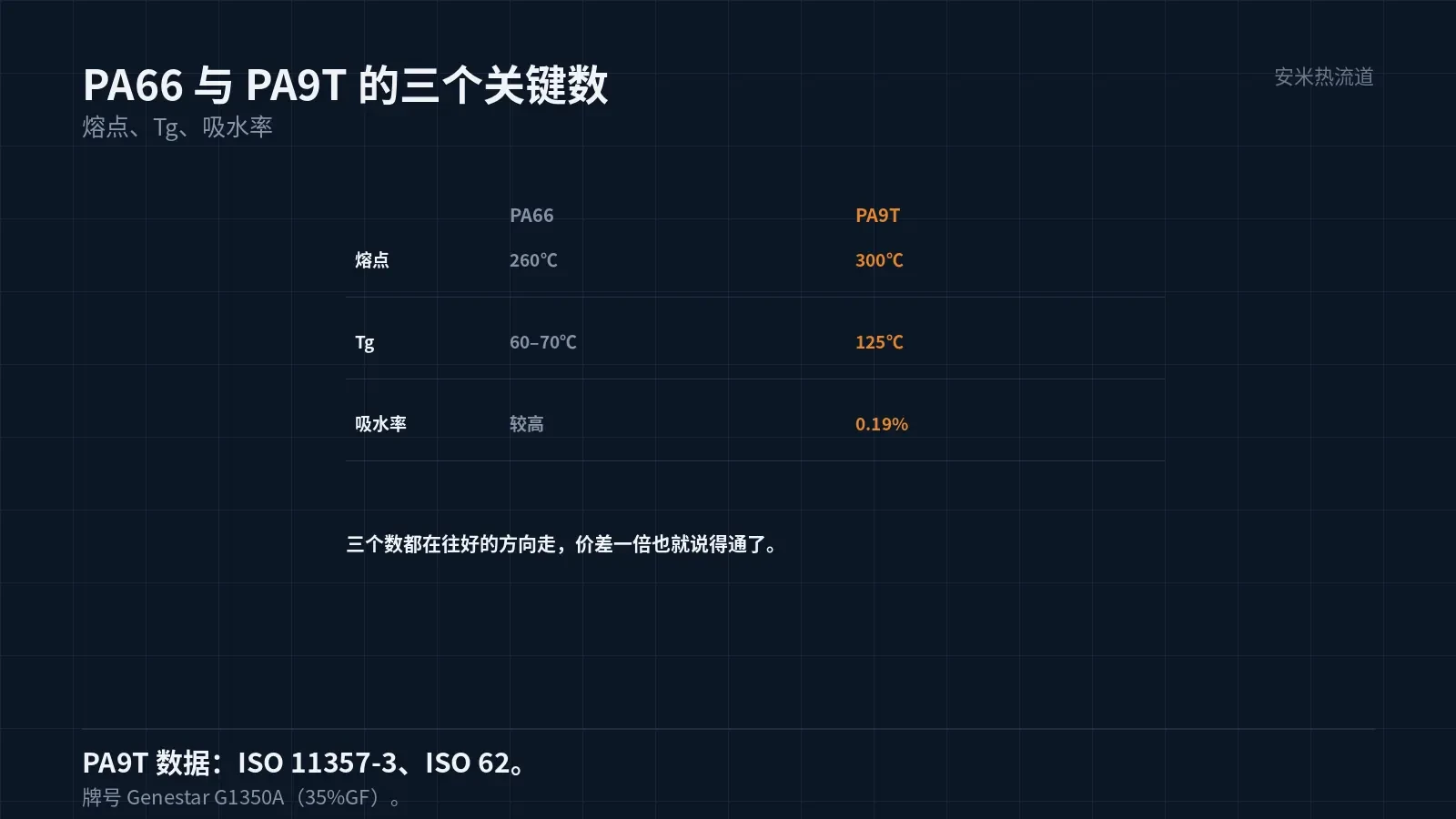
The melting point of PA9T is 300°C (ISO 11357-3), which is 40°C higher than PA66. This margin ensures long-term stability at 125°C.
The Tg is 125°C, right at the upper temperature limit for engine compartments. Rigidity remains stable near the Tg.
Water absorption is 0.19% (ISO 62), one order of magnitude lower than PA66. Low water absorption ensures dimensional and electrical stability.
When considering all three figures together, PA9T is better suited for engine compartments than PA66. This explains why customers are willing to pay double the price difference.
Note the grade: Kuraray Genestar G1350A is a 35% glass-filled grade with tensile strength of 200MPa,, flexural strength of 285MPa,, and flexural modulus of 10GPa..
Three Key Principles of Housing Design
First, consider wall thickness. Sensor housing walls are typically 1.0–1.5mm;. Walls that are too thin lack rigidity, while those that are too thick undergo greater dimensional changes after moisture absorption.
Second, inserts. Metal bushings are typically embedded in the housing for fixation. Ensure sufficient wall thickness around inserts to prevent stress concentration.
Third, sealing surfaces. The interface between the housing and cover must be flat; insufficient flatness causes leaks. Maintain uniform mold temperature on sealing surfaces to prevent warpage.
Among these three, sealing surfaces are the most challenging. They require full-circumference flatness, whereas warpage in injection-molded parts is global.
Therefore, sealing surface design must align with gate and cooling placement. Positioning the gate near the sealing surface ensures proper packing and minimizes shrinkage.
Drying and Molding
PA9T drying: 70–90°C for 4–8 hours; recommended moisture content ≤0.20%.
Insufficient drying introduces moisture into the melt, accelerating hydrolysis and reducing part strength while causing surface whitening. Strict monitoring is required in southern workshops.
Barrel temperatures: rear zone 280–320°C, middle zone 285–330°C, front zone 290–340°C, nozzle 300–350°C.
The manufacturer does not specify mold temperature. Determine it based on part geometry and cycle time: use higher temperatures for thin-walled parts and lower temperatures for thick-walled parts to prevent sink marks.
Monitor residence time during molding. PA9T degrades if held too long in the barrel; purge material when stopping production. This differs from PPS.
Validation and Failure Modes
Sensor housing validation typically requires three tests: thermal cycling, damp heat aging, and vibration. All three must pass for qualification.
Three failure modes: housing cracking (thermal aging + stress), seal failure (warping + aging), and signal anomalies (moisture absorption causing insulation degradation).
All three failures stem from material aging. Therefore, select materials based on end-of-life performance, not initial performance.
This point is often overlooked. Initial tests may pass, but issues that arise after three years of vehicle use can make troubleshooting difficult.
Provide the operating temperature, humidity conditions, lifespan requirements, and existing grades. We will verify materials and structure, then provide a quote upon confirmation.
MATCHED BY MATERIAL AND DEFECT
The article covers gate marks or residue on cosmetic surfaces; check VG for a flush break and pin maintenance.
Register for a selection review and quote
Submit part, mold, and material details. Our engineers will evaluate the gate solution per part and provide a quote.
Upload a 2D layout drawing using the form.
Online selection and quote
Scan to register