
PEI Drooling on Stop: Handling Amorphous Materials
问题排查16 min read
On this page
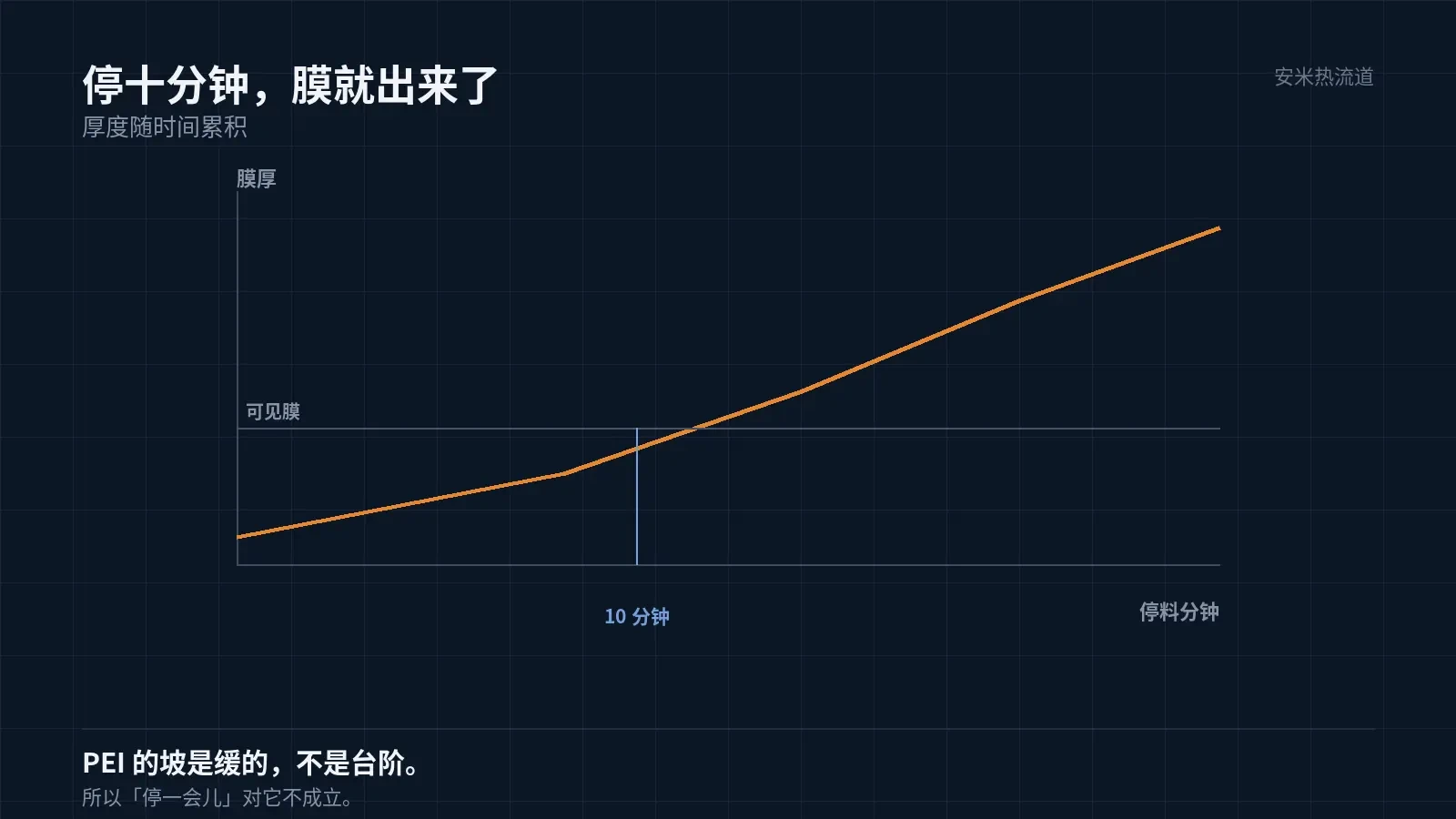
PEI strings faster than any other material. After a 10-minute pause, a film forms below the gate with clean edges and uniform thickness, still warm to the touch.
Unlike PA46, it does not first form a skin layer; unlike PEEK, it does not require multiple shots after stopping to appear. It continuously flows out because the melt never fully solidifies.
Why so fast?
For semi-crystalline materials, the outlet temperature drops after a stop. Near the melting point, heat release causes a pause that rapidly solidifies the melt in that section and stops drooling.
PEI lacks this phase. Temperature decreases steadily while viscosity gradually increases from "flowable" to "non-flowable," creating a slope rather than a step. This slope indicates an extended period during which the melt can still flow slowly.
Mold temperatures of 135–180°C further extend this process. The surrounding heat prevents rapid cooling of the small melt section at the outlet, resulting in an even gentler slope.
Therefore, PEI stringing is caused by "slow cooling," not "low viscosity." These two root causes require opposite corrective actions.
The diagnostic method is straightforward: after a 10-minute pause, a thick, uniform film indicates residual heat; bubbles, silver streaks, or fragmented boundaries indicate moisture. Adjust the molding cycle for the former; optimize drying for the latter. Do not confuse these two cases.
Redefine the Stop Condition
A 10-minute pause is standard for semi-crystalline materials; 10 minutes is sufficient to form a film for PEI.
In short, the PEI shutdown procedure cannot be reused from other materials. The duration, method, and handling of the first shot after restart must be defined separately.
The most practical on-site method is to record the time (in minutes) from stopping material feed to producing a film. This value represents the maximum allowable downtime for this specific machine and mold set. Exceeding it will inevitably cause material carryover.
Another often overlooked variable is ambient temperature. In summer, workshop temperatures exceed 30°C, leading to poor heat dissipation around the mold and hot runner, which slows gate cooling. A downtime duration that suffices in winter may be insufficient in summer.
Drying Is Another Critical Factor
ULTEM 1010 requires drying at 150°C for 4–6 hours, with moisture content not exceeding 0.02%. This limit is stricter than for most materials.
PEI is prone to hydrolysis at high temperatures. Excess moisture reduces melt viscosity, causing thinner flow and leakage, as well as silver streaks and bubbles on the product.
Therefore, distinguish between two types of stringing/drooling: if the film has no bubbles and boundaries are neat, it is residual heat leakage; if pinholes and silver streaks appear, it is due to excessive moisture. Address the former by adjusting the shutdown procedure and the latter by improving drying.
Verify dryer capability: stability at 150°C, adequate dew point, and proper hopper sealing. PEI does not absorb moisture quickly, but once absorbed, short drying cycles cannot remove it.
Excessive moisture also manifests as noise and odor during injection. Hydrolysis produces gas, resulting in faint popping sounds and silver streaks on parts. If you hear this, stop feeding material to verify drying conditions; do not adjust the temperature.
Comparison with Other Materials
PA46 shows thick stringing bands after material stoppage and color changes; PA9T forms thin, continuous films due to its Tg of 125°C and slow cooling; PEEK produces thick films that become evident only after several shots following shutdown.
PEI films are the most uniform, with consistent thickness and smooth edges—appearing almost like a coating. This morphology serves as its defining characteristic.
If morphology allows qualitative assessment, skip immediate parameter adjustments. Inspect the film first, then determine which variable to modify.
If a film consistently appears at the same location (e.g., always below a specific cavity's gate), check that nozzle's temperature and heater band first. Do not attribute it to general material properties. Recurrence at a single point indicates a local issue.
Remediation Sequence
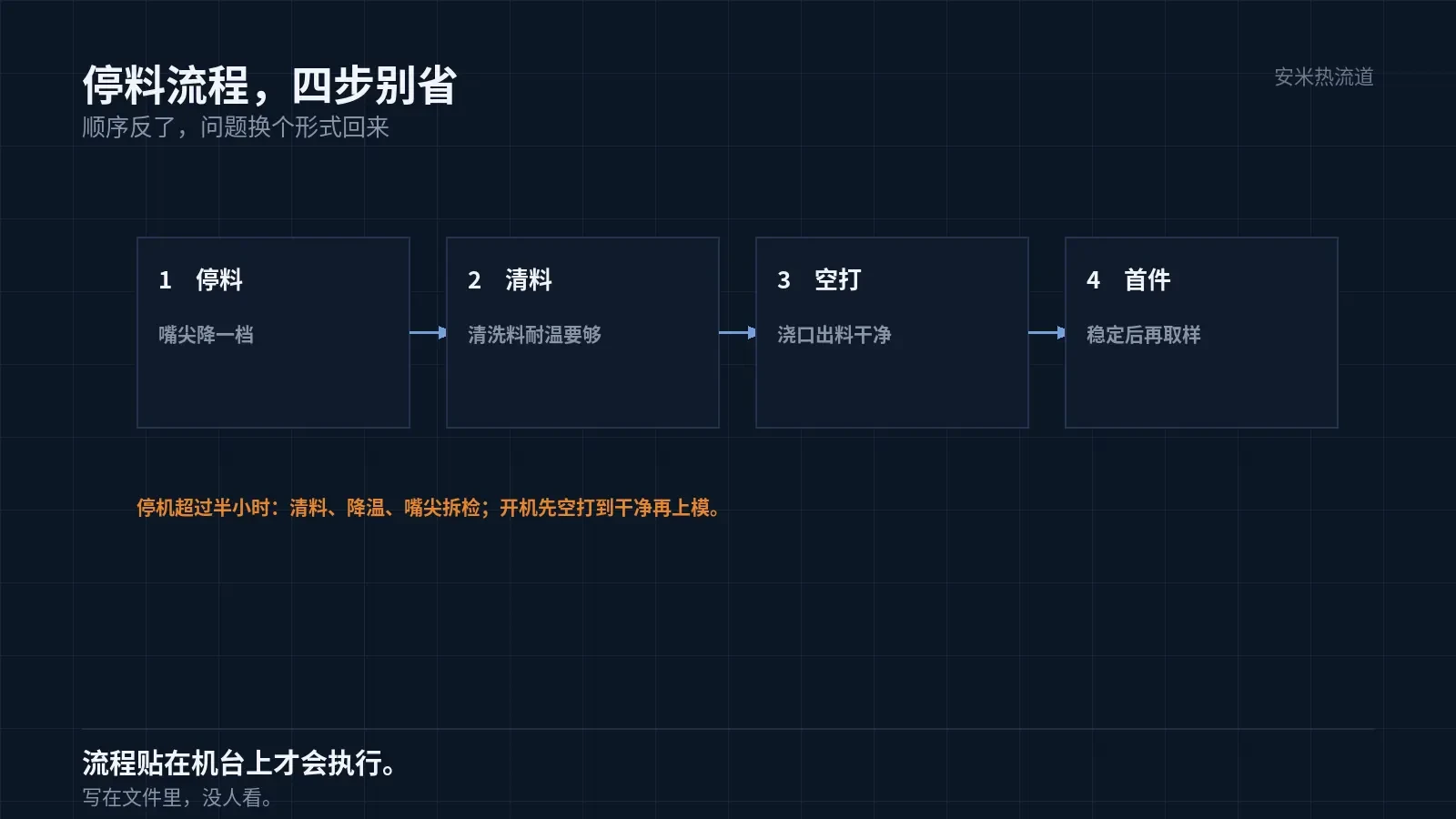
First, define the maximum allowable dwell time in work standards based on measured limits, not empirical estimates.
2. During material stoppage, reduce the nozzle tip temperature by one step. Do not shut down; instead, move it out of the "flowable" range.
3. If shutdown exceeds 30 minutes, follow the shutdown procedure: purge material, cool down, and inspect or remove nozzle tips.
4. Upon startup, run several dry cycles until the gate output is clean before mounting the mold. Do not treat the first shot as the first article.
5. When changing materials or colors, select cleaning compounds with sufficient thermal stability. Low-temperature cleaning compounds carbonize above 350°C, leaving residues in the channels that cause black spots upon the next startup.
Post the shutdown procedure card at the machine, specifying duration, target temperatures, and whether nozzle tip removal is required. Posted procedures ensure compliance; document-only instructions are often ignored.
Two Boundaries
Do not rely on lowering mold temperature to prevent seepage. Mold temperatures below 135°C cause internal stress and dimensional issues first; seepage may slow down but will not stop.
Do not rely on extending hold time or increasing hold pressure to suppress stringing. Stringing occurs after material stoppage, when the holding phase has already ended.
The shutdown procedure must also specify whether to close the valve pin during material stoppage. Closing cuts off material at the exit to reduce seepage; leaving it open allows continuous flow, which can cause membrane growth. This varies by equipment and requires verification on the machine.
Send data on stoppage duration, membrane appearance, and drying records. We will separately verify the residual heat and moisture content lines, then provide a quotation after confirming the solution.
Record moisture content based on actual measurements, not dryer setpoints. Correct settings do not guarantee correct material condition.
MATCHED BY MATERIAL AND DEFECT
This article covers stringing, drooling, clogging, and high-heat resins; refer to SD for gate freeze and break-off.
Register for a selection review and quote
Submit part, mold, and material details. Our engineers will evaluate the gate solution per part and provide a quote.
Upload a 2D layout drawing using the form.
Online selection and quote
Scan to register